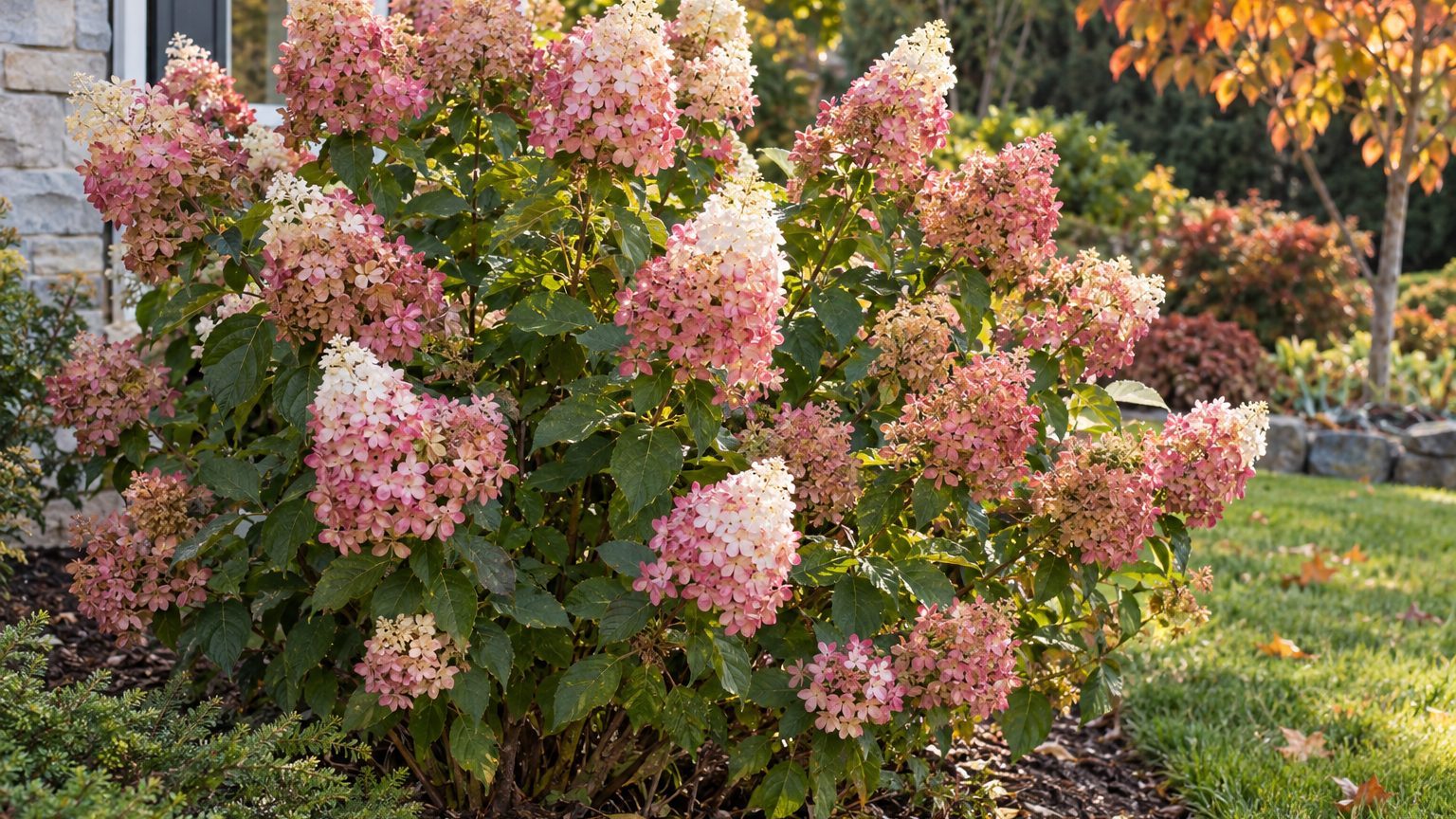

Quick Fire is a panicle hydrangea sold as the earliest of its type to flower, with blooms that open white and deepen to a strong pink. It flowers on the current season’s growth, and the type is rated for USDA zones 3a through 8b. The headline borrows tomato language, but this is a shrub, and the question underneath is the same: will it deliver in your season? The answer depends on your zone and your state, and the state pages carry the dates.
What Quick Fire actually is
Three facts decide whether this shrub suits a yard. The first is wood. Quick Fire blooms on the current season’s growth, so every flower forms on stems that grew this spring. The second is hardiness: USDA 3a through 8b for panicle Hydrangeas, according to the North Carolina Extension Gardener Plant Toolbox, the source for every figure on this page. The third is the color run. Flowers go from white to cream, age to pink, and finish tan, and none of it depends on soil chemistry.
A tomato label would give you days from transplant. No such figure exists in the sourced material for this shrub, and a number borrowed from another plant would only mislead you. The source describes Quick Fire as the earliest panicle, which is a comparison with other panicles, not a count of days.
Size is the other gap. The source gives a range of 8 to 25 feet for the panicle type as a whole, which is too wide to plan a hedge around. The mature height of this cultivar is not in the verified material, so check the nursery tag before you choose a spot. The species is also shallow-rooted, a detail that matters later.
For a side-by-side look at neighboring cultivars, the Hydrangea Varieties hub collects the sheets for each one.
What Quick Fire is good for

Nobody cooks this plant. The source lists no food use for any hydrangea. Only bigleaf hydrangea (H. macrophylla) is documented as toxic, and only when large quantities are eaten, with nausea, stomach pain, vomiting and sweating. Panicle types carry no such entry. That is not a reason to taste one. Keep this a plant for looking at, with the same plain caution you would give any garden shrub around pets and small children.
What it does well is ornamental work, and the mechanism is the wood. Because flowers form on the current season’s growth, a panicle can be cut back hard while dormant and still bloom that year. Bigleaf types lose their flowers to that same cut. The source adds that panicle is the only hydrangea that takes full sun well, and it calls the type a good substitute for the mop-head where mop-heads are not winter hardy. For a gardener in a cold climate who wants a big hydrangea show, that is the real selling point.
The color shift is the second draw. White to cream, then pink, then tan means one shrub changes the look of a border over several weeks. Quick Fire’s reputation rests on starting that sequence earlier than other panicles. The source documents no bloom-date calendar or length of each stage, so check those details with a local nursery.
Maintenance is rated low for the genus, and soil is forgiving: clay, loam or sand, acid to alkaline, as long as drainage is good. Wet feet now and then are tolerated. Native bees nest in dead hollow stems, which gives the shrub a second job after the flowers fade.
If you are comparing cultivars for a mixed planting, Vanilla Strawberry Hydrangea: When to Plant the Tomatoes That Ripen All at Once and Pistachio Hydrangea: When to Plant the Tomatoes That Ripen All at Once each cover their own cultivar on the same terms.
Where it ripens in time, and where it is a gamble
The arithmetic, in words
For a vegetable, the sum runs like this: frost-free window, minus the two weeks the soil needs to warm, minus days to maturity, equals picking time. A hydrangea in the ground changes every term. There is no transplant clock, because an established shrub wakes up on its own schedule, and there is no published days-to-bloom figure to subtract. The verified material also holds no frost-date table for this cultivar, so no city appears here with a bloom date.
What you can do is redo the sum with your own numbers. Start with your zone. The type is rated 3a through 8b, so a garden in zone 9 or warmer sits outside the range the source gives, and a garden in 3a sits at its cold edge. Next, find your local last spring frost and first fall frost from your state extension service. Then ask the nursery how long the cultivar takes to bloom once growth starts. Whatever is left between that bloom date and the first fall frost is your margin for flowers.
Where the range runs out
The wood habit works in your favor in cold country. Bigleaf flower buds form the previous summer, so a late frost or a spring prune takes the flowers with it. Quick Fire builds its flowers on new growth, so a hard winter that kills old stems costs you a slower start, not a bloom-less year. The source gives no frost tolerance for tender new shoots, so a late freeze after leaf-out remains a risk.
The gamble sits at the edges. At 3a, the margin for any shrub that must grow new flowering stems each spring is thinnest, and at 8b you are at the warm end of what the source lists. Between those, most gardeners have room to spare. The source gives no cultivar-specific data past the type’s range, so I would not call the variety unsuitable anywhere inside it, or claim anything outside it.
Pruning dates, zone-by-zone verdicts and winter protection vary by state, so they live on the per-state pages.
The two ways a season goes wrong
The night-temperature and heat limits that rule a tomato season have no counterpart in the source for this plant. A panicle’s flowers are not fruit that must set, so those thresholds do not transfer. Two other failures matter for a shrub.
The first is care borrowed from the wrong type. Quick Fire shares a genus with bigleaf hydrangea, and bigleaf advice leaks across. Someone who skips pruning for fear of losing flowers gives up the tidy, hard cut this type allows. Someone who spreads aluminum sulfate or lime hoping to move the color wastes money, because panicle color does not respond to pH. Coffee grounds and citrus peel belong in that same pile of remedies. The source repeats the folk idea that they turn flowers blue, but they barely shift pH, and on a panicle there is nothing to shift.
The second is stress at the roots and the range edges. Panicle hydrangeas are shallow-rooted, and the source says they benefit from mulch. In a hot, dry stretch at the warm end of the range, those roots are the first part of the plant to feel it. At the cold end, 3a asks the shrub to rebuild its flowering wood every spring on a short clock.
Since this variety’s pitch is earliness, I would put the first failure ahead. The head start counts only if spring growth proceeds without a setback, and a mistaken hard cut at the wrong moment or a pH treatment that does nothing are self-inflicted setbacks you can avoid.
What it resists, and what it does not
The verified material lists no resistance grades for Quick Fire. There is no catalogue line saying the cultivar shrugs off a given disease, and that should not be taken as protection. What exists is a list of what the source says affects hydrangeas in general.
The diseases the source names for the genus are leaf spot, bacterial wilt and powdery mildew. For panicle types it adds rust and bud blight. Plan for the possibility of any of them rather than for immunity. Good drainage, airflow and watering at the base of the plant are the practical lines of defense for leaf diseases.
The source names aphids, scales, nematodes and mites as pests, and says they are rarely a problem. Deer are the exception. The source lists them as a damage agent, and it also lists deer under resistance to challenges on the genus page. When two entries disagree, what gardeners observe is the safer guide: hydrangeas get browsed. Treat Quick Fire as a deer snack unless you have fencing or repellents in place.
Growing it without the usual mistakes
Start with the habit. Quick Fire is a woody shrub that blooms on new growth, so there is no staking-and-pinching routine like a vine tomato needs. Its work is to put up fresh flowering stems each spring. Give it room for that, and check the tag for the cultivar’s mature size, since the type’s range of 8 to 25 feet is too broad to space by. Full sun is acceptable for this type, unlike for most hydrangeas.
Mulch matters because the roots sit shallow. A layer over the root zone keeps the surface from drying out, and drainage should still be good, even though occasional wetness is fine.
The mistake this plant’s habit invites is cutting everything to the ground every year because it forgives you. A hard cut while dormant is allowed, but native bees nest in dead hollow stems. The source suggests cutting stems to 12 to 24 inches and leaving them standing until they break down. That is a better compromise than a flat cut, and it still leaves plenty of room for new growth. The right time to cut depends on your state, so check the page for yours.
On feeding, the verified material gives no schedule, and the genus is rated low-maintenance, so a light hand is reasonable. Propagation is by stem cutting or layering, and the source says panicle types can also be grown from seed.
Common questions
Will coffee grounds or aluminum sulfate change Quick Fire’s color?
No. Color responds to soil pH only in bigleaf and mountain hydrangeas. Quick Fire moves from white to cream to pink to tan on its own schedule. Skip the amendments.
Can I cut Quick Fire back hard?
Yes, while it is dormant, because it flowers on the current season’s growth. The month depends on your state, so use the page for your state, and consider leaving stems 12 to 24 inches tall for nesting bees.
Is Quick Fire deer-proof?
Do not assume so. The source lists deer as a damage agent for hydrangeas, even though one entry on the genus page hints at resistance. Observed behavior is that hydrangeas get browsed.
Is Quick Fire hydrangea poisonous?
The source documents toxicity only for bigleaf hydrangea, and only when large quantities are eaten. It lists no such entry for panicle types, but no hydrangea is a food plant. The toxic compounds in bigleaf (hydracyanosides) are found in bark, flowers, leaves and stems, and the source notes cats, dogs and horses can be affected too.