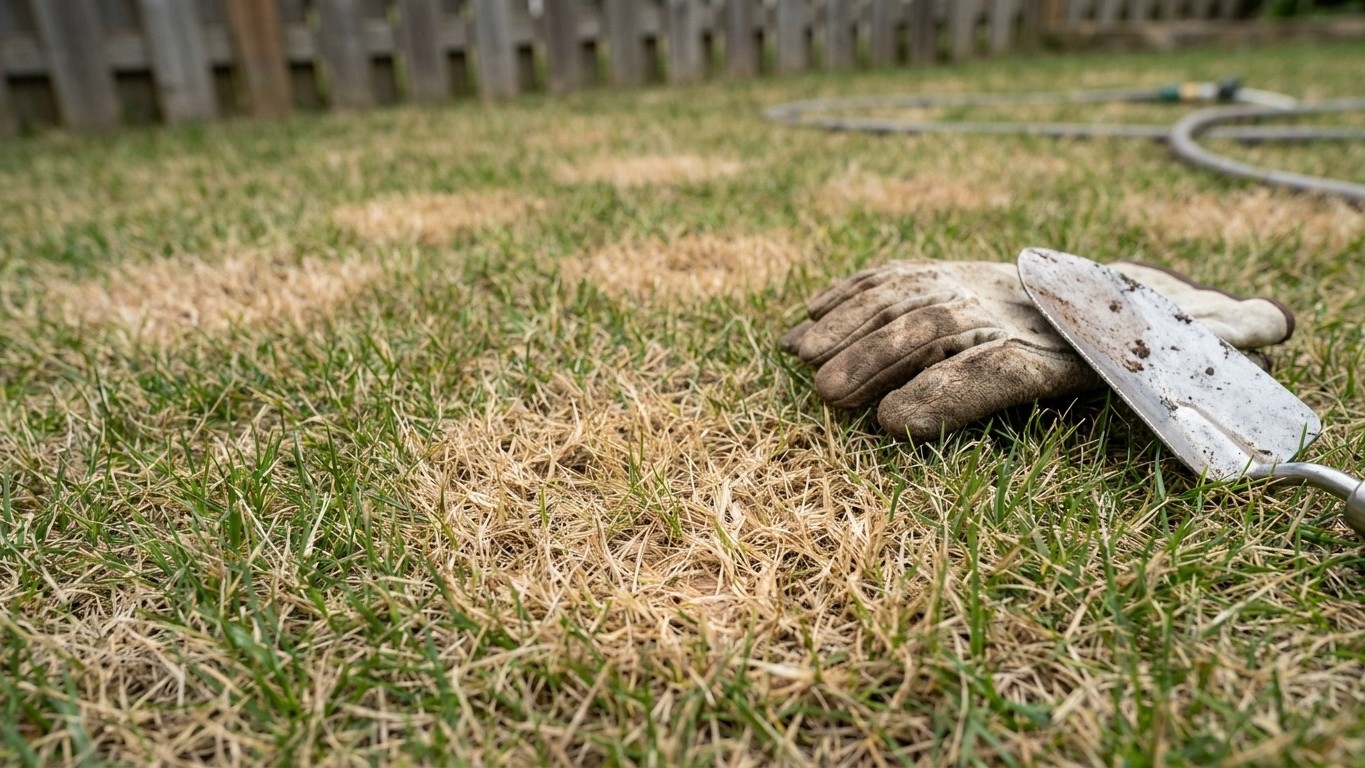

Dollar spot is a fungal lawn disease that leaves small, straw-colored, sunken patches roughly the size of a silver dollar scattered across the turf, most often on lawns that are short of nitrogen. The confirming detail is on the individual blade: a tan lesion shaped like an hourglass, with a reddish-brown border, cutting straight across the leaf. Before you reach for a fungicide, check when the lawn was last fed. A quick feeding often does more than a spray.
What you are looking at

Walk the lawn at an angle to the morning sun and the pattern shows up fast: dozens of small, circular, bleached-out patches, each one about the width of a coin, sometimes merging into larger irregular blotches when the pressure is heavy. The patches feel sunken compared to the surrounding turf and the color runs from straw-tan to a bleached almost-white, never the black or slimy look of some other turf diseases.
The pattern alone can fool you. Pull a few affected blades and look at them in good light. A blade with dollar spot shows a lesion shaped like an hourglass or a bowtie, narrow in the middle, wider at each end, running across the width of the leaf rather than along its length. The lesion itself is tan to straw-colored, and it carries a thin border the color of dried blood, reddish-brown, that separates the dead tissue from the still-green blade beyond it.
Early morning is the best time to check
If the dew is still on the grass and the air is calm, look for a fine, cobwebby, grayish-white growth across the patches. This is the fungus itself, active and spreading, and it disappears within an hour or two once the sun dries the leaf surface. If you miss it, the bleached patches and the hourglass lesion are enough on their own to confirm the diagnosis without needing to catch the mycelium in the act.
What it is not
Most bleached or discolored patches reported as a disease turn out to be something simpler. A lawn mowed too short, watered too shallowly, or scalped on an uneven patch of ground will bleach out in round or irregular patches that look a lot like dollar spot from a distance. The discriminating check is the blade itself: scalping and drought stress leave a torn or uniformly browned tip, not the hourglass lesion with a reddish border that marks a true fungal infection.
Dog urine spots are another common false alarm. They tend to show a ring of dark, over-green grass around a dead, bleached center, a pattern dollar spot does not produce. Grub damage pulls up loose from the soil like a rug with no roots attached, while a dollar spot patch stays rooted and simply looks starved.
Two other diseases get confused with dollar spot often enough to name here. Red Thread: Pink Threads on Grass That Needs Feeding shares the same underfed-lawn cause but shows pink to red thread-like strands binding the blade tips, not an hourglass lesion. Lawn Rust: Orange Dust on Your Shoes leaves an orange powder that rubs off on your shoe or hand, a giveaway dollar spot never produces. If none of these details match what you’re seeing, browse the wider list of Lawn Diseases before assuming the worst, since a nutrient or watering fix solves more lawn complaints than any fungicide does.
The conditions that bring it on
Dollar spot favors warm days, cool humid nights, and grass that stays wet for long stretches between mowings, whether from dew, overwatering, or irrigation run in the evening. It shows up on lawns short of nitrogen more than any other single factor, which is where the disease gets its reputation as the mark of a hungry lawn.
It is not choosy about season the way some turf diseases are. Both cool-season and warm-season grasses get it, though the timing differs: cool-season lawns tend to see it in the stretch between late spring and the heat of summer, while warm-season lawns see it through their active growing months. What both situations share is closely mowed turf with high humidity and low nitrogen.
Which grasses carry the most risk
Mowing height matters because a shorter canopy holds moisture on the leaf surface longer relative to its size and offers the fungus more entry points. The table below lines up mowing ranges from Clemson Cooperative Extension’s HGIC 1214 fact sheet and Penn State Extension’s lawn establishment guidance.
| Grass | Season | Mowing height |
|---|---|---|
| Kentucky Bluegrass | Cool-season | 2 to 3 in (Penn State Extension) |
| Perennial Ryegrass | Cool-season | 2 to 3 in (Penn State Extension) |
| Fine Fescues | Cool-season | 2.5 to 3.5 in (Penn State Extension) |
| Tall Fescue | Cool-season | 2.5 to 3.5 in (HGIC 1214) |
| Bermudagrass | Warm-season | 0.75 to 1.5 in (HGIC 1214) |
| Zoysiagrass | Warm-season | 0.75 to 2 in (HGIC 1214) |
| Centipedegrass | Warm-season | 1.5 to 2 in (HGIC 1214) |
| St. Augustinegrass | Warm-season | 2.5 to 4 in (HGIC 1214) |
Lawns mowed at the low end of their range hold more leaf moisture and see dollar spot pressure sooner than lawns kept at the higher end of the same range. This is one more reason not to scalp a lawn down between mowings, whatever the species.
What to do now
Most dollar spot outbreaks run their course on their own once the lawn gets fed and the weather shifts. A patch that looks dead in July often greens back in within a few weeks of a proper feeding, because the fungus damages the leaf blade, not the crown or root system underneath. Before spending money on a fungicide, check the two things dollar spot almost always tracks: nitrogen status and irrigation timing.
Clemson Cooperative Extension’s HGIC 1201 fact sheet on fertilizing lawns lays out feeding programs by grass species, and a lawn following that program rarely needs a chemical rescue for dollar spot. If your lawn is on a maintenance calendar already, the species-specific calendars from HGIC, including HGIC 1219 for tall fescue, HGIC 1216 for bermudagrass, and HGIC 1217 for zoysiagrass, give the feeding windows to check against.
When a fungicide earns its cost
A fungicide is worth the money on high-value turf, like a putting green or a lawn under contract for appearance, where the patches themselves are the problem regardless of cause. On an ordinary home lawn, a fungicide is money spent on weather if the underlying nitrogen deficiency and watering habit go unaddressed, because the disease will simply return once the product wears off. Homeowner-grade products containing active ingredients such as chlorothalonil, myclobutanil, or propiconazole are the ones typically available at retail for dollar spot. Some active ingredients are restricted-use in certain states, so check your state’s list of registered lawn products before buying, and always read the label for the grass species you’re treating.
Preventing it next season
Prevention here is almost entirely a habit change, not a purchase. Water early in the morning rather than in the evening, so the leaf surface dries within a few hours instead of sitting wet overnight. A single deep watering that soaks the root zone beats several light ones that only wet the leaf surface and feed the fungus.
Keep nitrogen on schedule for your grass species rather than skipping a feeding to save a bag. Clemson’s HGIC 1201 fact sheet on fertilizing lawns and the species-specific maintenance calendars, HGIC 1215 for centipedegrass, HGIC 1218 for St. Augustinegrass, and the others named above, lay out feeding windows that keep the lawn out of the nitrogen-starved state dollar spot favors.
Mowing and airflow matter too
- Mow at the higher end of your grass’s published range rather than the lower end, using the figures in the table above as your reference.
- Keep mower blades sharp. A torn leaf edge dries out and gives the fungus an easier entry point than a clean cut.
- Reduce thatch and prune back overhanging shrubs where airflow across the lawn is poor, since still, humid air near the soil surface is what lets leaf wetness linger.
- Follow Clemson HGIC 1205’s mowing guidance on removing no more than the recommended fraction of leaf blade per cut, since a badly scalped lawn stresses the turf in the same way underfeeding does.
None of this is a one-time fix. A lawn kept on a steady feeding schedule, mowed at the right height for its species, and watered in the morning rarely sees dollar spot return even in a season with the right weather for it.
Common questions
Will dollar spot kill my grass?
Rarely, on its own. The fungus damages the leaf blade rather than the crown or roots, so a fed and properly watered lawn typically regrows through the damage within a few weeks.
Can I just mow over it and ignore it?
You can, and on a home lawn that is often exactly what works, provided you also correct the nitrogen deficiency and watering habit that let it start. Mowing alone without a feeding fix tends to let the patches persist through the whole favorable stretch of weather.
Why does it look worse after I water?
Evening watering leaves the leaf surface wet overnight, which is the exact condition the fungus needs to spread. Switching to an early morning watering time, so the leaf dries within a few hours, is usually enough to slow visible spread within a week or two.
Is dollar spot the same fungus everywhere?
The disease shows the same hourglass lesion and coin-sized patch on both cool-season and warm-season lawns, but the season it appears in differs by grass type as described above. If you’re unsure which category your lawn falls into, check the species tables against what’s actually growing in your yard before assuming a treatment timed for the wrong season.