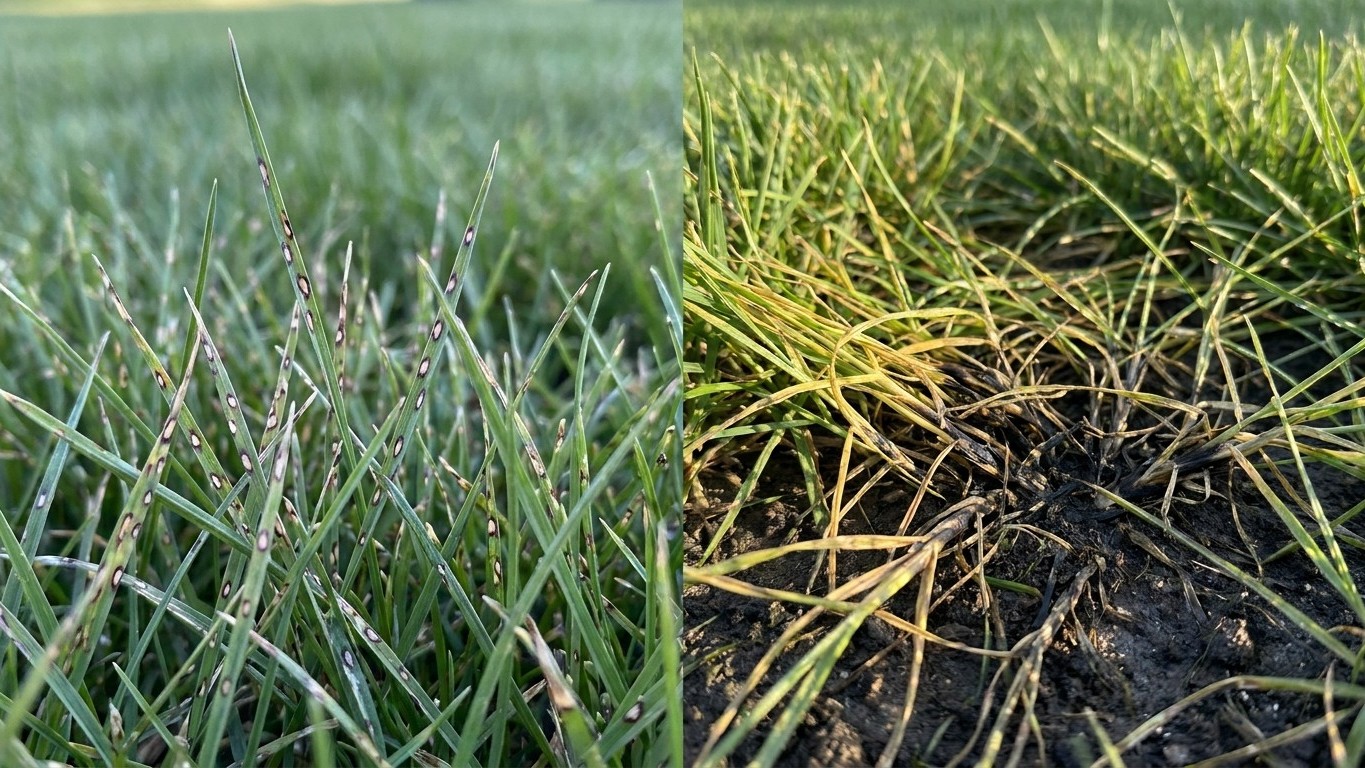

Leaf spot and melting out are the same lawn disease at two different ages. The fungus first shows up as small lesions scattered across grass blades (that’s leaf spot), then as it spreads into the crown and roots it kills entire patches of turf (that’s melting out). Kentucky bluegrass lawns are the classic victims, and the shift from cosmetic spotting to real thinning usually happens as spring turns into early summer.
What you are looking at
Start with a single blade, not the whole yard. Leaf spot lesions are small, oval to elongated, usually an eighth to a quarter inch long, with a purplish-brown to almost black border and a tan or straw-colored center. On a bluegrass lawn you’ll find several of these on one blade, sometimes so many they merge into a blighted tip. That blade-level detail is what separates this disease from almost everything else that discolors a lawn.
Zoom back out and the early stage looks unremarkable: a faint, uneven speckling across the grass, more visible in slanted morning light than at midday. Nothing dies yet. This is the leaf spot phase, and a lot of lawns sit here for weeks without getting worse.
Melting out is the second act, and it looks nothing like tidy spots. The fungus moves down into the crown, the growing point at the base of the plant, and into the roots. Blades yellow from the base up, then collapse and turn a dull brown or blackish color right at soil level. The lawn doesn’t die in a perfect circle the way some fungal patch diseases do. Instead you get irregular, ragged patches, a few inches across at first, sometimes widening to several feet, with thinning grass rather than a sharply defined dead zone. Pull on a blade in one of these patches and it may come away easily because the crown underneath has already rotted. That’s the tell that distinguishes melting out from simple leaf-tip browning: the plant is failing at the base, not just at the tip.
What it is not
Most brown lawn patches reported by homeworried gardeners are not a disease at all. The single fastest way to rule out leaf spot and melting out is to check individual blades for those purple-bordered lesions. If you don’t see spotting on the blade itself, look elsewhere before assuming disease.
A dull mower blade shreds grass tips instead of cutting them cleanly, leaving a frayed, whitish-gray cast across the whole lawn within a day of mowing. That’s uniform and mower-shaped, not lesion-shaped, and it appears right after cutting, not gradually over a week. Drought stress reads differently too: blades roll or fold lengthwise and brown from the tip backward, evenly, with no dark-bordered spots anywhere on the leaf.
Dog urine spots are their own giveaway: a small, dead, straw-colored circle with a ring of deep green, lush growth around the edge where the extra nitrogen fed the surrounding turf. That halo effect never shows up with leaf spot or melting out. Grub damage is different again. Lawn affected by grubs feels spongy and pulls back like a loose carpet because the roots have been eaten from below, but the blades themselves stay green until the very end, no spotting involved.
If your symptom is just tip browning after mowing, or a ring around a single urine spot, the honest answer is that you’re dealing with a habit or a pet, not a pathogen. Save the fungicide question for later and fix the mower or the watering schedule first.
The conditions that bring it on
This disease belongs to cool-season lawns. Kentucky bluegrass is by far the most susceptible turf, with perennial ryegrass and some fine fescues affected to a lesser degree. Warm-Season grasses like bermudagrass, zoysia, or St. Augustine are not the hosts for this particular fungus, so if your lawn is a warm-season type in a southern state, this specific disease is not your problem, even if the symptoms look superficially similar.
Timing matters as much as the grass type
The leaf spot phase favors cool, wet weather, the kind of extended damp spell that shows up in spring or again in fall, when nights are cool and dew sits on the grass for hours after sunrise. Repeated leaf wetness gives the fungus the window it needs to infect new blades. As the season warms and the plant is already carrying a spring infection, the disease can move down into the crown and roots, and that’s when melting out shows up, often right as early summer heat and any drought stress pile on top of an already weakened plant.
That sequence, cool wet spring followed by a stressful early summer, is the classic setup: a lawn that looked only mildly spotted in April can show real thinning by June. Lawns mowed too short, over-fertilized with nitrogen in spring, or sitting in heavy shade with poor air movement tend to carry the worst cases, because all three push the grass into lush, tender growth that the fungus exploits and that recovers more slowly once the crown is damaged.
What to do now
Most lawns carrying leaf spot alone need nothing more than patience. Once the weather turns warmer and drier, the fungus loses the leaf wetness it depends on, and new growth simply outpaces the spotting. A fungicide applied at this stage is money spent on weather, not disease control, since the cosmetic damage stops on its own.
Melting out is the point where a real decision matters. If large sections of turf have already collapsed at the crown, no fungicide will bring those plants back. Fungicides in this disease complex work preventively, protecting healthy tissue before infection, not curatively on tissue that’s already rotted. That means the useful window for a chemical application is early, at the first sign of leaf spot on a lawn with a known history of bad melting out, not after patches have already gone bare.
For a home grower, the active ingredients typically available over the counter for lawn disease control include chlorothalonil and myclobutanil, applied according to the label rate and timing. Availability and restrictions vary by state, so check your state’s list of permitted homeowner-use products before buying anything, since some formulations are limited to licensed applicators in certain states. If the lawn is only mildly spotted, skip the spray and reassess after the next dry stretch. If large patches have already melted out, plan on overseeding in fall rather than trying to chemically rescue tissue that’s already dead.
Preventing it next season
Prevention here is mostly a scheduling habit, not a product purchase. Watering in the early morning, rather than evening, lets the grass surface dry out during daylight hours instead of staying wet all night, which cuts the hours of leaf wetness the fungus needs to infect new blades. Deep, infrequent watering beats light daily sprinkling for the same reason.
Nitrogen timing changes the plant’s vulnerability more than most people expect. A heavy spring nitrogen application pushes soft, lush new growth right when leaf spot pressure is highest, which is exactly the tissue the fungus prefers. Shifting the bulk of fertilization to fall, when cool-season grasses are naturally building root reserves, produces a hardier plant heading into the following spring’s wet weather.
Mowing height matters just as much. Keep Kentucky bluegrass cut no shorter than about 2.5 to 3 inches, and never remove more than a third of the blade in a single pass. Taller grass shades its own crown, keeps soil temperatures more even, and gives the plant more leaf area to recover from minor infection. A sharp mower blade also avoids the ragged cuts that give any fungus an easier entry point.
Airflow finishes the list. Thatch buildup and overcrowded, shaded turf both trap moisture at the crown level, so annual aeration, dethatching where needed, and trimming back overhanging shrubs or trees all reduce the humid microclimate the disease depends on. None of this is expensive. It’s a handful of scheduling choices repeated every season, which is usually enough to keep a lawn out of the melting-out phase entirely.
Common questions
Will my lawn recover from melting out on its own?
Grass that’s only stressed and gone dormant will green back up once conditions improve, but tissue that’s actually rotted at the crown is dead and won’t regrow from that plant. Recovery in badly thinned patches usually requires overseeding in fall rather than waiting it out.
Can leaf spot spread from my lawn to my neighbor’s?
The fungus travels by splashing water, mowing equipment, and foot traffic, so it can move between adjoining lawns of the same susceptible grass type, particularly if you’re sharing a mower or blowing clippings across the property line.
Is melting out the same disease in warm-season lawns like zoysia or bermudagrass?
No. This specific disease complex targets cool-season grasses, especially Kentucky bluegrass. Warm-season lawns can develop their own leaf spot problems from different pathogens, but they aren’t the same disease and don’t follow the same spring-to-early-summer pattern.
Should I water less if I suspect leaf spot?
Cutting back on evening watering and switching to an early-morning schedule is the right move, since it shortens how long the grass stays wet. Cutting total water volume too aggressively, though, can add drought stress on top of a disease that’s already weakening the crown, which is the opposite of helpful.