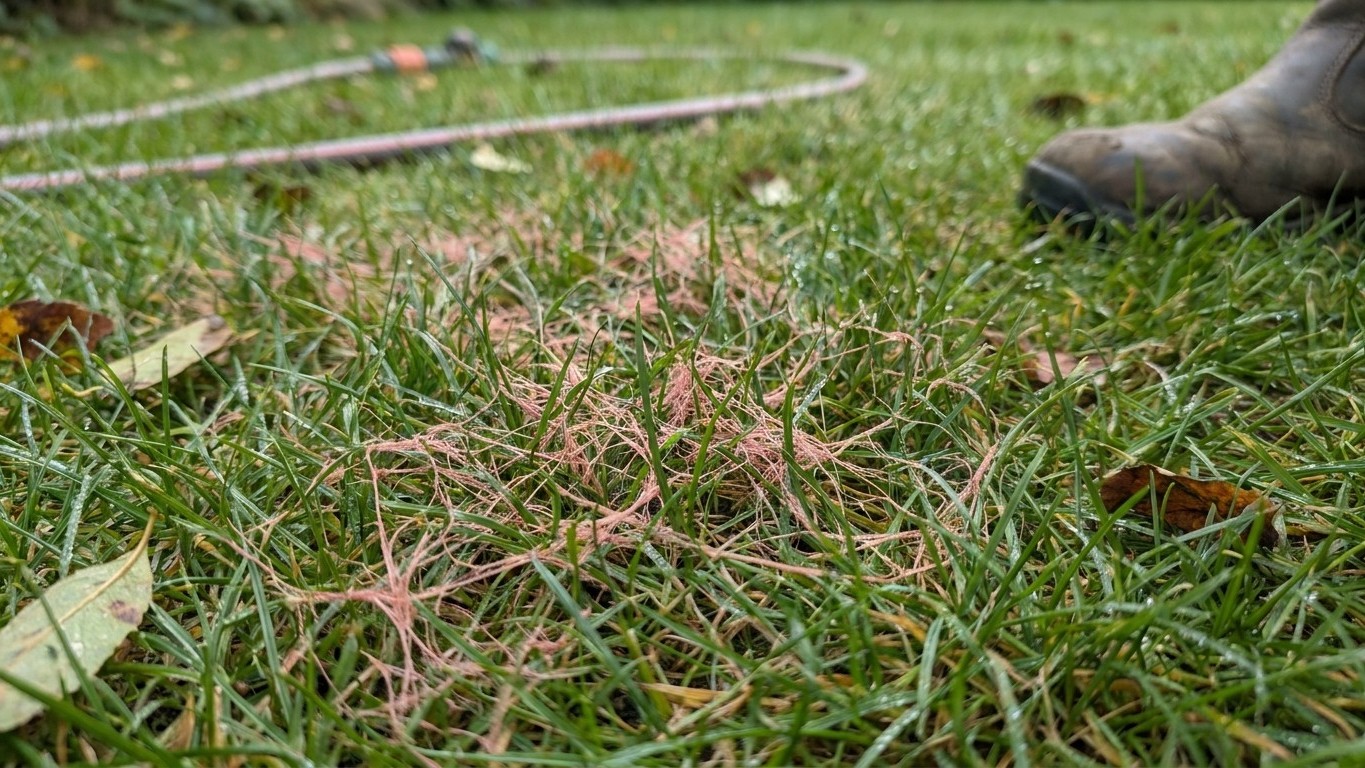

Red thread is a fungal lawn disease, caused by Laetisaria fuciformis, that produces thin coral-pink to red thread-like strands sticking out from the tips of grass blades. It shows up on cool-season turf during cool, humid stretches of spring or fall, and it is almost always a sign the lawn is running short on nitrogen rather than a sign of a doomed lawn. Check the individual blade for the pink threads before you do anything else, and pull a soil or tissue test if you haven’t fed the lawn recently.
What you are looking at

From a distance, red thread looks like irregular patches of bleached tan or pale pink grass scattered across the lawn, usually a few inches to a foot or so across. The patches can merge into larger, ragged-edged areas when the weather stays damp for several days running. Nothing about the pattern alone tells you much, because plenty of other problems produce tan patches of a similar size.
The blade is where you confirm it. Look closely, ideally with the grass still wet from dew or rain, and you’ll see thin, coral-pink to reddish strands extending from the cut tips of the leaves, sometimes branching, sometimes twisted like a tiny piece of red thread wound around the blade. These are called sclerotia, a hardened resting stage of the fungus. When the grass dries out they turn brittle, pale pink to tan, and can break off and blow around the yard, which is part of how the disease spreads to other spots.
In heavier infections you may also notice a faint pink, cobwebby mycelium coating the grass early in the morning, similar in texture to the web-like growth seen with some other fungal diseases, but pink rather than white or gray. Check for these signs together:
- Patches of tan or pink grass, a few inches to about a foot wide
- Pink to coral-red thread-like strands on the blade tips, easiest to see when wet
- Strands that turn brittle and pale when the grass dries
- Symptoms concentrated in low-nitrogen or recently starved turf
If you can find the threads on the blade, you have red thread. If you cannot find them anywhere in the patch after a close look, keep reading before you treat for it, because the same tan-patch look shows up for reasons that have nothing to do with fungus.
What it is not
Most tan or bleached patches reported as a lawn disease turn out to be a watering or mowing habit instead. Dog urine spots bleach a similar tan color but they’re usually small, round, and ringed with a darker green halo where the extra nitrogen fed the surrounding grass. There is never a pink thread on a urine spot.
A dull mower blade tears rather than cuts the leaf tip, and the shredded tips dry out and turn a grayish tan within a day or two, giving whole sections of the lawn a hazy, off-color look that people mistake for disease. Run a fingernail along a cut blade tip. A clean, sharp mower leaves a flat cut; a dull one leaves a frayed, split tip.
Drought stress bleaches grass in a more uniform pattern that tracks with slope, sun exposure, or an irrigation head that isn’t reaching that corner of the yard, rather than the scattered, irregular patches red thread produces. Rust, another fungal disease, coats the blade with an orange-yellow powder that rubs off on your shoe or pant leg, which red thread does not do. Dollar spot leaves small, sunken, hourglass-shaped lesions on individual blades rather than external pink threads.
If the lawn looks patchy but you cannot find a single pink thread anywhere, the more likely explanation is a mowing height that’s too low for the grass species, an irrigation pattern that’s missing a section, or a nitrogen program that has lapsed. For a wider rundown of what else causes patchy turf, the Lawn Diseases overview covers the more common look-alikes side by side.
The conditions that bring it on
When and where it shows up
Red thread is a disease of cool-season turf, and it appears during cool, humid, overcast weather in spring and again in fall, the two stretches when cool-season grass grows fastest but leaf surfaces also stay wet longest between mowings. Long dew periods and slow-drying grass, whether from shade, poor airflow, or evening irrigation, give the fungus the window of leaf wetness it needs to establish.
It attacks the grasses Penn State Extension’s Lawn Establishment guidance lists as cool-season species: fine fescues, Kentucky bluegrass, perennial ryegrass, and rough bluegrass, and it also shows up on tall fescue, which Clemson Cooperative Extension’s HGIC 1214 (Selecting a Lawn Grass) classes separately as cool-season turf with good shade tolerance. Warm-season lawns rarely see it, since species like bermudagrass, zoysiagrass, centipedegrass, and St. Augustinegrass are actively growing and shrugging off cool, wet weather at the time of year red thread needs to establish.
Low soil nitrogen is the other half of the equation. A lawn that’s growing slowly because it hasn’t been fed recently produces thinner, less vigorous leaf tissue, and that tissue is what the fungus colonizes fastest. This is why two lawns side by side, mowed the same way, can differ sharply in how bad an outbreak gets: the one on a regular feeding schedule usually shows scattered, minor patches, while the underfed one can end up mostly tan.
| Grass | Mowing height | Notes relevant to red thread |
|---|---|---|
| Fine Fescues | 2.5 to 3.5 in | Cool-season, excellent shade tolerance, poor wear (Penn State Extension) |
| Kentucky Bluegrass | 2 to 3 in | Cool-season, fair shade and drought tolerance, good wear (Penn State Extension) |
| Perennial Ryegrass | 2 to 3 in | Cool-season, fair shade and drought tolerance, good wear (Penn State Extension) |
| Rough Bluegrass | 2 to 3 in | Cool-season, excellent shade, poor drought and wear (Penn State Extension) |
| Tall Fescue | 2.5 to 3.5 in | Cool-season, good shade tolerance, fair drought and wear (Clemson HGIC 1214) |
What to do now
Let the lawn do the work first
Red thread almost never kills the grass outright. It damages the leaf blade, not the crown or roots, so the plant usually recovers as soon as conditions dry out and the lawn resumes normal growth, especially if it gets fed. In most home lawns, a fungicide is not necessary, and spraying one on a patch that would have grown out on its own within a couple of weeks is money spent chasing the weather rather than the disease.
What does help immediately: keep mowing on schedule at the height appropriate for the species, since a mower blade that’s dull or set too low stresses grass that’s already fighting an infection. Clemson’s HGIC 1205 (Mowing Lawns) recommends removing no more than a third of the blade height at any one cut, which matters more than usual when the leaf tissue is already compromised. Bag clippings from affected areas rather than leaving them on the surface, since the sclerotia can ride along in clippings and start a new patch elsewhere in the yard.
A light, appropriately timed feeding, following the rates in Clemson’s HGIC 1201 (Fertilizing Lawns), addresses the underlying nitrogen shortfall that let the disease take hold in the first place, and you should see the tan patches green back over within a couple of weeks once the grass is actively growing again.
Fungicide only earns its place on lawns where cosmetic damage genuinely can’t be tolerated, such as a golf green or a sports field under a mowing and traffic schedule that won’t allow the grass time to recover on its own. For a home lawn, that threshold almost never applies. If an outbreak is severe and repeats year after year despite correcting nitrogen and mowing habits, that’s the point to call your local extension office for a current, regionally approved product list rather than picking one off a shelf.
Preventing it next season
Feed on schedule
The single biggest lever is nitrogen. Follow the rates and timing in Clemson’s HGIC 1201 (Fertilizing Lawns) for your grass species rather than skipping a feeding cycle when the lawn looks fine, because red thread tends to find the lawns that went a season without adequate nitrogen. A cool-season lawn that’s fed on a regular schedule rarely shows more than a trace of it even in a wet spring.
Water in the morning, not the evening
Shortening how long the grass stays wet overnight cuts down the window the fungus needs to spread. Run irrigation early enough that the leaf surface has the whole day to dry rather than watering in the evening and leaving the lawn wet through a cool night. This same habit reduces the risk of several other fungal problems, including snow mold, which shows up under very different winter conditions but is caused by the same kind of prolonged leaf wetness.
Mow at the right height for your grass
Cutting cool-season turf too short thins the leaf canopy and stresses the plant right when it needs vigor to outgrow a light infection. Keep fine fescues and tall fescue at 2.5 to 3.5 inches and Kentucky bluegrass or perennial ryegrass at 2 to 3 inches, following Penn State Extension’s guidance, and sharpen the mower blade at least once a season so the cut is clean rather than torn.
Open up airflow
Shade and still air both slow drying time after dew or rain. Thin overhanging branches, widen gaps between shrubs, and dethatch a lawn that’s built up a spongy layer, since dense thatch holds moisture right at the point where the disease establishes. None of this is a product you buy once. It’s a maintenance routine, and lawns that keep to it season after season rarely see red thread build into anything more than a passing cosmetic patch, unlike a problem such as fairy ring, which can persist in the soil for years regardless of mowing or watering changes.
Common questions
Will red thread kill my lawn?
No, it damages the leaf blade rather than the crown or root system, so established turf almost always grows out of it once conditions change and nitrogen is corrected. A lawn that’s severely weakened by drought or heavy traffic on top of an infection can be slower to bounce back, but the disease itself is rarely fatal.
How long does it take to go away?
Once you correct nitrogen and the weather turns drier, most patches green back up within a couple of weeks of active growth. There’s no fixed timeline published for how many days that takes, since it depends on how fast your particular grass is growing at the time.
Can I just mow it off?
You can mow as usual, but bag the clippings from affected patches instead of leaving them on the surface. The pink sclerotia can hitch a ride in clippings and start new patches wherever you dump or spread them.
Does red thread mean I have a fungus problem in my soil generally?
Not necessarily. Red thread is triggered mainly by a nitrogen shortfall in the grass itself rather than a broad soil health issue, so a lawn can have red thread one season and none the next simply based on how well it was fed and how wet the spring was.