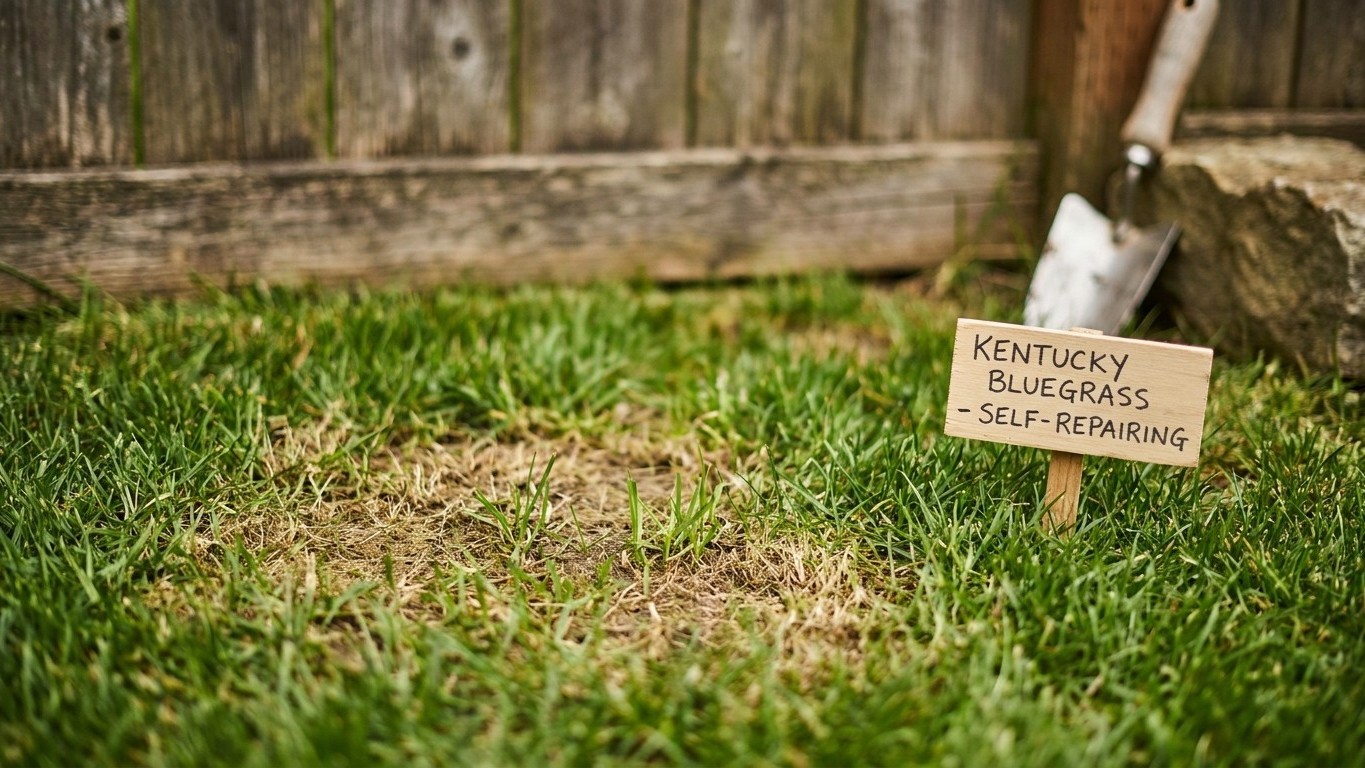

Kentucky bluegrass seed is slow: 14 to 21 days to germinate, and complete establishment usually takes months. It is a cool-season grass that spreads by rhizomes, underground stems that help it recover from injury. Before you buy a bag, find your state in the three lists below and see which group it falls in.
What Kentucky Bluegrass actually is

University of Georgia Extension, in Lawns in Georgia: Selection and Species, lists Kentucky bluegrass in its table of cool-season turfgrasses. The same publication says cool-season grasses grow well during the cool months of spring and fall, when temperatures average 60 to 75 °F, and may become stressed, dormant or injured during the hot months of summer. Spring and fall are its growing seasons, and summer is the stretch it has to get through.
University of Georgia Extension describes a fine to medium leaf texture and a bright green color, and calls the rhizomatous or creeping growth habit a major attribute. Rhizomes are underground stems. NC State Extension, in chapter 9 of the Extension Gardener Handbook, says Kentucky bluegrass sod knits well because those rhizomes spread. Rutgers NJAES, in Seeding Your Lawn (FS584), adds that spreading rhizomes enhance recovery from injury and fill in voids.
The seed is where patience comes in. Virginia Cooperative Extension says seed is readily available but slow to germinate, 14 to 21 days, and that complete establishment usually takes months. Rutgers NJAES calls it somewhat slow to establish from seed, and University of Georgia Extension’s Table 1 gives its establishment rate as medium.
It is one species among many. The Grass Types index sets them side by side, and the page on rough bluegrass covers a different grass that shares part of the name.
Where it works, and where it fails
NOAA’s 1991-2020 climate normals supply the two figures that matter most here: days at 90°F or more, and the average low of the coldest month. Both are taken at each state’s reference city, so the far ends of a large state can fall in the neighboring group. The sorting into first choice, transition and will-not-hold is The Homestead Post’s own reading of those figures, not a ruling by any extension service.
First choice
Every state in this group logs 28 days or fewer at 90°F or more, by NOAA’s 1991-2020 normals. Nebraska is the hottest of them and Michigan and Wyoming the mildest, at 10 days each.
| State | Days at 90°F or more | Coldest-month average low |
|---|---|---|
| Nebraska | 28 | 15°F |
| Iowa | 18 | 14°F |
| Delaware | 18 | 26°F |
| West Virginia | 16 | 26°F |
| Ohio | 15 | 22°F |
| Indiana | 15 | 21°F |
| Illinois | 14 | 19°F |
| South Dakota | 14 | 8°F |
| New York | 12 | 28°F |
| North Dakota | 12 | 0°F |
| New Hampshire | 11 | 17°F |
| Minnesota | 11 | 9°F |
| Wyoming | 10 | 18°F |
| Michigan | 10 | 19°F |
Transition: a compromise
In these states no grass excels, and Kentucky bluegrass is one compromise among several. NOAA’s 1991-2020 normals put them between 37 and 71 days at 90°F or more.
| State | Days at 90°F or more | Coldest-month average low |
|---|---|---|
| Oklahoma | 71 | 27°F |
| Kansas | 58 | 22°F |
| Utah | 52 | 24°F |
| Idaho | 48 | 25°F |
| New Mexico | 42 | 26°F |
| Tennessee | 40 | 30°F |
| Colorado | 40 | 18°F |
| Kentucky | 37 | 28°F |
Two extension services describe the warm edge of the range. NC State Extension says Kentucky bluegrass is well suited for the mountains of North Carolina and can be grown with tall fescue in the piedmont. University of Georgia Extension says it does not perform as well as tall fescue but can be used in the mountainous areas of north Georgia, and that it can become semi-dormant during hot weather. The tall fescue page covers the grass both services compare it with.
Where it will not hold
NOAA’s 1991-2020 normals give Arizona 169 days at 90°F or more with a coldest-month low of 45°F, Nevada 131 and 40°F, Texas 102 and 44°F, Florida 73 and 43°F, Mississippi 71 and 37°F, and Louisiana 71 and 46°F. NC State Extension calls Kentucky bluegrass not suitable for the coastal plain of North Carolina.
In these states a warm-season grass is the choice. Warm-season grasses grow in the opposite half of the year and are seeded in the opposite season, so moving to one means a new lawn, not different seed in the old one. Carpetgrass is one warm-season page on this site.
Shade, drought, traffic: what it will take

The ratings below come from one table: University of Georgia Extension, Lawns in Georgia: Selection and Species, Table 1 (cool-season turfgrasses for Georgia lawns), column ‘Kentucky Bluegrass’. The third column sets each rating beside a line from another body. Another state’s extension may rate the same grass differently.
| Trait | University of Georgia Extension, Table 1 | Another line on the same quality |
|---|---|---|
| Shade tolerance | good | NC State Extension: grows better than tall fescue in moderate shade |
| Sun tolerance | excellent | Virginia Cooperative Extension: a full-sun turfgrass |
| Drought resistance | good to fair | NC State Extension: may turn brown in a two- to four-week summer drought, recovers well from most droughts |
| Wear tolerance | good | NC State Extension: most cultivars recuperate from and tolerate pest control measures and moderate levels of traffic |
| Cold hardiness | excellent to very good | none |
| Heat hardiness | fair to poor | University of Georgia Extension: can become semi-dormant in hot weather |
| Establishment rate | medium | Rutgers NJAES: somewhat slow to establish from seed |
Sun or shade: the sources split
University of Georgia Extension says Kentucky bluegrass does best in partial shade but will grow in open sun if adequate moisture is present, while its table still gives sun tolerance an excellent rating. NC State Extension says it prefers fertile, limed, well-drained soils in sun or light shade. Virginia Cooperative Extension calls it a full-sun turfgrass and says it indicates a commitment to a moderate to high maintenance lawn. The sources differ on sun versus shade, so read the one closest to your climate.
Brown is not dead
NC State Extension says Kentucky bluegrass may turn brown during a two- to four-week summer drought and recovers well from most droughts.
Seeding or sodding it
University of Georgia Extension’s Table 1 marks Kentucky bluegrass as established by seed and by sod, through its ‘Can be seeded’ column. Penn State Extension, in Lawn Establishment, says it is the most common cool-season turfgrass species used for sod in Pennsylvania.
Seeding rate
Published rates for a new lawn run from 1 to 3 lb per 1000 square feet, because each source gives its own figure.
| Source | Pounds per 1000 square feet |
|---|---|
| Penn State Extension (Lawn Establishment) | 2 to 3 |
| University of Maryland Extension | 2 to 3 |
| University of Illinois Extension | 3 for a new lawn, 1.5 to overseed |
| NC State Extension (Extension Gardener Handbook) | 1 to 2 |
| NC State Extension (lawn grasses for shade) | 1.5 to 2 |
| Rutgers NJAES | approximately 2 |
The spread is wide enough that it pays to ask your own state’s extension office which figure fits local conditions. University of Illinois Extension gives 1.5 lb for overseeding, which is half its new-lawn figure of 3 lb (our arithmetic).
Timing and the wait
Virginia Cooperative Extension says that for cool-season grasses spring establishment is possible but fall is the preferred time for planting. Its germination figure of 14 to 21 days works out to two to three weeks between sowing and the first seedlings. Rutgers NJAES describes the grass as somewhat slow to establish from seed, and University of Georgia Extension rates its establishment rate medium.
Mowing and keeping it

Recommended heights run from 1.5 to 3.5 inches across the sources, and each one gives its own range.
- University of Illinois Extension: 2 to 3 inches
- K-State Research and Extension: 2 to 3 inches
- NC State Extension (Extension Gardener Handbook): 1.5 to 2.5 inches, when planted alone
- University of Missouri Extension: 2.5 to 3.5 inches
- Virginia Cooperative Extension: 1.5 to 2.5 inches
By simple arithmetic, 2.5 inches is the one height that sits inside all five ranges. That is not a recommendation, so check the guide from your own state. For how much to take off, NC State Extension says to cut often enough that less than one-third of the total leaf surface is removed. University of Illinois Extension says no more than one-third of the leaf blade should be removed in any one cutting.
What it asks of you
Virginia Cooperative Extension says Kentucky bluegrass has an aggressive creeping growth habit from rhizomes and can produce a significant thatch layer over years of aggressive management.
Common questions
Can I mix Kentucky bluegrass with tall fescue?
Yes, in some regions. NC State Extension says it can be grown with tall fescue in the North Carolina piedmont. NC State Extension adds that in a mix, tall fescue enhances drought and heat tolerance, while Kentucky bluegrass provides finer texture and greater recuperative potential.
Can I seed Kentucky bluegrass in spring if I missed fall?
You can, but the odds are worse. Virginia Cooperative Extension says seed is slow to germinate and complete establishment usually takes months, which makes spring plantings much less successful than early fall ones.
Does Kentucky bluegrass get brown patch?
It can, though less often than some others. Penn State Extension, in its brown patch fact sheet, says Kentucky bluegrass and the fine fescues are less likely than perennial ryegrass or tall fescue to develop brown patch symptoms. Less likely is not the same as immune.
Should I water it when it turns brown in summer?
NC State Extension says it is not necessary to irrigate. Letting the grass go dormant prevents drought stress, and watering often increases disease problems.