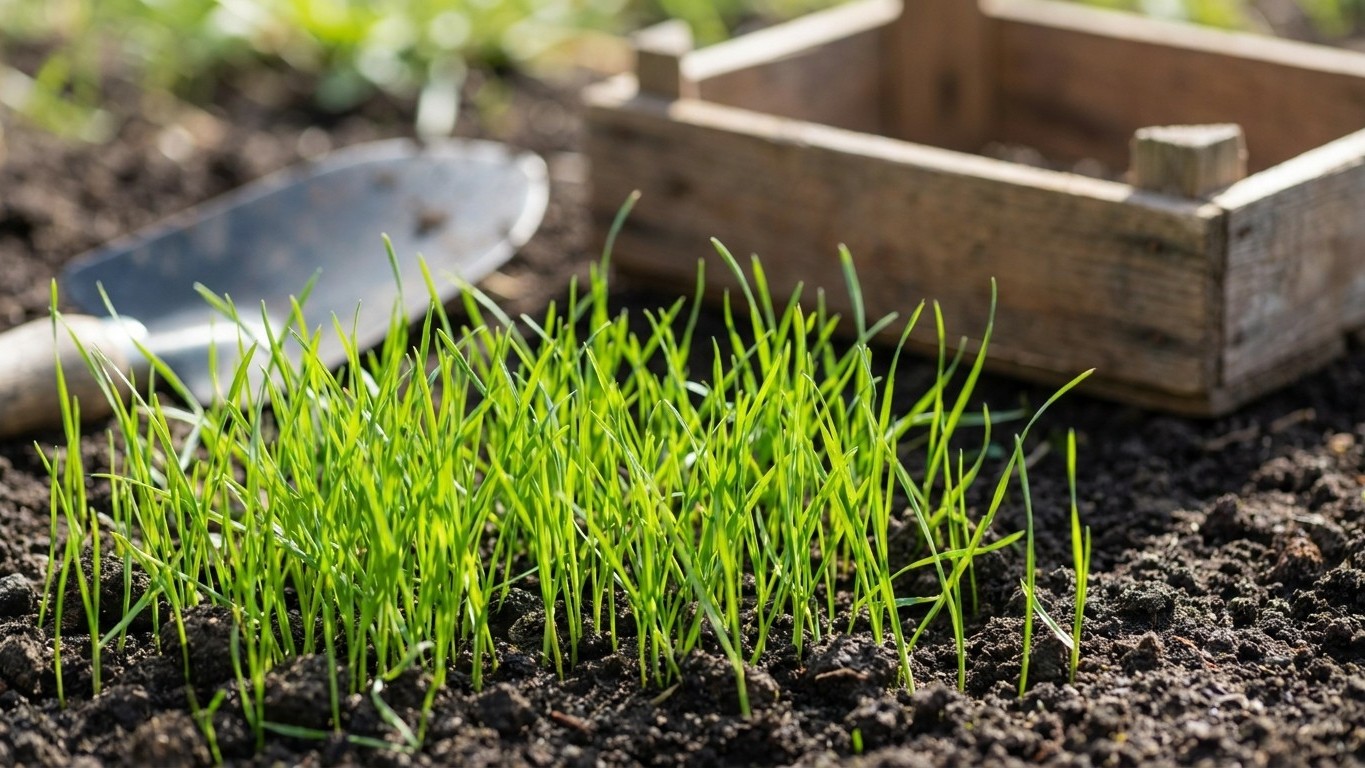

Seven to 10 days is how long perennial ryegrass seed takes to sprout, and that speed works against you when the seed goes down into summer heat. The seedlings arrive quickly and then meet a season that stresses cool-season grasses. Sow it as the weather cools, and check that your region suits a cool-season grass before you buy a bag.
What Perennial Ryegrass actually is

Perennial ryegrass is a cool-season grass. University of Georgia Extension lists it in the table of cool-season turfgrasses in Lawns in Georgia: Selection and Species. The same publication says cool-season grasses grow well during the cool months of spring and fall, when temperatures average 60 to 75 °F. It adds that they may become stressed, dormant, or injured during the hot months of summer.
Virginia Cooperative Extension (Virginia Tech) describes it as a bunch-type grass, best suited to full sun or moderate shade at elevations above 1500 feet. That statement is made for Virginia, so it is a regional note and not a national rule. Virginia Cooperative Extension also says it germinates in 7 to 10 days, one of the fastest grasses from seed, and is one of the fastest to establish a dense canopy.
Two other bodies describe the same quickness in their own words. Rutgers NJAES, in Seeding Your Lawn (FS584), says turf-type perennial ryegrasses show very rapid establishment. University of Georgia Extension rates the establishment rate of ryegrasses as fast and marks the group as established by seed.
Virginia Cooperative Extension also states the trade-off in one sentence. Mature perennial ryegrass has excellent wear tolerance, but it is not very heat and drought tolerant and can have significant disease pressure in warmer climates. If you are still choosing between species, the grass types overview lists the alternatives.
Where it works, and where it fails
The climate figures below come from NOAA’s 1991-2020 climate normals, taken at each state’s reference city. Other parts of a large state can fall in the neighboring group. The sorting into first choice, transition and will-not-hold is The Homestead Post’s own reading of those figures, not a ruling by any extension service.
First choice: cool summers, cold winters
NOAA’s normals give Nebraska 28 days at 90 F or more, with the coldest month averaging a low of 15 F. Iowa has 18 such days and a coldest-month low of 14 F. Ohio has 15 days and 22 F, Illinois 14 days and 19 F, and New York 12 days and 28 F. Minnesota has 11 days and 9 F, Michigan 10 days and 19 F, and North Dakota 12 days and 0 F. These are the territories where a cool-season grass is the first choice.
Penn State Extension calls perennial ryegrass the best species for renovation of lawns, because it germinates and establishes quickly and its roots can penetrate slightly compacted soils.
Transition: a compromise, and no grass excels
In the transition belt, perennial ryegrass is a compromise. NOAA’s normals put Oklahoma at 71 days at 90 F or more with a coldest-month low of 27 F, and Kansas at 58 days and 22 F. Utah has 52 days and 24 F, Idaho 48 days and 25 F, and New Mexico 42 days and 26 F. Tennessee has 40 days and 30 F, Colorado 40 days and 18 F, and Kentucky 37 days and 28 F.
Will not hold: warm-season territories
NOAA’s normals give Arizona 169 days at 90 F or more with a coldest-month low of 45 F. Nevada has 131 days and 40 F, Texas 102 days and 44 F, Florida 73 days and 43 F, Mississippi 71 days and 37 F, and Louisiana 71 days and 46 F. Virginia Cooperative Extension says the grass can have significant disease pressure in warmer climates. University of Georgia Extension treats it as an annual in Georgia: seeded in the fall, it stays green through winter and spring, then dies in late spring to early summer as temperatures become too hot for it to survive.
In these territories the choice is a warm-season grass. It grows in the opposite half of the year and is seeded in the opposite season, so this is a change of calendar, not a swap. Bahiagrass and centipedegrass each have their own page.
Shade, drought, traffic: what it will take

University of Georgia Extension publishes these ratings in Lawns in Georgia: Selection and Species, Table 1 (cool-season turfgrasses for Georgia lawns). They sit in the column headed Ryegrasses, which covers ryegrasses as a group. Another state’s extension may rate the same grass differently, so read them as one published opinion, set beside what other bodies say.
| Quality | University of Georgia Extension, Table 1 | Another named body |
|---|---|---|
| Shade tolerance | Very good to good | Rutgers NJAES: moderate. Virginia Cooperative Extension: full sun or moderate shade |
| Drought resistance | Fair to poor | Virginia Cooperative Extension: not very heat and drought tolerant |
| Wear tolerance | Very good to good | Virginia Cooperative Extension: excellent (mature grass) |
| Cold hardiness | Excellent to very good | None given |
| Heat hardiness | Good to fair | Virginia Cooperative Extension: not very heat tolerant |
| Establishment rate | Fast | Rutgers NJAES: very rapid |
Shade is rated very good to good in the Georgia table, the kind of rating you would read against a lawn under a tree. Rutgers NJAES calls the shade tolerance of turf-type perennial ryegrasses moderate. Virginia Cooperative Extension places the grass in full sun or moderate shade.
Drought resistance is rated fair to poor, the rating word for a lawn between rains. Heat hardiness is good to fair, the range that describes a lawn in July. Virginia Cooperative Extension’s wording on both is that the grass is not very heat and drought tolerant.
Wear tolerance is very good to good, which suits a lawn that kids cross every day. Cold hardiness is excellent to very good, the rating for a lawn facing a hard winter. Rutgers NJAES adds that turf-type perennial ryegrasses survive in a wide range of soil conditions but grow poorly in extremely wet areas.
Seeding or sodding it
Seed is the route
University of Georgia Extension marks perennial ryegrass as established by seed, in the ‘Can be seeded’ column of its Table 1. Virginia Cooperative Extension says it germinates in 7 to 10 days. You are not waiting weeks for a lawn to appear.
Seeding rates, source by source
The published figures span 4 to 10 lb per 1000 square feet. Each source gives its own number under its own conditions.
- Penn State Extension (Lawn Establishment): 4 to 5 lb in sunny areas and well-drained soils.
- Penn State Extension (Lawn Establishment): 4 to 6 lb for overseeding or renovation of lawns.
- University of Illinois Extension: 5 to 10 lb for a new lawn (fescue and ryegrass), and 3 to 5 lb to overseed.
- Rutgers NJAES: 4 to 6 lb.
- Clemson Cooperative Extension (overseeding with ryegrass, South Carolina): 5 lb to overseed an established lawn and 10 lb on a barren area.
When to sow
Virginia Cooperative Extension says that for cool-season grasses, spring establishment is possible but fall is the preferred time for planting. For overseeding a bermudagrass lawn with ryegrass, Clemson Cooperative Extension (HGIC 1206) says thirty days before the first frost is generally a good time. That is when daytime highs are near 70 °F and nighttime lows are usually above 50 °F. By simple arithmetic, you count back thirty days from your own first-frost date, which your state’s extension office can give you.
Keep the Georgia rule in mind if you live in the warm south. University of Georgia Extension says seed sown in fall stays green through winter and spring, then dies in late spring to early summer as temperatures become too hot.
Mowing and keeping it

Height, source by source
The published heights run from 1 to 3 inches. Each body gives its own figure.
| Source | Mowing height | Note |
|---|---|---|
| University of Illinois Extension | 2 to 3 inches | |
| K-State Research and Extension | 2 to 3 inches | |
| Clemson Cooperative Extension | 1.5 to 2 inches | Ryegrass overseeding, South Carolina |
| NC State Extension (Extension Gardener Handbook) | 1.5 to 2.5 inches | Mixed with Kentucky bluegrass |
| University of Georgia Extension | 1 to 3 inches | |
| Virginia Cooperative Extension | 1 to 2.5 inches |
Whatever height you pick, follow the one-third rule. NC State Extension says to cut often enough that less than one-third of the total leaf surface is removed. University of Illinois Extension says no more than one-third of the leaf blade should be removed in any one cutting.
What it asks of you
Clemson Cooperative Extension warns that ryegrass seed that did not germinate the previous year may germinate and grow into big clumps, so an overseeded lawn can look weedy. Virginia Cooperative Extension calls it a bunch-type grass, which fits the clumping habit.
Penn State Extension names perennial ryegrass, creeping and colonial bentgrasses, and tall fescue as particularly susceptible to brown patch. Kentucky bluegrass and the fine fescues are less likely to develop symptoms. Other lawn problems, such as gray leaf spot and armyworms, have their own pages, and the wider routine sits under lawn care.
Brown in summer is not automatically dead grass. University of Georgia Extension says cool-season grasses may become stressed, dormant, or injured in the hot months.
Common questions
Can I sow perennial ryegrass in spring instead of fall?
Yes, but it is the second choice. Virginia Cooperative Extension says spring establishment is possible for cool-season grasses, but fall is the preferred time. A spring sowing has to get through the summer months, when University of Georgia Extension says cool-season grasses may become stressed, dormant, or injured.
Is annual ryegrass the same as perennial ryegrass?
No. University of Georgia Extension lists perennial ryegrass, annual ryegrass and rough bluegrass as separate temporary cool-season turfgrasses for Georgia. It also treats perennial ryegrass as an annual there. For a damp, shady spot, read the rough bluegrass page as well.
Why is last year’s ryegrass coming up in clumps in my lawn?
Seed that did not germinate last year can still come up this year. Clemson Cooperative Extension says such seed may germinate and grow into big clumps, and an overseeded lawn can then look weedy. The clumps are not a new planting gone wrong.
Can I grow it in Florida or Texas?
Not as a lasting lawn. NOAA’s 1991-2020 normals give Florida’s reference city 73 days at 90 F or more and Texas’s 102, and The Homestead Post groups both as will-not-hold. University of Georgia Extension does list perennial ryegrass as a temporary winter cover, used to overseed warm-season grasses such as bermudagrass and zoysiagrass for winter green. Ask your state’s extension office which approach it recommends locally.