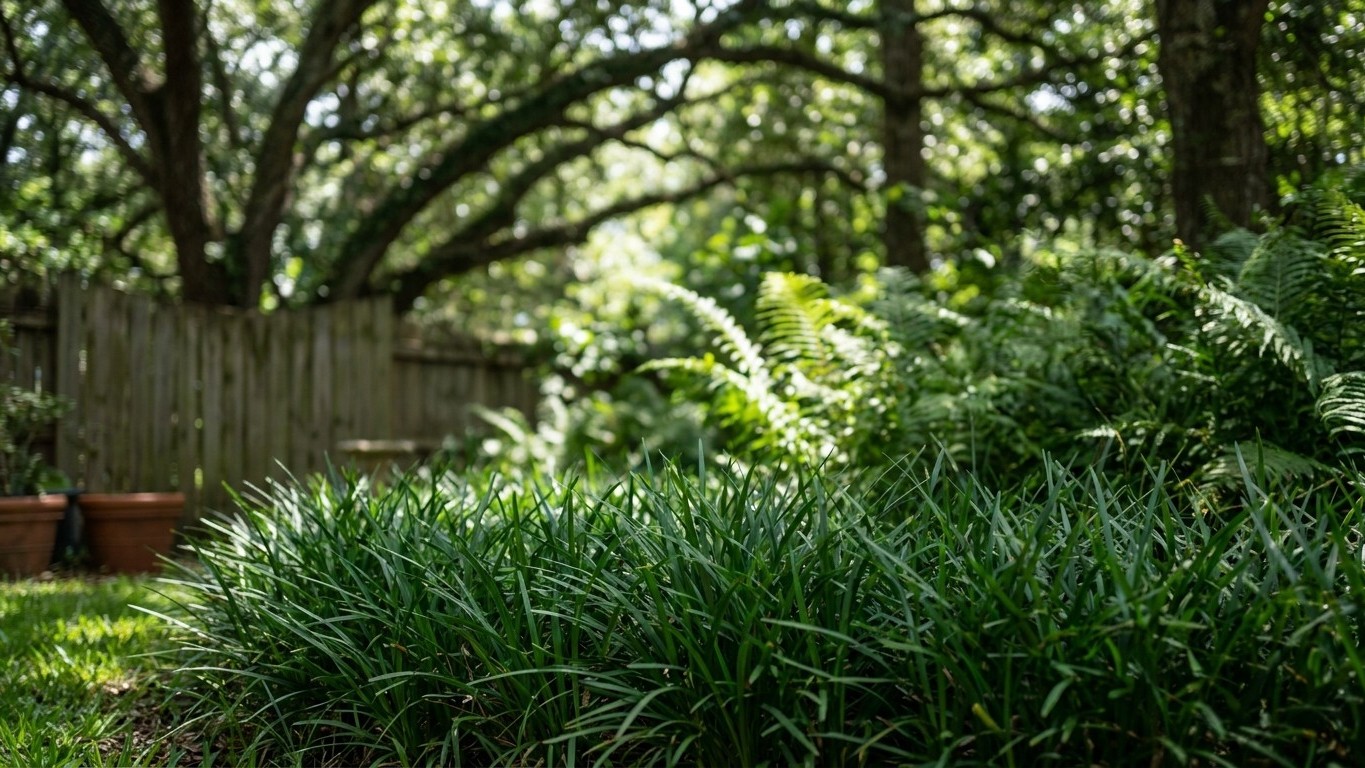

St. Augustinegrass’s shade tolerance gets repeated like a blanket promise, as if the grass simply shrugs off tree cover wherever it’s planted. It doesn’t. That reputation was earned in the Deep South’s heat, where warm nights and long summers let it keep photosynthesizing even under a thin canopy. Move the same grass a few hundred miles north and the math changes: cooler nights cut its energy budget, and shade that it shrugged off in Florida starts thinning it out in Virginia.
What St. Augustinegrass actually is

St. Augustinegrass is a warm-season grass, according to HGIC. That single fact decides its whole calendar. It grows through the hot months, slows as nights cool, and goes dormant and brown at the first real frost. That browning is not the plant dying. It is the plant shutting down until soil temperatures rise again in spring, the same pattern every warm-season lawn in the Deep South follows.
You can pick it out of a mixed or neglected lawn by its blades: broad, blunt-tipped, and a blue-green shade that reads darker than most cool-season turf. It spreads by above-ground stolons rather than underground rhizomes, so a healthy stand looks coarse and slightly ropy up close, with runners visible at the soil surface between mowings. That stoloniferous habit is also why it fills in fast once established and why it climbs over a bed edge if you let it.
HGIC scores its other tolerances this way: drought good, wear fair. Those two ratings matter more than the leaf shape when you are deciding whether this grass fits your yard, and the next sections translate them into situations you can actually picture. St. Augustinegrass sits alongside several other warm-season options covered in our broader rundown of grass types, and it is worth reading that comparison before you commit, since its poor cold tolerance rules it out for a lot of the country outright.
Where it works, and where it fails
HGIC lists coastal areas and southern zones as St. Augustinegrass’s home range, and the climate figures back that up. In Florida, where the reference city logs 73 days a year at 90°F or hotter and a coldest-month average low of 41°F, it is a first choice. Mississippi (71 hot days, 35°F coldest-month low) and Louisiana (71 hot days, 45°F low) sit in the same bracket. Texas runs hotter still, 102 days above 90°F, with a 43°F coldest-month low, and St. Augustinegrass performs well through its coastal and southern counties in particular. These figures come from the National Weather Service station used to represent each state, and a state as large as Texas or California will run colder in its northern or inland counties than the reference city suggests.
The wider warm-season map
| State | Days per year at 90°F or hotter | Coldest month average low | St. Augustinegrass verdict |
|---|---|---|---|
| Florida | 73 | 41°F | First choice |
| Mississippi | 71 | 35°F | First choice |
| Louisiana | 71 | 45°F | First choice |
| Texas | 102 | 43°F | First choice, coastal and southern counties |
| Alabama | 58 | 32°F | First choice, but near its cold limit |
| South Carolina | 55 | 38°F | First choice |
| Hawaii | 19 | 66°F | First choice |
| California | 2 | 49°F | First choice, coastal counties |
| Arkansas | 69 | 31°F | Near its cold limit |
| Arizona | 169 | 45°F | Mild winter, but outside its usual coastal/southern range |
| Nevada | 131 | 39°F | Mild winter, but outside its usual coastal/southern range |
Move north into the transition zone and there is no clean answer left. Oklahoma (71 days above 90°F, 29°F coldest-month low), Tennessee (40 days, 28°F low), Kentucky (37 days, 27°F low) and Kansas (58 days, 22°F low) all sit where no single grass excels. St. Augustinegrass’s poor cold hardiness makes it a losing bet through a normal winter in these states, and a grower there is generally better served by something bred for the split, like the option covered in Zoysiagrass: Shade and Cold Both, and Slow to Establish.
Past that, in Nebraska, Iowa, Ohio, Indiana, West Virginia and Delaware, coldest-month lows run from 14°F to 26°F and St. Augustinegrass will not survive a winter outdoors. Plant a cool-season grass instead. That’s exactly the territory Tall Fescue: The Cool-Season Grass That Holds Through Summer is written for.
Shade, drought, traffic: what it will take

Shade: excellent
HGIC’s excellent shade rating is the whole reason to choose this grass over other warm-season turf. Set a lawn under a mature live oak or a magnolia canopy where most grasses thin to bare dirt, and St. Augustinegrass is one of the few that will still carry a full stand. It is not shade-proof in total darkness, but under dappled or partial canopy it holds where bermudagrass and zoysiagrass typically give out.
Drought: good
A good drought rating means it can go through a dry summer stretch without irrigation and come back, but it will show the stress first: blades roll inward and the color shifts to a dull blue-gray before the stand actually browns. That rolling is your cue to water, not a sign the lawn is finished.
Wear: fair
Wear tolerance is rated only fair, which is the one rating that surprises people who picked this grass purely for the shade score. A dog’s worn running line along a fence, a footpath across the yard to the gate, or a swing set landing zone will all thin out faster on St. Augustinegrass than on a grass built for traffic. Rotate the play area or add a paved path across the highest-use line if you have kids or a big dog.
Cold hardiness: poor
This is the rating that draws the map in the section above. Poor cold hardiness does not just mean normal winter dormancy and browning, which every warm-season lawn goes through. A genuinely hard freeze, especially on a young or thin stand, can kill the crowns outright rather than just put the grass to sleep, and that means resodding in spring rather than watching it green back up on its own.
Seeding or sodding it
Here is the number that changes the budget most: HGIC lists St. Augustinegrass as established by sod, sprigs, or plugs only. There is no seed to buy. That single fact rules out the cheapest path into a warm-season lawn and pushes the whole project toward one of three routes:
- Sod: full coverage the day it’s laid, highest upfront cost per square foot, no bare-dirt waiting period.
- Sprigs: loose stolons planted into prepared soil, cheaper than sod, fills in over a season as the stolons spread.
- Plugs: small squares of sod set on a grid, cheaper than full sod coverage, fills the gaps between plugs as it spreads, which can take more than one growing season depending on spacing.
Because it is a warm-season grass, all three go into the ground on the warm-season calendar rather than the cool-season one. Clemson Cooperative Extension’s HGIC 1203 places warm-season planting around May, in contrast to cool-season grasses like tall fescue, which go in mid to late September. Planting St. Augustinegrass in September the way you would tall fescue gives it almost no warm season left to root in before dormancy, so stick to the warm-season window.
If you are coming from a cool-season lawn and assuming you can just scatter seed the way you did with fescue, budget differently here. Sod alone typically runs several times the material cost of seed for an equivalent area, and sprigs or plugs sit in between, cheaper than sod but slower to close in and more vulnerable to weed competition in the bare soil between them while they spread.
Mowing and keeping it

HGIC sets the mowing height for St. Augustinegrass at 2.5 to 4 inches, taller than most cool-season lawns are cut. That height matters because the grass’s growing point sits close to the soil surface on its stolons, and scalping it low exposes those growing points to heat stress and lets weeds into the gaps its blades would otherwise shade out. Mow toward the top of that range in the hottest, driest part of summer and toward the lower end in spring flush.
The one-third rule still applies
Never take off more than a third of the blade length in a single cut, regardless of what height you’re mowing to. On a fast-growing St. Augustinegrass lawn in peak summer, that can mean mowing more often than you would with a slower-growing turf, rather than letting it get long and knocking it back hard in one pass.
Because it spreads by stolons rather than staying in a tidy clump, St. Augustinegrass will climb over a bed edge, a walkway, or a driveway seam faster than most lawns. Edge it on a schedule rather than waiting until it’s visibly invaded the mulch, since a running stolon that’s rooted into a flower bed is a lot more work to pull than one you catch at the edge. Dethatch every year or two as well. The same stolon growth that fills the lawn in fast also builds a thatch layer at the soil surface, and a thick mat blocks water and fertilizer from reaching the roots.
Expect the whole lawn to go brown after the first hard frost. That is dormancy, not death, the same pattern every warm-season grass in the Deep South follows, and color returns as soil warms in spring provided the freeze wasn’t severe enough to kill the crowns outright, the risk covered above under cold hardiness.
Common questions
Can I overseed St. Augustinegrass with something for winter color?
That question belongs to grasses you can seed in the first place, and St. Augustinegrass isn’t one of them. Overseeding a dormant warm-season lawn for winter green is a common practice with grasses like bermudagrass, but St. Augustinegrass’s own establishment is by sod, sprigs or plugs, so check with a local nursery or your extension office before assuming the same overseed approach will take here.
Why does my St. Augustinegrass look thin under my biggest tree?
Shade itself usually is not the problem, since HGIC rates this grass excellent for shade tolerance. Root competition from a large, thirsty tree, or foot traffic concentrated in that one shady spot, is a more likely culprit than the shade alone.
Is St. Augustinegrass the same as centipede grass?
No, they’re different species with different tolerance profiles, even though both turn up in Deep South lawns and both spread by stolons. Don’t substitute one care routine for the other; check the specific grass you have before you set a mowing height or a fertilizer schedule.
My lawn stayed brown well past when the neighbors’ greened up. What happened?
That delay points toward winter injury rather than ordinary dormancy, especially if the winter had one unusually cold night rather than a steady mild cold. Given this grass’s poor cold hardiness rating, a hard freeze can kill crowns outright in patches, and those patches need resodding rather than more time to wait out.