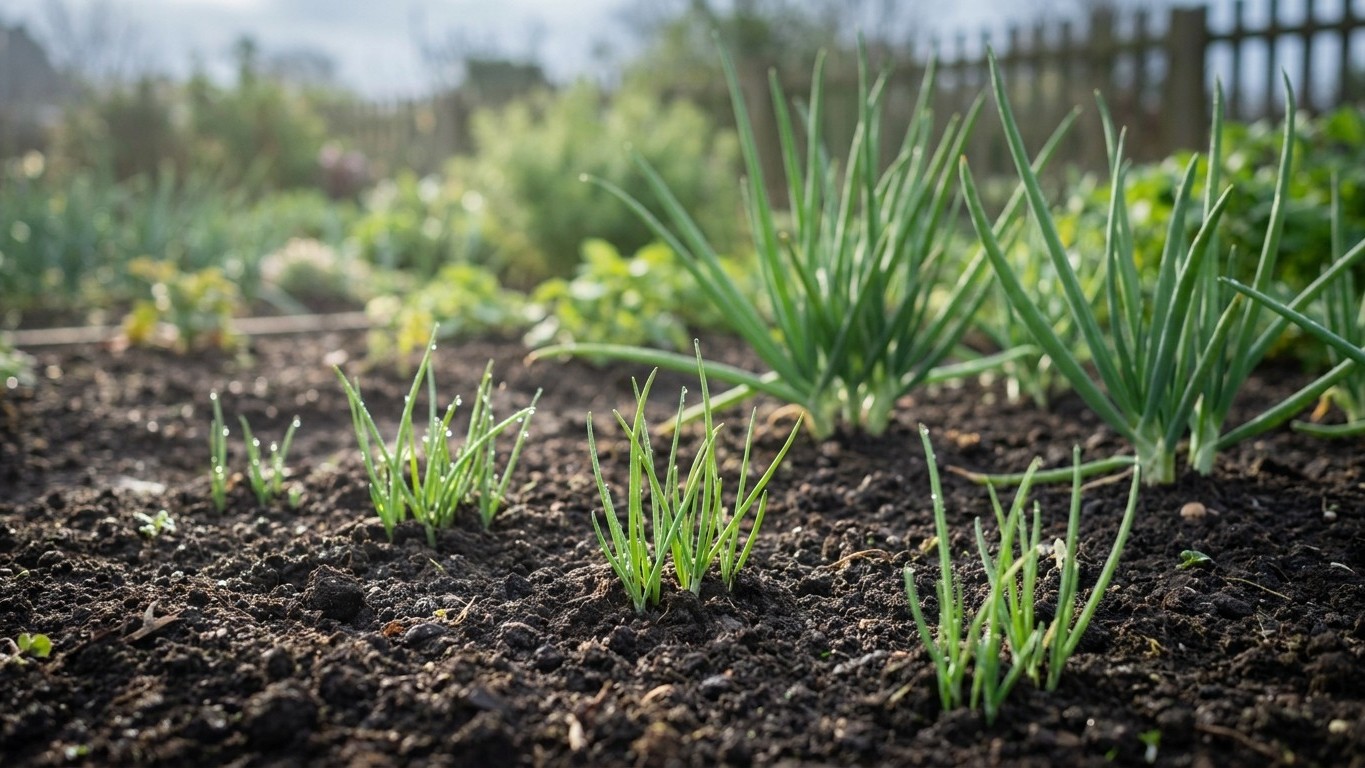

Planting onions in fall instead of spring lets the crop overwinter as a small plant, then finish bulbing weeks ahead of anything started fresh in spring. The technique is standard practice in southern gardens and increasingly tested farther north. Success depends almost entirely on timing the fall planting so the young plant hits a precise size window before hard cold arrives, not too small, not too large. That single balance decides whether the bed produces bulbs in early summer or nothing at all.
Overwintering Onions for an Early Harvest

Overwintering onions means planting in fall so the crop spends the cold months alive in the ground as a small plant, then resumes growth as days lengthen and finishes bulbing in early summer, well ahead of a spring-sown crop. The plant essentially pauses through winter rather than starting from seed after the last frost, which is what buys the earlier harvest date.
The mechanism only works within a narrow window. Go into winter with a plant that’s too large and it behaves as though it has already completed a winter cycle. The following spring, instead of putting energy into a bulb, it sends up a flower stalk. That’s bolting, and once it starts, the bulb is essentially finished as a storage crop. Go into winter with a plant that’s too small, on the other hand, and it simply doesn’t have enough root and leaf mass to survive freezing temperatures. It dies over the winter instead of pausing through it.
That narrow target is why planting date matters more with overwintered onions than with any other timing decision in onion growing. A week or two in either direction can push the plant out of the size range that survives winter without also triggering premature flowering. Spring planting doesn’t carry this risk because the plant never experiences a winter cold cycle before it bulbs. Overwintering deliberately exposes the plant to that cold cycle, which is exactly what makes the early harvest possible, and exactly what makes the timing so unforgiving.
In the South, this isn’t treated as an advanced technique at all. Fall planting is the norm, because the short-day varieties grown there are built to bulb in response to the lengthening days of late winter. Planting in fall simply lines the plant’s growth cycle up with that day-length trigger. Gardeners farther north, working with different day-length varieties and a harsher winter, have to manage the same size window with less margin for error and often with the help of mulch or row cover to get the plant through the cold intact.
How to do it
- Contact your local extension office this week to confirm the recommended fall planting window for onions in your county. This is the single most important piece of information in the entire process, since the target date shifts with latitude and local frost patterns.
- Match the variety type to your region before you buy anything: short-day types for southern latitudes where fall planting is standard, intermediate or long-day types farther north where day length and winter severity change the equation.
- Prepare the bed with loose, well-drained soil. Onions overwintering in soggy ground are far more likely to rot at the crown than to simply freeze.
- Sow seed or set out transplants on the recommended date, not earlier and not later. Planting ahead of schedule risks an oversized plant that bolts in spring; planting late risks a plant too small to survive winter.
- Water consistently through fall to help the plant establish roots, but avoid heavy feeding that pushes excessive top growth right before cold weather arrives.
- Check plant size as the first hard freeze approaches. The goal is a plant that’s clearly established, with a handful of true leaves, but still compact rather than lush.
- Apply a mulch layer once the ground begins to cool to insulate roots through the coldest stretch of winter, then leave the bed alone through the dormant period.
- Pull mulch back gradually in late winter as new growth resumes, and restart normal watering and feeding to carry the plant into its bulbing phase.
What goes wrong
- Bolting. A hollow flower stalk pushes up from the center of the plant in spring, and the bulb beneath it turns woody or splits instead of filling out. This happens when the plant went into winter already too large. Once the stalk appears, the bulb won’t recover into a storage onion. Harvest right away and use the onion fresh, since it won’t keep.
- Winterkill. Plants collapse into mush after a hard freeze, or the bed is simply empty by late winter with no sign of growth. This is usually the result of planting too late in fall, leaving the seedling too small to survive cold. There’s no fixing it after the fact; note the planting date was too late for your area and use a spring-sown crop as the backup for that season.
- No bulb forms. The plant keeps producing leaves through late winter and spring but never swells into a bulb at the base. This points to a variety mismatch, most often a long-day type planted where a short-day or intermediate type was needed for the local day-length pattern. Harvest what’s there as green onions rather than waiting on a bulb that isn’t coming, and switch variety type before the next fall planting.
- Crown rot. Plants look fine into winter, then turn soft and slimy at the base once mulch is removed in spring. Waterlogged soil under the mulch trapped moisture against the crown through the cold months. Pull the remaining mulch back immediately to let the area dry out, and plan the next overwintered bed in a spot with better drainage or in a raised bed.