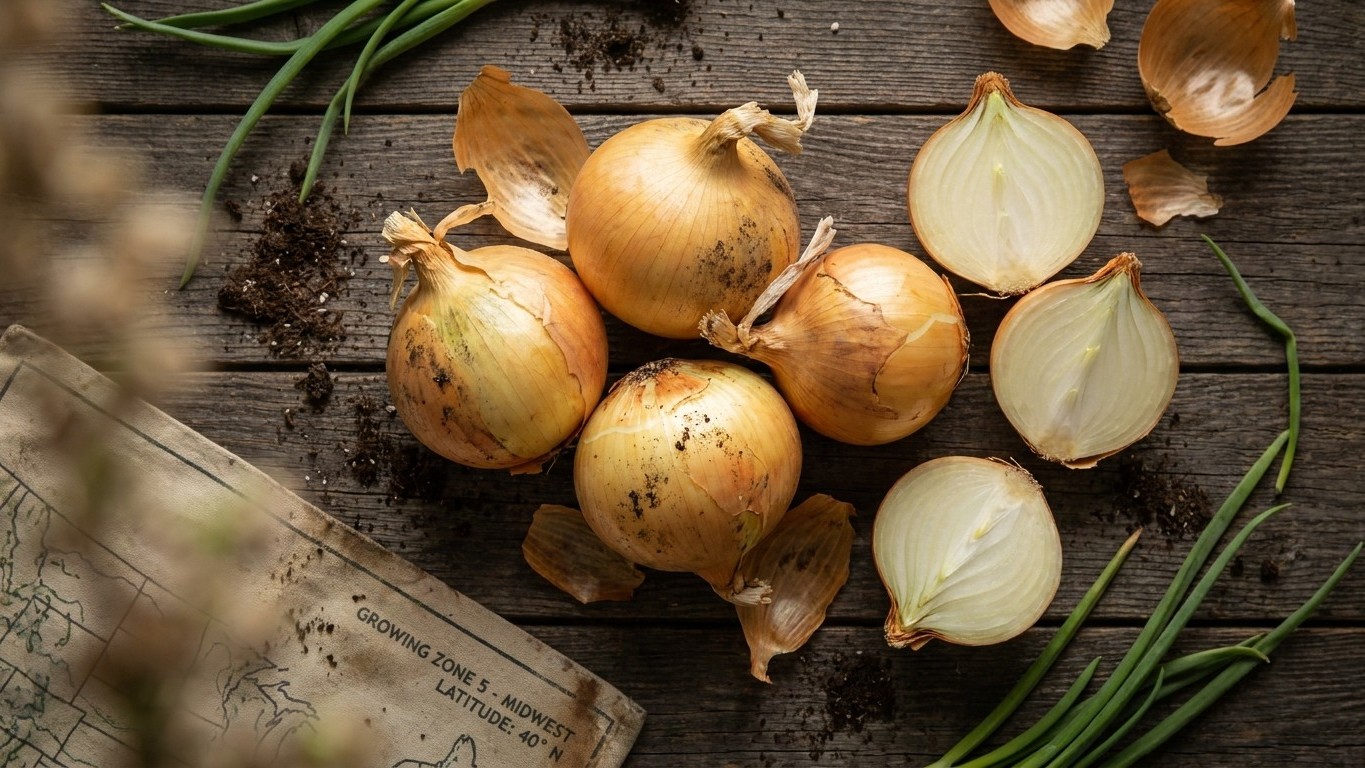

Candy onion belongs to the intermediate-day group, which means it bulbs reliably between roughly 33 and 40 degrees north latitude. Outside that band, plant a mistake, not a mystery. Inside it, expect a yellow, sweet-tasting bulb ready about 110 days after transplant, but one that keeps for only a month. Sweetness and shelf life are a trade-off here, not a coincidence.
Will Candy bulb where you are

Candy onion is classified as an intermediate-day variety. That single fact decides more than anything else on this page, because it sets the geography where this onion will actually form a bulb. The workable zone runs between 33 and 40 degrees north latitude, a band that covers a wide swath of the middle United States, from parts of the Carolinas and Georgia up through Tennessee, Kentucky, southern Ohio, and across to the middle latitudes of the Midwest and the Mid-Atlantic.
Here’s the part that trips up a lot of first-time onion growers: bulbing has nothing to do with temperature. An onion plant reads the clock, not the thermometer. Once daylight hours reach a certain threshold, the plant shifts its energy from leaf growth into bulb formation, and that threshold is genetically fixed by day-length group. This is why long-day onions are grown in the far north, where summer days stretch past 15 hours, while short-day onions are grown near the Gulf Coast, where summer daylight barely reaches 12. Candy sits in the middle, needing something in between, and that’s exactly what its latitude range reflects.
Plant it well outside that range and the plant does not simply produce a smaller onion. It produces no onion at all. In the Deep South, where days stay shorter for longer, Candy will keep pushing out leaves without ever triggering the hormonal switch that starts a bulb. Try to store what you dig up, and it rots instead of curing, because there was never a real bulb there to begin with. In the far north, above roughly 40 degrees, the reverse problem shows up: day length arrives too early, before the plant has built enough leaf mass, so bulbing starts on an undersized top and the harvest disappoints.
If you garden right around 33 or right around 40 degrees north, you’re in a blurred zone. Onions don’t respect lines on a map with precision, and a slightly early or slightly late season can push results either way. Treat those latitudes as a trial, not a guarantee, and keep notes on how your particular microclimate behaves before you commit a full bed to this variety.
What Candy is like
Assuming the latitude checks out, here’s what actually shows up in the garden and on the cutting board. The catalogue data on Candy onion is straightforward:
- Color: Yellow
- Days to maturity from transplant: 110
The flavor is where this variety earns its name. Candy onion sits on the sweet side, with few of the sulfur compounds that give storage onions their bite. That’s good news for anyone slicing one raw onto a burger or folding it into a salad, since sweet onions don’t leave the sharp aftertaste or the lingering breath that stronger varieties do.
But that sweetness comes at a direct cost, and it’s a mechanism worth understanding rather than just accepting as a label. The same sulfur compounds responsible for a sharp, tear-inducing onion also act as a natural defense against the bacteria and fungi that cause rot in storage. Strip those compounds out to get a milder flavor, and you strip out the bulb’s own preservation system along with them. Candy onion keeps for just 1 month, and that number isn’t a flaw in growing technique or a curing mistake. It’s built into the plant’s chemistry.
No sweet onion variety manages to also be a great long-term keeper. If a seed catalogue ever suggests otherwise, be skeptical. The honest way to think about Candy onion in the kitchen is as a season onion: eat it fresh, cook with it right after harvest, and don’t plan on it carrying your household through winter. Save the sharper, sulfur-heavy varieties for that job.
When to plant it
Planting timing for onions follows day-length group, and the rules change depending on where you garden, which surprises a lot of people who assume “onion season” is the same everywhere. In mild-winter regions, short-day onions typically go into the ground in fall and are harvested the following late spring, using the winter months to build root and leaf growth before spring daylight triggers bulbing. In the northern half of the country, long-day onions go in from late winter into early spring, since the ground is frozen too hard for a fall planting and the plants need to rush through leaf growth before the long days of early summer arrive.
Candy, as an intermediate-day type, generally falls into the spring-planting camp used across the transition zone it’s suited to, going in from late winter into early spring depending on your specific location within that 33 to 40 degree band. Gardeners closer to the southern edge of the range may have more flexibility with timing than those near the northern edge, where the growing window is tighter.
The date on a calendar matters far less than a simple physical test: how big is the plant when day length starts triggering bulbing? Onions are unusual in that the size of the leafy top at the moment bulbing begins directly sets the ceiling on how large the bulb can grow. A plant with only a few thin leaves at that trigger point will form a small bulb no matter what else you do right. A plant with a robust cluster of leaves has the stored energy to push into a large one.
That means the real goal of early-season planning isn’t hitting an exact date, it’s making sure transplants or sets go in early enough, and get enough consistent growth, to reach a healthy size before the daylight clock does its work. If your onions consistently come out small, look first at how much leaf growth happened before bulbing started, not at the harvest date itself.
Growing it well
Onions are shallow-rooted plants, and that single trait explains most of what goes wrong in an onion bed. The root system sits close to the surface and doesn’t reach out aggressively for water or nutrients, which makes onions poor competitors against anything else growing nearby. A bed left weedy for even a couple of weeks during active growth doesn’t just look untidy, it directly steals the moisture and nutrients an onion needs to build the leaf mass that determines bulb size later. Keep the area around Candy onion clear from planting through most of the season, and keep the soil consistently moist rather than letting it swing between soaked and bone dry.
Bolting is the other issue worth watching for, especially in a variety like Candy that’s already working with a narrow keeping window. Bolting happens when a stress, often a cold snap early in the season followed by a warm spell, tricks the plant into thinking it’s completed a full growing cycle, so it sends up a flower stalk instead of continuing to build the bulb. Once an onion bolts, the bulb that forms around that flower stalk develops a tough, woody core and will not store well no matter how carefully you cure it. If you spot a flower stalk emerging, don’t wait. Pull that bulb and use it first, since it’s already on borrowed time.
Beyond weeding, watering, and watching for bolting, resist the urge to overcomplicate things with unnecessary inputs. Onions respond most to consistency: steady moisture, clear soil, and enough room to develop leaves undisturbed by competition. That’s the foundation this variety needs to reach its full potential within its 110-day timeline.
Harvesting and keeping it
The signal that Candy onion is ready has nothing to do with a date circled on a calendar. It’s a physical change in the plant itself: the tops fall over on their own, flopping down at the neck as the bulb finishes maturing and the plant’s energy shifts away from the leaves entirely. Watch for this rather than counting days, since growing conditions can push the actual harvest a bit earlier or later than the 110-day estimate from transplant.
Curing comes next, and it’s the step most home gardeners skip, which is exactly why so many homegrown onions rot within weeks of coming out of the ground. A properly cured onion has a neck that’s dried down to a papery texture, sealing off the bulb from the kind of moisture and airborne bacteria that cause rot in storage. Skip curing, and even a naturally hardy onion won’t make it. For a variety like Candy, already working with a short shelf life, cutting curing short shortens that window even further.
The sequence from field to storage runs in a specific order:
- Watch for the tops to fall over naturally, signaling the bulb has finished maturing.
- Lift the bulbs from the soil, handling them gently to avoid bruising the outer layers.
- Lay or hang the onions in a warm, dry, well-ventilated spot out of direct sun.
- Let them cure until the necks and outer skins are fully dry and papery, typically a couple of weeks.
- Move cured bulbs into cool, dry storage, checking periodically for soft spots.
Candy onion keeps for 1 month, and that number should shape how you plan your kitchen around it. An onion that keeps six months becomes a pantry staple, carrying a household from harvest into the following spring. An onion that keeps a month is a season ingredient, meant to be used up in the weeks right after harvest rather than tucked away for later. Plan your recipes, your canning, and your meal rotation around eating Candy onion while it’s fresh, and let a sharper, longer-keeping variety handle the rest of the year.