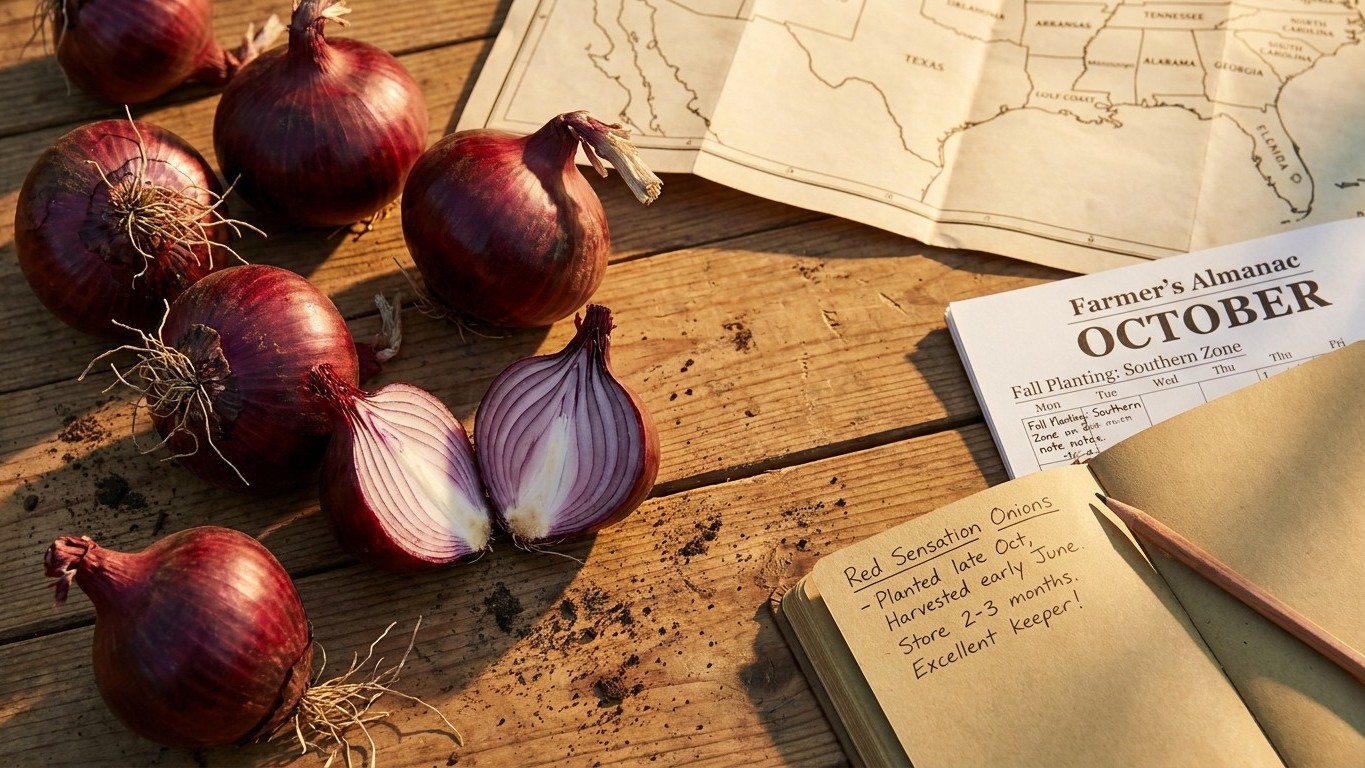

Red Sensation is a short-day onion, which means it only forms bulbs correctly between roughly 25 and 35 degrees north latitude, think the Gulf Coast up through the mid-South. Grown there, it matures in 145 days from a fall planting and stores for 2 to 3 months. Grown further north, it won’t bulb at all. That single fact decides everything else about whether this variety belongs in your garden.
Will Redwing bulb where you are

Latitude is not a suggestion with short-day onions. It’s the switch that turns leaf growth into bulb growth. Red Sensation is classified as short-day, and it bulbs correctly between 25 and 35 degrees north latitude, a band that covers most of Texas, the Gulf states, the lower Southeast, and stretches up into parts of the mid-South. Outside that window, the plant doesn’t respond to the cue it needs, and the results aren’t a smaller onion. They’re no onion.
Here’s the mechanism, and it runs against what most gardeners assume. Onions don’t bulb because of heat. They bulb because of day length, the number of daylight hours the plant is exposed to as the season turns. Short-day varieties like this one need only about 10 to 12 hours of daylight to trigger bulbing, which happens early in the season at southern latitudes. Long-day varieties need 14 to 16 hours, a threshold that only shows up in the extended summer daylight of northern states. Counterintuitively, it’s the far north that gets the longer summer days, not the south, which is exactly why long-day onions are bred for Minnesota and Maine, and short-day onions for Louisiana and South Texas.
Plant Red Sensation well north of the 25-35 degree band, in Ohio or Wisconsin or New England, and the day length never reaches the point where bulbing is triggered while the plant still has a full root system and healthy tops. The plant keeps producing leaves instead. What you pull at the end of the season is a fat green stalk over a thin, undeveloped base, not a storage bulb. Push it into a cellar hoping it will cure like a proper onion, and it rots within weeks.
If you garden right at the edge of that range, say the southern edge of Virginia or the northern tier of Texas, you’re in a blurred zone. The 25-35 degree figure is a continuum, not a hard line, and local microclimate, elevation, and how early you get the plant in the ground all shift the outcome slightly. A gardener near the boundary should expect variable results rather than a guaranteed harvest, and should treat a trial planting as exactly that: a trial, not a commitment.
What Redwing is like
Assuming the latitude checks out, what you actually get is a medium-sized bulb with a high percentage of single centers, meaning most bulbs form one solid core rather than splitting into a double, which matters if you slice onions for rings or want even cooking. The variety is classed as a grano type, and its standout trait isn’t sweetness so much as consistency of color: a well-grown bulb is red all the way through, not just red-skinned with pale rings hiding under the surface. Cut one open and you should see color from the outer layer to the center, which is the entire reason a cook reaches for a red onion instead of a yellow one for a salad or a sandwich.
- Color: Red, both skin and flesh
- Size: Medium bulb
- Shape: High percentage of single centers
- Days to maturity: 145 days, counted from fall planting, not from transplant
That maturity figure is worth pausing on, because it doesn’t work the same way as it does for most onions discussed elsewhere on this site. Short-day types like Red Sensation go into the ground in autumn in the South and spend the winter as small plants before bulbing in spring, so the 145-day count runs from that fall planting date, not from when a transplant goes into warm spring soil.
The keeping quality follows directly from the flavor, and it’s worth understanding the trade-off as a mechanism rather than a marketing label. The sulfur compounds responsible for an onion’s sharp bite are the same compounds that act as a natural preservative, discouraging the microbes and moisture loss that spoil a bulb in storage. A mild or sweet onion has fewer of those compounds, which makes it pleasant to eat raw but leaves it with little defense once it’s out of the ground. Red Sensation, published to keep for 2 to 3 months under ideal conditions, sits on the milder, shorter-keeping side of that spectrum. It’s an onion meant to be eaten within a season, not one you plan to still have in the pantry come spring.
When to plant it
Planting time isn’t fixed on a calendar page. It follows the day-length group, and that’s the part that trips up gardeners moving from one region to another, or reading advice written for the wrong zone. Long-day onions, grown in the northern half of the country, go into the ground in late winter to early spring, as transplants or sets, so they have a long stretch of increasing daylight ahead of them before the summer solstice triggers bulbing. Short-day onions like Red Sensation work on the opposite calendar. In the mild-winter areas where this variety actually bulbs, it’s planted in autumn, spends the cooler months as a small, cold-hardy plant, and is harvested the following late spring once bulbing has run its course.
That reversal is the reason the 145-day maturity figure is counted from a fall planting rather than a spring transplant. Anyone applying a spring planting schedule to a short-day onion in the South is working against the plant’s biology.
The date on the calendar matters less than a size test the plant itself is running. Bulbing begins the moment day length crosses the threshold this variety responds to, and it begins regardless of how big or small the plant happens to be at that moment. That means the size of the tops right before bulbing starts sets a ceiling on how big the final bulb can get. A plant that’s still small and underdeveloped when the trigger hits will bulb anyway, just early and small, because the plant has no way to delay the process and catch up. A gardener who plants too late in the fall, giving the young onion too little time to build size before winter and the following spring’s day-length shift, ends up with undersized bulbs no matter how well the rest of the season goes. Getting the fall planting date right, early enough for solid root and leaf growth before winter, matters more than any other single decision in the whole growing cycle.
Growing it well
Onions have shallow, sparse root systems, and that single fact explains most of what goes wrong in an onion bed. A shallow root can’t reach down for water the way a tomato or a squash can, so a dry stretch shows up fast as stalled growth and, eventually, a smaller bulb at harvest. The same shallow root system makes onions poor competitors against weeds. A weed that would barely slow down a deeper-rooted vegetable can quietly rob an onion of the moisture and nutrients it needs during the exact weeks when bulb size is being determined. Keeping the bed weeded and evenly watered through the growing season isn’t a nicety with onions, it’s the difference between a bulb that fills out and one that doesn’t.
Bolting is the other issue worth watching for, and it shows up as a flower stalk pushing up from the center of the plant before the bulb has finished developing. A bolted onion redirects its energy into producing seed rather than storage tissue, and the bulb that results, while still edible, will not keep. Cold snaps after an early spring warm-up are a common trigger for bolting in onions generally. If you spot a flower stalk forming, the practical response is simple: pull that plant and use it right away, in the kitchen, rather than setting it aside for storage where it will fail faster than the rest of the crop.
Beyond weeding, watering, and watching for bolt, there isn’t a published spacing or fertilizer figure specific to this variety to pass along here. General onion-growing guidance from your local Cooperative Extension office is the better source for those specifics, since soil and climate conditions vary too much region to region for a single number to apply everywhere.
Harvesting and keeping it
The plant tells you when it’s ready, and the signal has nothing to do with a date circled on a calendar. As the bulb finishes bulking up, the tops weaken at the neck and fall over on their own, usually a good portion of the bed within a few days of each other. That collapse, not a guess at maturity based on days since planting, is the reliable signal that it’s time to lift the crop.
Curing is the step most home gardeners skip, and it’s the reason a perfectly good harvest ends up rotting in a box a few weeks later. An onion pulled straight from the ground still has a soft, moist neck, and that neck is an open door for rot organisms once bulbs are piled together in storage. Curing closes that door by drying the neck and outer skins until they’re papery and tight.
- Watch the bed until the majority of tops have fallen over on their own.
- Lift the bulbs, keeping the tops attached rather than cutting them off immediately.
- Spread the bulbs in a single layer somewhere warm, dry, and out of direct rain, a covered porch or a garage works, for one to two weeks.
- Check the necks: they should feel dry and papery, not soft or damp, before you move on.
- Trim the dried tops and roots, and store the cured bulbs somewhere cool and dry with airflow, out of direct sunlight.
What you do with the crop after that comes down to the published keeping time of 2 to 3 months under ideal conditions. In practical terms, that’s a fall and early-winter onion, not a spring one. An onion that stores for six months lets a household stretch a single harvest across most of the year; one that stores for three months is an onion you plan to eat, share, or use up while it’s fresh, in salads and on sandwiches, rather than one you tuck away for later.