
Vidora is a short-day onion, and that single fact decides everything else. It bulbs reliably between 25 and 35 degrees north latitude, the belt that runs through the Deep South and along the Gulf Coast. Grown there, it keeps for up to three months under ideal conditions, long enough to carry a household from harvest through early summer, but not a winter storage onion. Its sweetness comes at the cost of shelf life, and that trade-off runs through every part of how you grow, harvest, and eat it.
Will Walla Walla Sweet bulb where you are

Vidora is classified as a short-day onion, which means it starts forming a bulb once daylight hours drop to a certain threshold in late spring, typically around 10 to 12 hours. That single detail is the whole story for whether this variety will work in your garden. The catalogue figures place its bulbing range between 25 and 35 degrees north latitude, a band that covers most of Texas, Louisiana, Florida, Georgia, Alabama, and the Carolinas, along with the desert Southwest at lower elevations.
Here is the part that trips up gardeners who move a plant north thinking climate is the deciding factor: onions bulb in response to day length, not temperature. A short-day variety planted in Minnesota or Michigan will grow lush green tops all summer, because the long summer days up there never trigger bulb formation the way they do closer to the equator. Instead the plant just keeps making leaves. Then fall arrives, the plant goes dormant with no bulb worth harvesting, and whatever swelling did occur tends to rot in storage rather than cure properly. This is counterintuitive at first, since most people assume a “sweet southern onion” simply needs southern heat. It doesn’t need heat. It needs the shorter day lengths that occur naturally at lower latitudes.
The flip side explains why long-day onions dominate in the northern tier of the country. Locations far to the north experience much longer summer daylight, sometimes 15 or 16 hours at the solstice, and that extended light is exactly what triggers bulbing in long-day types. Short-day varieties like Vidora simply never encounter their trigger threshold up there, because the days never get short enough during the growing season to fool the plant into switching from leaf growth to bulb growth.
If you garden right around 33 to 35 degrees north, say the upper edge of Georgia or the Carolina Piedmont, you’re in a genuine blurred zone. The bounds given here are a continuum rather than a hard cutoff, and a planting a few degrees beyond 35 may still bulb, just less predictably from year to year depending on how mild or unusual the season runs. Nobody can promise you a firm yes or no at that edge. What can be said plainly is that well inside the 25 to 35 degree band, Vidora bulbs correctly and consistently; well outside it, expect leaves and no usable onion.
What Walla Walla Sweet is like
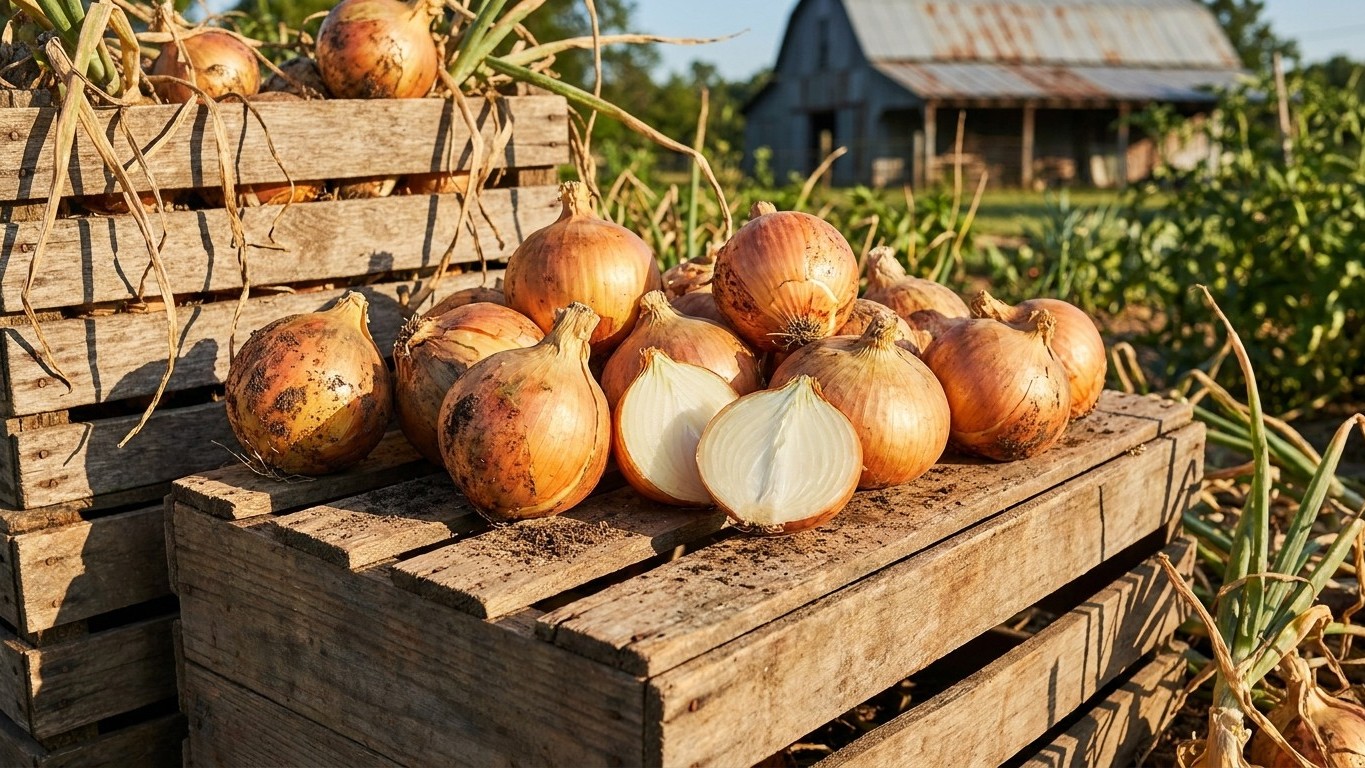
Grown within its range, Vidora produces a jumbo, uniform, globe-shaped bulb of the Granex type, with yellow skin. Granex is the type most home cooks recognize as the classic “sweet onion” shape and texture, distinct from the flatter storage onions sold loose in supermarket bins. Days to maturity run 130, counted from fall planting rather than from transplant, which matters because it’s a different clock than most other onion varieties use.
The flavor is described as the classic sweet Granex profile: mild, low in bite, pleasant eaten raw in a sandwich or salad rather than reserved for cooked dishes only. That mildness is not a marketing label, it’s chemistry. Onions build up sulfur compounds as a defense mechanism, and those same compounds are what make a storage onion sharp on the tongue and resistant to decay in the root cellar. A variety bred to minimize those compounds tastes sweeter and milder, but it also loses the chemical protection that lets a sharper onion sit in a mesh bag until March without spoiling.
That’s the honest trade-off with Vidora. You get a bulb pleasant enough to eat raw, sliced thick on a burger or diced into a salsa without the harsh aftertaste some cooking onions leave behind. What you don’t get is a long winter keeper. The catalogue figure for storage life is up to three months under ideal conditions, and that number should shape your planning from the day you plant it. This is not the onion to grow if your goal is a pantry that lasts until spring planting rolls around again. It’s the onion to grow if your goal is fresh, sweet eating for a defined stretch of the year, then moving on to something else once the supply runs out.
When to plant it
Because Vidora is a short-day type, its planting calendar runs opposite to what many new onion growers expect. In the mild-winter regions where this variety thrives, short-day onions go into the ground in autumn, not spring. The plants spend the winter establishing roots and leafy top growth while day lengths are still shrinking or holding low, and then the following spring, as days start lengthening again but haven’t yet crossed the long-day threshold, the plant reads the day length and switches over to bulb formation. Harvest follows in late spring.
This is the reverse of what happens with long-day onions further north, which typically go into the ground in late winter or early spring specifically so they have several months of vegetative growth before the long summer days of June trigger bulbing. Two different calendars, driven by the same underlying mechanism, just running on opposite halves of the year depending on the variety’s day-length group.
The date on the calendar matters less than a simpler test: how big is the plant when day length finally triggers bulbing? Whatever size the tops have reached at that moment is roughly the size ceiling for the bulb that follows. A small, stunted plant that gets caught by the trigger too early will only ever produce a small bulb, no matter how much care you give it afterward, because the plant has already been told to stop building leaves and start building a bulb. That’s why fall planting timing for Vidora isn’t arbitrary, it needs enough weeks of mild autumn and winter growth to build a decent frame of leaves before the spring trigger arrives. Plant too late in the fall and the plant simply won’t have caught up in size when the switch flips, and the harvest will disappoint regardless of how well you fertilized or watered it.
Growing it well
Onions have shallow, sparse root systems, and they compete poorly against weeds for water and nutrients. This isn’t an abstract warning, it shows up directly in bulb size. A Vidora plant fighting grass or chickweed for moisture during the weeks before bulbing simply won’t have built the leaf mass needed to support a jumbo bulb, and you’ll pull up something closer to golf-ball size instead of the uniform globes the variety is known for. Keeping the bed weed-free and consistently watered through that pre-bulbing stretch is the single most controllable factor in final bulb size.
Bolting is the other risk worth watching closely, especially in the South where a stretch of unseasonably warm weather in late winter can trick a young onion plant into thinking it’s already gone through a full winter cycle. When that happens, the plant shifts into flowering rather than bulbing, sending up a hard central stalk topped with a seed head. A bolted onion will not store, its energy has gone into reproduction rather than into building a dense bulb, and the neck stays thick and open rather than closing down properly for curing. Vidora is bred with strong bolt resistance, which is precisely why it holds up in southern conditions where a spring warm snap is common rather than exceptional. That resistance doesn’t mean bolting is impossible, only that the plant tolerates more temperature swing before it happens. If you do spot a bolted plant, pull and eat it right away rather than trying to store it, since it won’t keep regardless of what the rest of the bed does.
Vidora also carries an intermediate published resistance to pink root, a common soil-borne disease that causes roots to turn pink, then brown, and shrivel, weakening the plant’s ability to take up water and nutrients. Intermediate resistance is not immunity. It means the plant tolerates some level of pink root pressure in the soil better than a fully susceptible variety would, but it can still be affected in soil with a heavy disease history. Crop rotation, avoiding planting onions in the same bed year after year, remains the more reliable defense regardless of the variety’s built-in tolerance.
Harvesting and keeping it
The signal that Vidora is ready has nothing to do with a date circled on the calendar. The tops fall over on their own, bending at the neck and lying down in the row, and that collapse is the plant telling you it has stopped feeding the bulb and finished its growth cycle. Pulling before that point gives you a smaller, less mature onion; waiting substantially past it risks the neck rotting in wet soil. Watch the bed rather than the days-to-maturity number, though that 130-day figure from fall planting gives you a rough window to start checking.
Curing is the step most home gardeners skip, and it’s the reason so many homegrown onions go soft and moldy within weeks of being pulled. Curing means letting the harvested bulbs sit in a warm, dry, well-ventilated spot, tops still attached, until the necks dry down and turn papery rather than green and fleshy. That papery neck acts like a natural seal, closing off the opening that bacteria and moisture would otherwise use to get into the bulb. Skip this step and even a well-grown Vidora onion will start to soften and spoil within days rather than weeks.
Once cured, Vidora keeps for up to three months under ideal conditions, meaning cool, dry, and dark storage with decent airflow. In practical terms, that turns a spring harvest into onions you’re using through early to mid summer, not onions still sitting in the pantry come the following winter. The catalogue guidance here is straightforward: eat it in season. Treat Vidora as a fresh-eating sweet onion to work through steadily after harvest, and plan on a different, sharper-flavored storage variety if your goal is a bulb that lasts deep into the colder months.