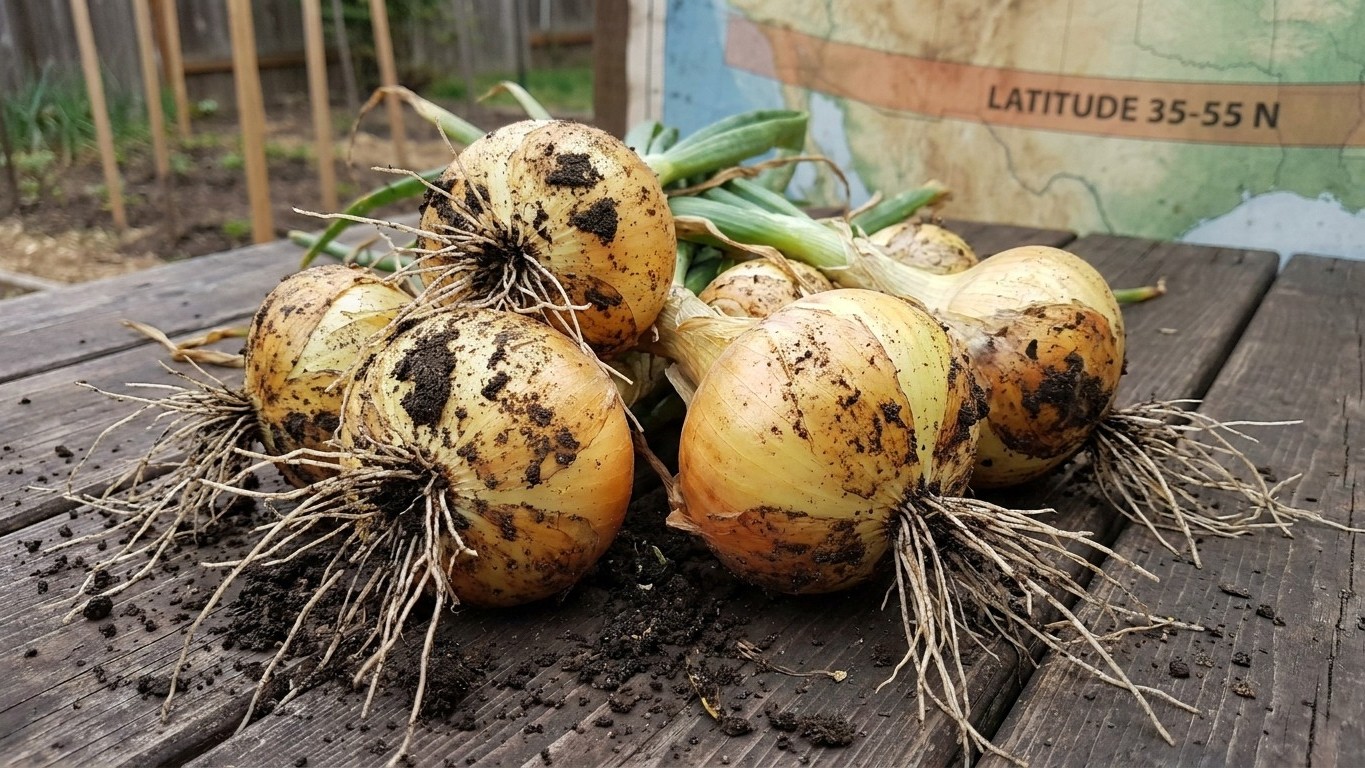

Walla Walla Sweet is a long-day onion, which means it only forms bulbs correctly between roughly 35 and 55 degrees north latitude. Outside that band, plant tops will grow, but the bulb underneath may never form. Inside it, expect a large yellow onion, ready in about 125 days from transplant, sweet enough to eat raw, and short-lived in storage compared with sharper varieties.
Will Walla Walla Sweet bulb where you are

This is the question to settle before anything else, because it decides whether the rest of this guide is useful to you. Walla Walla Sweet belongs to the long-day group, and it bulbs reliably between 35 and 55 degrees north latitude. That range covers most of the northern half of the United States, from roughly the California-Oregon border up through the Canadian prairies. South of that band, in places like the Gulf Coast or southern Texas, this variety struggles to make a bulb worth harvesting.
The reason has nothing to do with heat, and that trips up a lot of gardeners who assume onions bulb because the weather warms up. They don’t. Onions bulb in response to the number of daylight hours they receive, and that number is fixed by where you live on the planet, not by the thermometer. A long-day onion needs somewhere around 14 to 16 hours of daylight before it will switch from growing leaves to swelling a bulb. The far north gets those long summer days; the Deep South never does, no matter how hot July gets down there.
Here’s the part that surprises new growers: this isn’t a matter of getting a smaller onion if you plant outside the range. A long-day onion grown too far south simply keeps making leaves. The bulb stage never triggers. What you end up with, after months of care, is a green top with a soft, underdeveloped base that rots in storage within weeks. There’s no partial credit for planting the wrong day-length type.
If you’re near the edge of the range
Latitude bands aren’t hard lines drawn on a map. They’re a continuum, and 35 to 55 degrees north is a general working zone, not a cutoff etched in stone. A gardener at 33 or 34 degrees north, say in parts of the Carolinas or the middle of Texas, sits in a blurred zone. Results there can go either way depending on the specific season’s daylight and local microclimate. If that’s you, treat this as an experiment worth trying on a small scale rather than a sure thing, and don’t plant your whole onion patch on the assumption it will work.
What Walla Walla Sweet is like
Grown where it belongs, this variety produces a large, yellow-skinned bulb, typically ready about 125 days after transplanting into the garden. That’s a longer commitment than many kitchen vegetables ask for, closer to the timeline of a small shrub than a quick salad green. The size and shape reward the wait: these are big, round to slightly flattened onions with thin skin and a high water content, which is part of what makes them pleasant to eat raw.
The flavor is the real draw, and it’s genuinely sweet, not just “mild” in the way some sellers stretch the word. That sweetness comes from carrying fewer of the volatile sulfur compounds responsible for the sting and tears associated with sharper onions. Bite into one raw and you get crunch and juice without the burn that sends you reaching for a glass of water.
The trade-off nobody advertises
Those same sulfur compounds that make a storage onion sharp on the tongue are also what protect it in the root cellar or pantry. They’re antimicrobial, in a sense, part of the plant’s own defense system against rot and decay. A sweet variety like this one was bred, deliberately or by selection, with fewer of those compounds. That’s wonderful for a sandwich or a raw salad ring. It’s bad news for anyone hoping to store a winter’s supply.
Cooking doesn’t rescue the difference either. The sweetness holds up reasonably well when this onion is caramelized or grilled, since there’s little sharp acidity to begin with, but don’t expect it to develop the same depth a pungent storage onion gets when slow-cooked for hours. This is an onion built for eating soon after harvest, not for building a French onion soup base in February. No sweet onion variety, this one included, manages to also be a long keeper. The two traits work against each other by chemistry, not by bad luck.
When to plant it
Onion planting time isn’t one fixed date on the calendar. It shifts depending on which day-length group a variety belongs to, and that surprises a lot of first-time growers who expect one universal “onion planting week” the way they might for tomatoes.
Short-day onions, grown mostly in the South, actually go into the ground in fall, overwinter as small plants, and get harvested the following late spring. That schedule works because short-day types only need about 10 to 12 hours of daylight to trigger bulbing, a threshold the Southern winter and early spring can supply.
Walla Walla Sweet doesn’t follow that calendar, because it’s a long-day type. Long-day onions go into the ground in late winter to early spring, timed so the plants have a full growing season ahead of them before the long days of summer arrive and flip the switch to bulb formation. In northern states, that typically means starting seed indoors in late winter and transplanting out once the ground can be worked, or direct-seeding as soon as soil conditions allow in early spring.
The test that matters more than the date
A specific calendar date is a rough guide at best, because seasons shift and regions vary. What actually determines your bulb size is simpler and more mechanical: the plant needs to be big enough, with enough healthy green top growth, before day length reaches the threshold that triggers bulbing. Onions don’t get a second chance to build size once that switch flips. Whatever size the tops have reached at that moment is roughly the size the bulb below will grow to. Plant too late, and even perfect summer weather afterward won’t make up for lost time. A thin, underdeveloped plant produces a thin, underdeveloped onion when the daylight clock runs out.
Growing it well
Onions have shallow, sparse root systems, and they lose fights with weeds badly. A stand of grass or chickweed crowding the base doesn’t just look untidy, it pulls water and nutrients away from roots that can’t reach very deep to compensate. The visible result later in the season is a bulb that stayed small no matter how well the top growth looked earlier on. Keeping the bed clear, especially in the weeks right after transplanting, protects bulb size more than almost any other single practice.
Water matters for the same reason. Because the root zone is shallow, onions dry out faster than deeper-rooted vegetables planted right next to them, and a dry stretch during bulb swelling shows up later as smaller, sometimes misshapen onions rather than as wilted leaves you’d notice in the moment. Consistent moisture through the bulbing stage protects the size the plant was on track to reach.
Watch for bolting
Sometimes an onion plant sends up a flower stalk instead of, or in addition to, swelling its bulb. That’s bolting, usually triggered by a cold snap early in the season followed by warmth, and it’s a signal, not a disaster. A bolted plant redirects energy into the flower stem, and the bulb that forms underneath will be tough at the core and won’t store even for a short while. The practical move is to treat bolted plants as the first ones to pull and use. Eat them fresh, right away, rather than setting them aside for storage, because they’ll be the first to spoil regardless of how they’re cured.
Harvesting and keeping it
The plant tells you when it’s ready, and the signal is unmistakable once you know to look for it: the green tops soften at the neck and fall over on their own, usually across a spread of days rather than all at once. That flop is the plant’s own cue that bulb growth has finished, and it’s a far more reliable marker than counting to the 125-day mark on a calendar, which is a useful estimate but not a guarantee tied to your specific season.
Once most of the tops have fallen, pull the bulbs and move to the step most home gardeners skip, which is exactly why so many homegrown onions turn soft and moldy within weeks of coming out of the garden. Curing means laying the bulbs out somewhere warm, dry, and airy, out of direct sun, until the outer skins turn papery and the neck tissue dries down tight around the stem. That neck seal is what keeps decay organisms from working their way into the bulb during storage. Skipping this step, or rushing it because the bulbs look done on the outside, is the single most common reason home-grown onions rot early.
What short storage life means for your kitchen
Given the lower sulfur content behind its sweetness, this variety is not a candidate for the shelf life some storage onions manage. A long-keeping storage onion, cured properly, can hold six months or more, feeding a household clear into spring from a single fall harvest. Walla Walla Sweet isn’t built for that. Plan to use it within a few weeks to a couple of months of curing, treating it as a seasonal onion rather than a pantry staple. That’s not a flaw so much as the nature of the trade: the sweetness that makes it worth growing in the first place is the same trait that keeps it from lasting on the shelf.