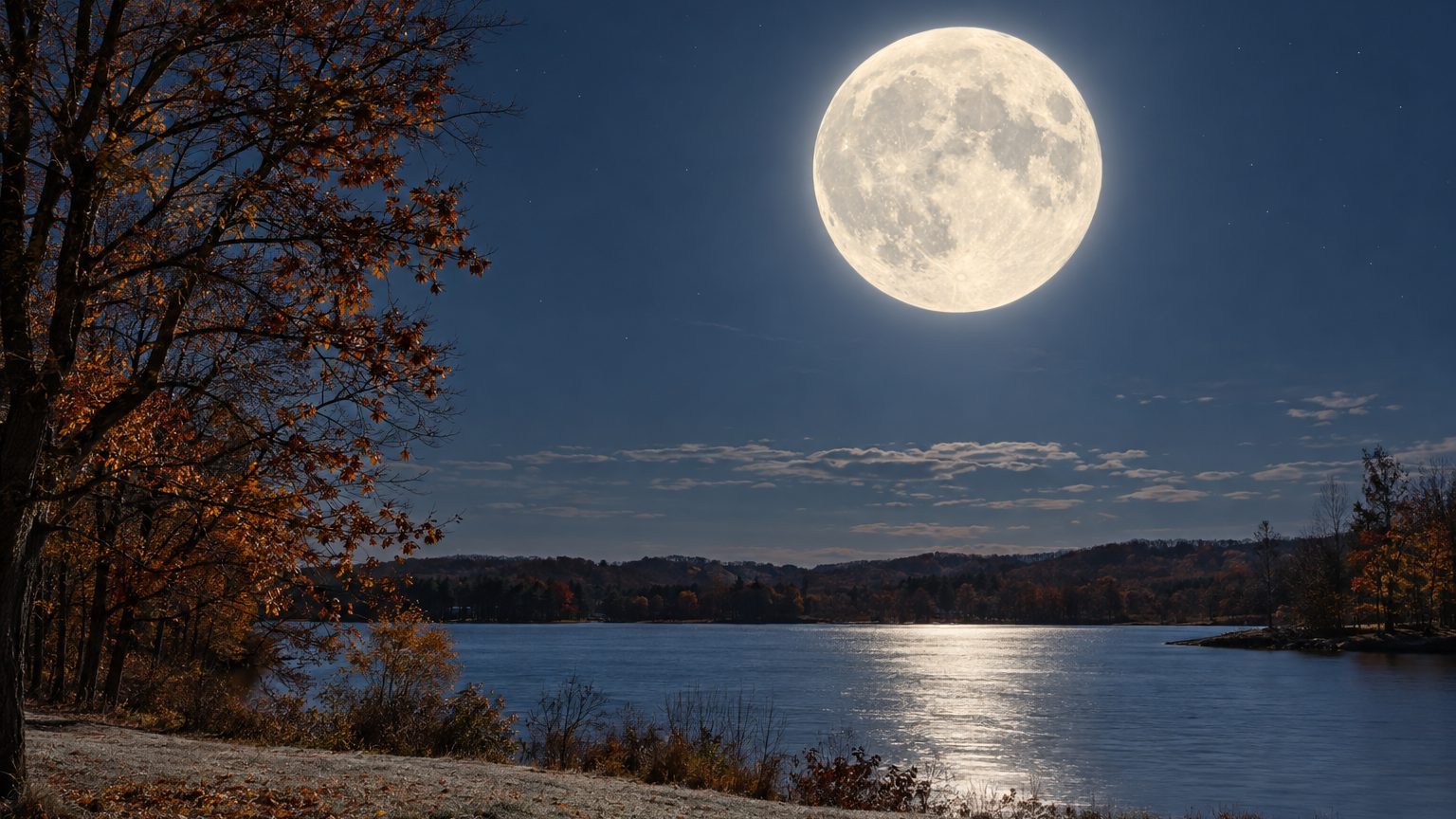

Every full moon has a traditional name, and the twelve most Americans know come from the Old Farmer’s Almanac: Wolf Moon in January, Snow Moon in February, Worm Moon in March, and so on through the Cold Moon in December. The names follow the calendar month, with one exception. The Harvest Moon follows the September equinox instead. Below are all twelve, the dates for 2026 and 2027, and what almanac tradition says about the full moon in the garden.
The twelve full moon names
The sky does not know what month it is, so the names are a layer of human bookkeeping. Each calendar month gets one name, and the year 2026 shows what that means in practice. It has thirteen full moons, because May holds two of them: one on May 1 at 1:23 p.m. ET and another on May 31 at 4:45 a.m. ET. Both carry the Flower Moon name, and the second one is also called a Blue Moon.
Where the names come from
The almanac drew its list from Algonquin naming and from names used by colonial settlers. No single native nation is the source of each one, and several have competing versions. What the names share is a habit of marking the season the way a farm or a hunting camp would notice it. The table gives the almanac’s usage and the reasoning traditionally attached to each name.
| Month | Traditional name | Where the name comes from |
|---|---|---|
| January | Wolf Moon | Winter, when wolves were heard howling near settlements |
| February | Snow Moon | The deepest snow of the winter, in the almanac’s northern climate |
| March | Worm Moon | Tradition ties it to the end of winter, when earthworms and their trails reappear |
| April | Pink Moon | Early spring wildflowers, especially moss pink or creeping phlox. Not the color of the Moon |
| May | Flower Moon | Spring blooms across the countryside |
| June | Strawberry Moon | The wild strawberry season, a name used in several native traditions |
| July | Buck Moon | Male deer growing new antlers in midsummer |
| August | Sturgeon Moon | The season when sturgeon were caught in the Great Lakes and large lakes of the Northeast |
| September | Harvest Moon | The full moon nearest the September equinox, tied to the gathering of crops |
| October | Hunter’s Moon | The hunting season that followed the harvest |
| November | Beaver Moon | Beavers preparing for winter, and the season for trapping them |
| December | Cold Moon | The onset of deep winter cold |
The Harvest Moon rule
Eleven of the names belong to a month. The Harvest Moon belongs to a moment: it is the full moon that falls closest to the September equinox. In 2026 the equinox arrives on September 22 at 8:05 p.m. ET, and the full moon on September 26 at 12:49 p.m. ET takes the name. In 2027 the equinox is September 23 at 2:01 a.m. ET, and the full moon on September 15 at 7:03 p.m. ET is the closest one.
Because the rule is about distance from the equinox and not about the month, the name can land on an October full moon in some years. When that happens, the Hunter’s Moon name moves to the next full moon. In 2026 and 2027 the Harvest Moon stays in September, so the Hunter’s Moon keeps its October slot.
Full moon dates in 2026 and 2027
All times below are Eastern (ET). Readers in other time zones need to convert them, and the calendar date can shift for times close to midnight, such as the October 26, 2026 full moon at 12:11 a.m. ET. A Blue Moon is marked here when it is the second full moon in a calendar month.
| Date | Time (ET) | Name | Blue Moon |
|---|---|---|---|
| January 3 | 5:02 a.m. | Wolf Moon | No |
| February 1 | 5:09 p.m. | Snow Moon | No |
| March 3 | 6:37 a.m. | Worm Moon | No |
| April 1 | 10:11 p.m. | Pink Moon | No |
| May 1 | 1:23 p.m. | Flower Moon | No |
| May 31 | 4:45 a.m. | Flower Moon | Blue Moon |
| June 29 | 7:56 p.m. | Strawberry Moon | No |
| July 29 | 10:35 a.m. | Buck Moon | No |
| August 28 | 12:18 a.m. | Sturgeon Moon | No |
| September 26 | 12:49 p.m. | Harvest Moon | No |
| October 26 | 12:11 a.m. | Hunter’s Moon | No |
| November 24 | 9:53 a.m. | Beaver Moon | No |
| December 23 | 8:28 p.m. | Cold Moon | No |
Notice that June 2026 has no full moon until June 29, and that February’s arrives on the first of the month. Those early-month dates are what push a second full moon into May.
| Date | Time (ET) | Name | Blue Moon |
|---|---|---|---|
| January 22 | 7:17 a.m. | Wolf Moon | No |
| February 20 | 6:23 p.m. | Snow Moon | No |
| March 22 | 6:43 a.m. | Worm Moon | No |
| April 20 | 6:27 p.m. | Pink Moon | No |
| May 20 | 6:59 a.m. | Flower Moon | No |
| June 18 | 8:44 p.m. | Strawberry Moon | No |
| July 18 | 11:44 a.m. | Buck Moon | No |
| August 17 | 3:28 a.m. | Sturgeon Moon | No |
| September 15 | 7:03 p.m. | Harvest Moon | No |
| October 15 | 9:47 a.m. | Hunter’s Moon | No |
| November 13 | 10:25 p.m. | Beaver Moon | No |
| December 13 | 11:08 a.m. | Cold Moon | No |
2027 has twelve full moons, one per month, and none of them is a Blue Moon. Note also that the 2027 Harvest Moon falls before the equinox, on September 15, while the 2026 one falls after it. The rule only asks which full moon is nearer, not which comes first.
What the full moon means in the garden
Gardeners who plant by the Moon divide the lunar month into quarters, and the almanac rule is that the full moon marks the turning point. According to almanac tradition, crops that bear above ground go in while the Moon is growing toward full, and root crops go in after the full moon, in the third quarter, as the Moon wanes toward its last quarter. In 2026 that third-quarter stretch after the Hunter’s Moon runs from October 26 at 12:11 a.m. ET to the last quarter on November 1 at 3:28 p.m. ET. In 2027 it runs from the Hunter’s Moon on October 15 at 9:47 a.m. ET to the last quarter on October 22 at 1:29 p.m. ET. For the full explanation of how the tradition treats the day of the full moon itself, see planting on a full moon.
The effect of the Moon on crops is not proven, and nothing on this page should be read as a promise of a result. The tradition is old, widely repeated, and fun to follow, but it is a custom and not a measurement. The Moon also never overrides the calendar of the place. Frost dates and soil temperature decide whether a crop can go in the ground at all, and the Moon, for anyone who follows it, only chooses among days that are already open. For planting dates in your area, use your state’s planting guide, then look at planting by the moon if you want to see how the almanac’s other phases and sign days fit in.
Questions
Which month has a Blue Moon?
In 2026 it is May. The first full moon of the month comes on May 1 at 1:23 p.m. ET and the second on May 31 at 4:45 a.m. ET. The second one is the Blue Moon, and it keeps the Flower Moon name. None of the twelve full moons of 2027 is a Blue Moon.
What is the Harvest Moon?
It is the full moon nearest the September equinox, whichever month that full moon happens to fall in. The 2026 Harvest Moon rises on September 26 at 12:49 p.m. ET, four days after the equinox on September 22 at 8:05 p.m. ET. The 2027 Harvest Moon is on September 15 at 7:03 p.m. ET, ahead of the equinox on September 23 at 2:01 a.m. ET. The name comes from the season of gathering crops, and it is the one name on the list tied to an astronomical event instead of a month.
When is the next full moon after October 26, 2026?
The Hunter’s Moon on October 26 at 12:11 a.m. ET is followed by the Beaver Moon on November 24, 2026, at 9:53 a.m. ET. After that comes the Cold Moon on December 23 at 8:28 p.m. ET, the last full moon of 2026. The first full moon of 2027 is the Wolf Moon on January 22 at 7:17 a.m. ET.