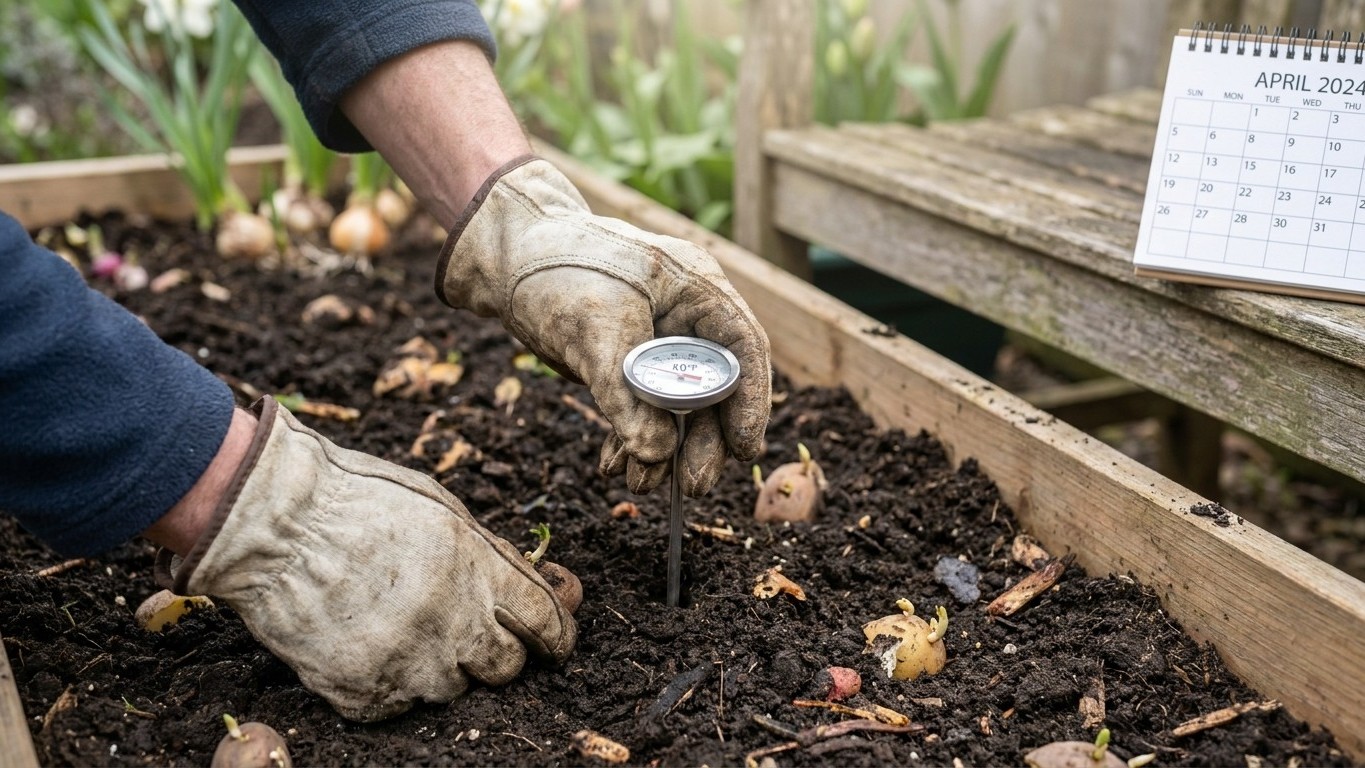

For most of Ohio sitting in USDA zone 6a, the math comes down to two figures: a last spring frost window of May 5 to May 15, published by Ohio State University Extension, and a 14-to-21-day head start potatoes need to catch the moment soil hits 50°F, according to Utah State University Extension and the University of Maine Cooperative Extension. Count backward from that mid-May frost window and the working target lands in mid-to-late April, soil conditions permitting.
The short answer
Ohio State University Extension’s Ohio Gardening Calendar puts the last spring frost for zone 6a between May 5 and May 15. That’s the anchor date. Everything else about potato timing gets counted backward from it, not forward from some fixed calendar day that stays the same regardless of what the soil is doing.
Utah State University Extension’s fact sheet Potatoes in the Garden is specific about the mechanism behind the counting: potatoes go in the ground as soon as the soil itself reaches 50°F, and that moment typically falls 14 to 21 days before the last frost date. Apply that window to Ohio’s zone 6a frost range and the planting target sits roughly in the back half of April, stretching toward the first days of May depending on how fast a given plot’s soil warms that particular spring.
That’s a range, not a single day, on purpose. Soil temperature doesn’t move on a schedule. A south-facing bed with loose, sandy loam can hit 50°F a full week before a shaded, clay-heavy plot ten miles away. The frost date gives you the outer boundary; the soil thermometer gives you the real green light. Ohio State’s calendar tells you when frost risk drops off across zone 6a; it doesn’t tell you when your specific patch of dirt is warm enough to keep a seed potato from rotting instead of sprouting.
The University of Maine Cooperative Extension’s Bulletin #2077 backs the same logic from a different angle, framing the 50°F soil threshold as the trigger point rather than any fixed date on a wall calendar. Two extension services, working from different states, land on the identical rule: soil temperature decides the day, frost date decides the season.
So the short answer for zone 6a Ohio is a counted-back window, not a stamped date. Take the May 5 to May 15 frost range, subtract 14 to 21 days, and treat the result as a target to confirm with a soil thermometer rather than a deadline to hit no matter what the dirt says.
What actually decides it
Soil temperature is the real clock, not the calendar
Air temperature and soil temperature move at different speeds. A warm afternoon in April can push the thermometer into the 60s while six inches down, the ground is still holding onto winter. Seed potatoes planted into soil colder than 50°F don’t just wait patiently; they sit in cold, often wet ground and are prone to rotting before they ever sprout. That’s why Utah State University Extension frames 50°F soil as the actual planting trigger, with the 14-to-21-day gap before frost functioning as a rough estimate of how long it usually takes soil to catch up to that mark once the last frost date approaches.
This is the piece that lets you reason about a plot this page never mentions. A raised bed warms faster than ground-level soil because there’s more exposed surface area and often better drainage. A north-facing slope warms slower than a south-facing one. Mulched soil warms slower than bare soil in early spring. None of that changes the frost date. All of it changes when your soil actually crosses 50°F, which is the number that matters.
The 90°F ceiling that shuts tuber growth down
The other end of the season has its own mechanism, and it’s the more consequential one. Both Utah State University Extension and the University of Maine Cooperative Extension identify soil temperatures above 90°F as a point where tuber set and tuber fill are inhibited. That’s not a slowdown you can water your way out of. Once soil runs that hot, the plant’s underground growth stalls regardless of how much irrigation it gets.
That single fact reshapes how planting timing should be thought about in any region prone to hot summers, Ohio included. If a plot regularly sees soil temperatures climb past 90°F in mid-to-late summer, especially in raised beds, containers, or dark, unshaded ground, the strategy isn’t to push planting later and nurse the crop through the heat. It’s to plant as early as soil allows, so tubers set and bulk before the soil crosses that ceiling, effectively growing the crop as a spring dig rather than a summer one. Where summer soil heat is less of a concern, the timing pressure comes almost entirely from the frost side of the calculation instead.
How to do it
- Find your zone’s last frost window. For zone 6a Ohio, Ohio State University Extension’s Ohio Gardening Calendar puts that window at May 5 to May 15.
- Subtract 14 to 21 days from that window, per Utah State University Extension, to establish a target planting range rather than a fixed date.
- Check actual soil temperature with a soil thermometer before planting, since 50°F soil, not the calendar, is the real trigger identified by both Utah State University Extension and the University of Maine Cooperative Extension.
- Buy certified seed potatoes rather than grocery-store tubers or saved stock from an unknown source. Uncertified seed can carry virus that stunts the crop before it has a chance.
- Cut larger seed potatoes into pieces if needed, then let the cut surfaces heal over before putting them in the ground.
- Weigh the local heat pattern when choosing a season class. In areas where soil regularly climbs past 90°F in summer, an early or mid-season class planted as soon as soil allows gives tubers the best shot at setting and filling before that ceiling is reached.
- Plant into the prepared bed once soil temperature confirms the 50°F mark, rather than defaulting to a single date pulled from a chart.
What goes wrong
- Planting strictly by calendar date and ignoring soil temperature. A date on a chart doesn’t account for a cold, wet spring that leaves soil below 50°F well past when the frost window says it’s safe. Check the soil with a thermometer before digging in, regardless of what the date says.
- Waiting too long and letting soil heat catch up with the crop. If planting is delayed into late spring, tubers may still be setting and filling when soil temperatures climb toward or past 90°F, and Utah State University Extension and the University of Maine Cooperative Extension are both clear that heat above that mark stalls the process outright. The fix is planting as early as soil allows and treating the crop as an early dig in warmer areas.
- Planting uncertified seed potatoes. Seed saved from a grocery bag or a neighbor’s leftover stock can carry virus that isn’t visible until the crop underperforms. Certified seed is the one input worth not cutting corners on.
- Chasing a days-to-maturity number that doesn’t exist in the source material. Neither Utah State University Extension nor the University of Maine Cooperative Extension publishes a specific day count for varieties. Plan around the published season class instead, early, mid-season, or late, rather than a number pulled from somewhere else.
- Assuming one date works across all of Ohio. The May 5 to May 15 window applies to zone 6a specifically. A plot in a different zone will have a different last frost range, and the same counting-back method needs to start from that zone’s own figure, not this one.
Common questions
Can I plant potatoes before the last frost date in zone 6a Ohio?
Yes, that’s the whole point of counting backward. Utah State University Extension’s 14-to-21-day guideline puts planting before the frost date itself, timed to when soil crosses 50°F rather than after frost risk has fully passed.
What if my soil hasn’t reached 50°F by my calculated target date?
Wait for the soil, not the calendar. Both Utah State University Extension and the University of Maine Cooperative Extension identify 50°F soil as the actual trigger; planting into colder ground risks rot rather than germination.
Does the potato’s season class change when I should plant?
The planting date itself is set by soil temperature and frost timing, not by season class. But in areas where soil regularly exceeds 90°F in summer, choosing an early or mid-season class and planting as soon as soil allows gives the crop a better window to set and fill tubers before that heat ceiling arrives.
Is certified seed potato really necessary, or can I use seed from a previous crop?
Certified seed matters because uncertified stock can carry virus that isn’t visible at planting time but shows up as reduced vigor and yield later. It’s a one-time decision at purchase that avoids a problem that’s difficult to fix once the crop is in the ground.