
Forty-five to fifty-five days. That’s the window Utah State University Extension gives for a pumpkin to go from open flower to ripe fruit, and it’s the number that decides whether the pumpkin sitting on your vine right now turns orange before frost or stays green and unusable. Not from the day you planted the seed. From the day the flower opened. Count from there, and you’ll know where you stand.
The short answer
Utah State University Extension states plainly, in its guide “Pumpkins in the Garden,” that pumpkins take 45 to 55 days to mature after flowering. That single detail changes how every backyard grower should be doing the math. If you’ve been counting from the day you dropped seeds into the mound, or from the day the vine first started running across the lawn, you’ve been counting the wrong clock. The extension’s figure starts at bloom, specifically when a female flower opens and gets pollinated, not at germination and not at transplant.
This matters because a pumpkin patch doesn’t produce all its flowers on the same day. A vine can throw female flowers over several weeks, meaning one fruit on the same plant might be three weeks ahead of another. Ask “will my pumpkins ripen” and the honest answer depends on which flower, on which fruit, you’re asking about. A pumpkin that set from a flower open in early July has a very different outlook than one that set from a flower that opened in late August.
The practical move is simple: walk the patch, find the flowers that have already opened and turned into small green fruit, and mark or remember roughly when that happened. Add 45 days for the earliest realistic ripening, 55 for the latest. Compare that window to your area’s typical first fall frost. If the window closes before frost usually arrives, that fruit has a real shot. If the math runs past your frost window, that fruit is racing a clock it’s likely to lose, though a light frost alone doesn’t always kill a pumpkin outright, and it can be brought in and finished elsewhere out of the cold.
None of this is guesswork dressed up as science. It’s the extension’s own framework, and it’s the reason so many home gardeners misjudge their pumpkin timeline every year. They count from seed. The plant counts from flower.
What actually decides it
Several things happen between seed and harvest, and it’s worth separating them because only one of them actually starts the ripening clock. Soil temperature, sowing method, and pollination timing all play a role, but they don’t carry equal weight.
Soil temperature sets the pace, but it isn’t the trigger
Utah State University Extension recommends sowing pumpkin seed once soils reach 65 F, using four to six seeds per mound, planted 1 to 2 inches deep, with mounds spaced 4 feet apart. That 65 F soil threshold is a germination condition, not a calendar date, and it is not the same thing as your area’s last frost date. Soil lags behind air temperature by weeks in spring, so a 65 F reading can arrive well after frost risk has already passed in the air. Growers who treat “last frost” and “65 F soil” as interchangeable often end up planting too early into cold, slow-draining soil, where seed simply sits and rots instead of germinating.
Row covers and plastic mulch shift the starting line
The extension notes that plastic mulch and row covers let gardeners plant pumpkins as much as two weeks before the last frost date, by warming the soil artificially and buffering young seedlings from cold snaps. That head start matters for the whole season, because every day gained at planting is a day gained toward an earlier flowering date, which in turn is a day gained toward beating the frost with the 45- to 55-day ripening window.
The flower is what settles the question
Soil temperature decides when you can safely plant. Mulch and covers decide how much earlier than normal you can push that planting. But neither one decides whether a specific pumpkin will ripen. That’s decided entirely by the date its flower opened and set fruit, because that’s the date the 45- to 55-day clock starts running. Two vines planted on the same day, in the same soil, can carry fruit on very different ripening schedules if their flowers opened at different times, and that is the number to track, not the planting date.
How to do it
- Wait for 65 F soil. Check soil temperature directly rather than guessing from air temperature or the calendar. Utah State University Extension ties seed sowing to this threshold, not to the last frost date.
- Use plastic mulch or row covers if you want a two-week head start. These let you plant earlier than the last frost by protecting seedlings and warming soil, per the extension’s guidance.
- Sow four to six seeds per mound, 1 to 2 inches deep. Space mounds 4 feet apart to give vines room to run without crowding each other out.
- Thin seedlings once they’re established so the strongest plants aren’t competing for water and nutrients within the same mound.
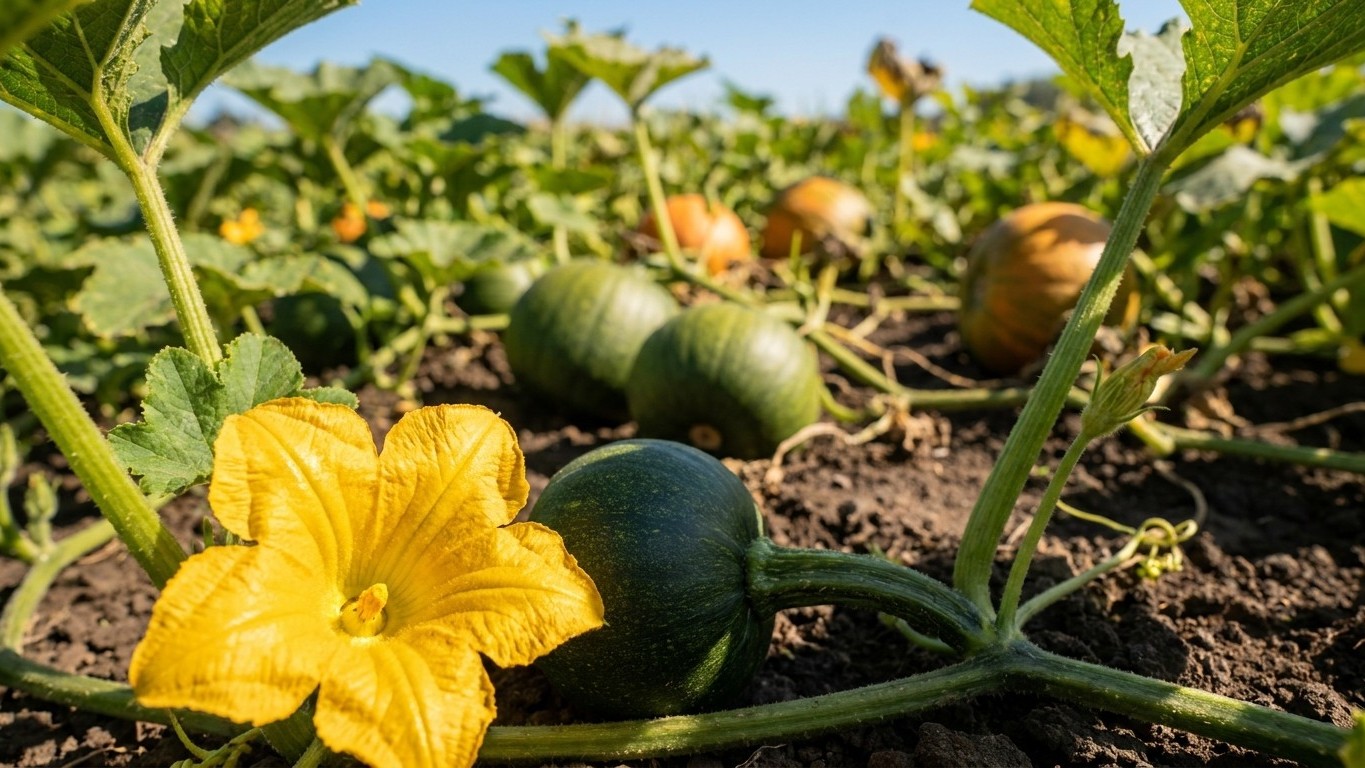
- Watch for female flowers, the ones with a small swollen bulge at the base that will become the fruit once pollinated. Note roughly when each one opens.
- Count forward 45 to 55 days from each flowering date, not from the planting date, to estimate when that specific pumpkin should ripen.
- Compare that ripening window against your first expected fall frost. Fruit whose window closes well before frost has a solid chance; fruit whose window runs past frost is at risk.
- Bring vulnerable fruit indoors, or under cover, if frost threatens before the window closes. Keep them somewhere they will not freeze while they finish coloring.
What goes wrong
- Counting from the seed date instead of the flower date. This is the single most common error, and it throws off every estimate that follows. The fix is to physically track flowering, not planting, since the 45- to 55-day window from Utah State University Extension starts at bloom.
- Treating 65 F soil as the same moment as the last frost. Soil warms slower than air, so planting the moment the calendar says “last frost” can mean planting into soil that’s still too cold, leading to poor germination or rot. Check soil temperature directly instead of relying on frost-date charts alone.
- Planting too early without protection. Pushing seed into the ground ahead of the recommended window without plastic mulch or row covers exposes seedlings to cold soil and cold snaps. If you want the extra two weeks, use the covers the extension describes; don’t skip that step and plant early anyway.
- Storing harvested pumpkins somewhere they can freeze. The extension gives no specific storage temperature, humidity level, or keeping time for pumpkins, only the general guidance to keep them where they will not freeze. Don’t borrow a storage number from another crop or another source; a garage, shed, or covered porch that stays above freezing is the safe bet described here.
- Losing vines to squash bugs or cucumber beetles before flowering even happens. Both pests can knock back a plant enough to delay or stop flowering entirely, which wrecks the ripening math before it starts. See the dedicated pages on squash bugs and cucumber beetles for identification and control specific to each.
- Assuming all varieties ripen the same way. Utah State University Extension’s variety list names several pumpkins for home gardens without attaching maturity days or size figures to any of them. Don’t assume a variety name implies a specific timeline; the flowering-to-harvest window described here applies across the crop generally, not to one named type with its own published number.
Common questions
How do I know which flowers are female and will become fruit?
Female pumpkin flowers have a small swollen section at the base of the bloom, which is the undeveloped fruit. Male flowers sit on a plain, thin stem. Tracking female flowers specifically is what lets you mark an accurate starting point for the 45- to 55-day ripening window.
Can I speed up ripening once the flower has already opened?
Utah State University Extension’s guidance centers on the 45- to 55-day window after flowering; it doesn’t describe a way to shorten that window once pollination has occurred. The more useful lever is earlier flowering, achieved through earlier planting with mulch or row covers.
What if frost hits before my pumpkin finishes its window?
Move the fruit somewhere it will not freeze, since that’s the storage condition the extension specifies. It doesn’t publish a specific temperature or timeframe for how long a partially ripe pumpkin can finish coloring indoors, so treat “not freezing” as the baseline requirement rather than searching for a precise number.
Does soil temperature affect how fast the pumpkin ripens after flowering?
The 65 F soil threshold from Utah State University Extension governs seed germination at planting time, not the post-flowering ripening period. Once a flower has opened and set fruit, the 45- to 55-day window is the figure to track, separate from the soil-temperature condition used earlier in the season.