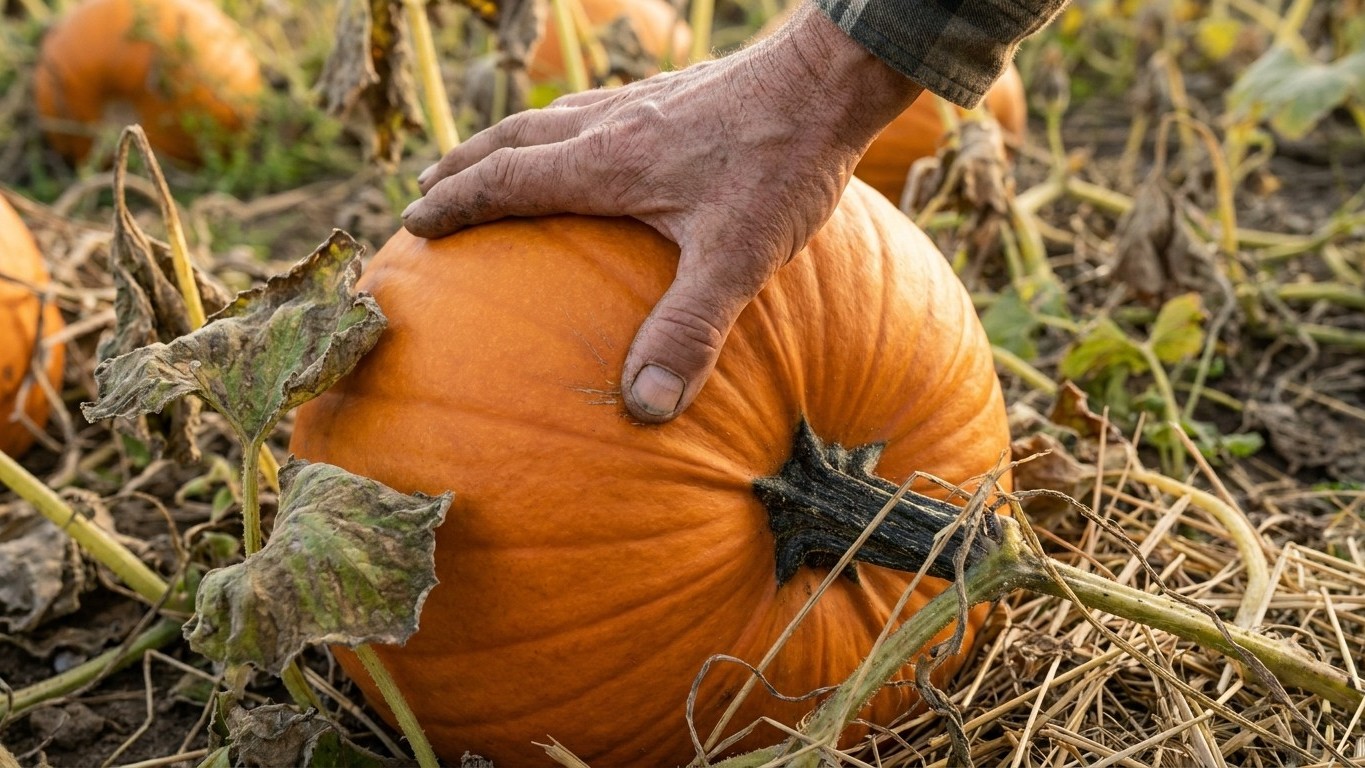

The pumpkin is ready when the skin resists a fingernail, the color has fully turned, and the vine starts to die back. Utah State University Extension lists all three signs, but only one of them actually settles the question on the day you’re standing in the patch deciding whether to cut.
The short answer
Utah State University Extension’s guidance on pumpkins in the garden gives three signs of ripeness, not one. The skin should be hard enough that it doesn’t break easily when you press a fingernail into it. The fruit should be fully colored, meaning the green has finished turning to whatever orange, tan, or other shade the variety produces. And the vine attached to that fruit should begin to die back on its own.
None of those three signs works alone as well as people assume. Color can mislead you. Some pumpkins reach full color while the flesh underneath is still soft and immature, especially in a season with uneven heat. Vine dieback is useful but slow to read, because a vine can look tired from disease, drought stress, or squash vine borer damage long before the fruit itself is actually mature. That leaves the skin. The fingernail test is the one Utah State University Extension frames as the physical check, the one you perform with your hand rather than your eye, and it’s the test that carries the most weight when the other two signs disagree with each other.
Here’s what that looks like in practice. You press a fingernail into the skin near the stem, not on a soft spot or a blemish. If the nail slides in and leaves a dent or breaks the skin, the pumpkin isn’t there yet. If the skin resists and the nail can’t puncture it without real pressure, that fruit has hardened off. Combine that with a good, even color and a vine that’s clearly fading, and you have three signs pointing the same direction. That’s the moment to cut.
What the source does not give you is a calendar date, a days-to-maturity range for this particular check, or a temperature threshold to plan around. Utah State University Extension is describing a physical state of the fruit, not a date on a planting calendar. That’s a meaningful distinction, because a lot of garden advice tries to compress “when is it ripe” into a single number of days after planting, and that number shifts too much with weather, variety, and soil to be reliable on its own. The fingernail test doesn’t care what the calendar says. It tells you what’s true about the fruit in front of you, which is the only thing that actually matters when you’re deciding whether to cut the vine.
What actually decides it
Three signs, one deciding factor. That’s the mechanism worth understanding before you walk out to the patch with a knife.
Color changes first, usually well before the fruit is fully mature. A pumpkin can look finished, fully orange from stem to blossom end, while the rind underneath is still thin and the flesh hasn’t fully developed its sugars or its structure. That’s why color alone is a weak signal. It tells you the fruit has progressed, not that it’s done.
Vine dieback comes later and tells you something real, but it’s a slow and sometimes ambiguous signal. A healthy vine naturally starts to yellow and collapse as the plant redirects its remaining energy into the fruit near the end of the season. But vines also die back from squash vine borer damage, from powdery mildew, from simple exhaustion after a long, hot summer. If your vine is dying back because of a borer problem rather than seasonal maturity, that’s not the same signal Utah State University Extension is describing, even though it looks similar from a distance.
The skin hardness test is the one that resolves the ambiguity, because it measures something the other two signs can’t fake. A soft rind means the fruit hasn’t finished developing the protective layer it needs to survive handling, curing, and storage, regardless of what color it has reached or how the vine looks. A hard rind, one that resists a fingernail pressed with real force, means that protective layer has developed. That’s a physical, mechanical fact about the fruit rather than a visual impression, and it’s the reason the fingernail test functions as the tiebreaker when color and vine condition don’t line up.
This also explains why growers are told to check the skin near the stem rather than on the side facing the sun, or on a spot that’s been resting on damp soil. Sun-facing skin can harden or discolor unevenly, and ground contact softens the rind independent of ripeness. Testing near the stem gives a more representative read of the fruit’s actual condition.
None of this comes with a days-from-flowering figure in Utah State University Extension’s guidance on this particular point, and it shouldn’t be assumed from other crops. The physical test exists precisely because a fixed number of days doesn’t hold up across a season with variable heat, moisture, and vine health.
How to do it
- Press a fingernail into the skin near the stem. Check for resistance. If the nail leaves a dent or breaks through easily, wait.
- Confirm the color is complete. Look at the whole fruit, not just the side facing the sun, since shaded portions color more slowly.
- Check the vine for natural dieback. Distinguish seasonal fading from damage caused by disease or pests, since the two look different up close.
- Cut the stem rather than pulling or twisting the fruit. Utah State University Extension specifies harvesting with the stem attached, so use a sharp knife or pruners and leave the stem intact on the fruit.
- Handle the fruit by the body, not the stem. A stem that snaps off during handling creates an open wound that invites rot, even if the pumpkin passed every ripeness check.
- Move harvested pumpkins somewhere they will not freeze. That is the storage guidance Utah State University Extension gives, without a specific temperature, humidity level, or keeping-time figure attached. Treat that gap honestly rather than filling it with a number borrowed from another crop.
- Sort by intended use before storing. If any of the harvest is going into pie filling or other cooked dishes, remember that Clemson Extension advises selecting sugar pumpkins, described as “a smaller, sweeter variety with close-grained flesh,” rather than the large carving type, whose flesh is thinner and more watery by comparison. A carving pumpkin isn’t inedible, it’s simply the wrong tool for cooking.
What goes wrong
- Cutting based on color alone. A fully orange pumpkin can still have soft, immature skin underneath. Run the fingernail test before cutting, even when the color looks finished.
- Pulling the fruit off instead of cutting the stem. This tears the stem away and leaves an open wound that shortens the fruit’s keeping ability. Always cut with a knife or pruners and leave the stem attached to the fruit.
- Carrying pumpkins by the stem. The stem can snap under the weight, creating the same open-wound problem as pulling the fruit. Support the body of the fruit with both hands instead.
- Storing harvested pumpkins somewhere unheated but exposed to freezing. Utah State University Extension’s only storage instruction is to keep them where they will not freeze. A garage or shed that dips below freezing overnight defeats that guidance even if it feels like reasonable storage.
- Assuming vine dieback always means the fruit is ready. If the vine is collapsing because of squash vine borer damage or disease rather than normal seasonal fading, the fruit underneath may not have finished hardening. Check the skin directly instead of trusting the vine’s appearance alone. Growers dealing with vine collapse from pests should look at dedicated coverage of squash bugs and cucumber beetles rather than assuming dieback equals ripeness.
- Using a carving pumpkin for pie filling and expecting sugar-pumpkin results. Clemson Extension’s distinction is about flesh texture, not edibility. A carving variety will cook, but the “close-grained flesh” of a sugar pumpkin is what produces a better result in cooked dishes.
Common questions
Does the vine need to be completely dead before I harvest?
No. Utah State University Extension lists the vine beginning to die back as one of three signs, not a requirement for total collapse. Combine it with the fingernail test and full color rather than waiting for the vine to be entirely gone.
How long will a harvested pumpkin keep in storage?
That figure isn’t published in Utah State University Extension’s guidance. The only instruction given is to store pumpkins somewhere they will not freeze, without a specific keeping-time, temperature, or humidity attached. Treat any specific number you see elsewhere as coming from a different source, not this one.
Can I still use a carving pumpkin for pie if that’s all I grew?
Yes, it isn’t inedible. Clemson Extension simply recommends sugar pumpkins for cooking because of their “close-grained flesh,” which produces a better texture than the thinner, more watery flesh typical of large carving varieties.
What if the skin passes the fingernail test but the color still looks unfinished?
Give it more time on the vine if the plant is still healthy. Utah State University Extension treats full color as one of three signs, and a fruit that hasn’t finished coloring likely hasn’t finished developing internally either, even if the skin has started to harden.