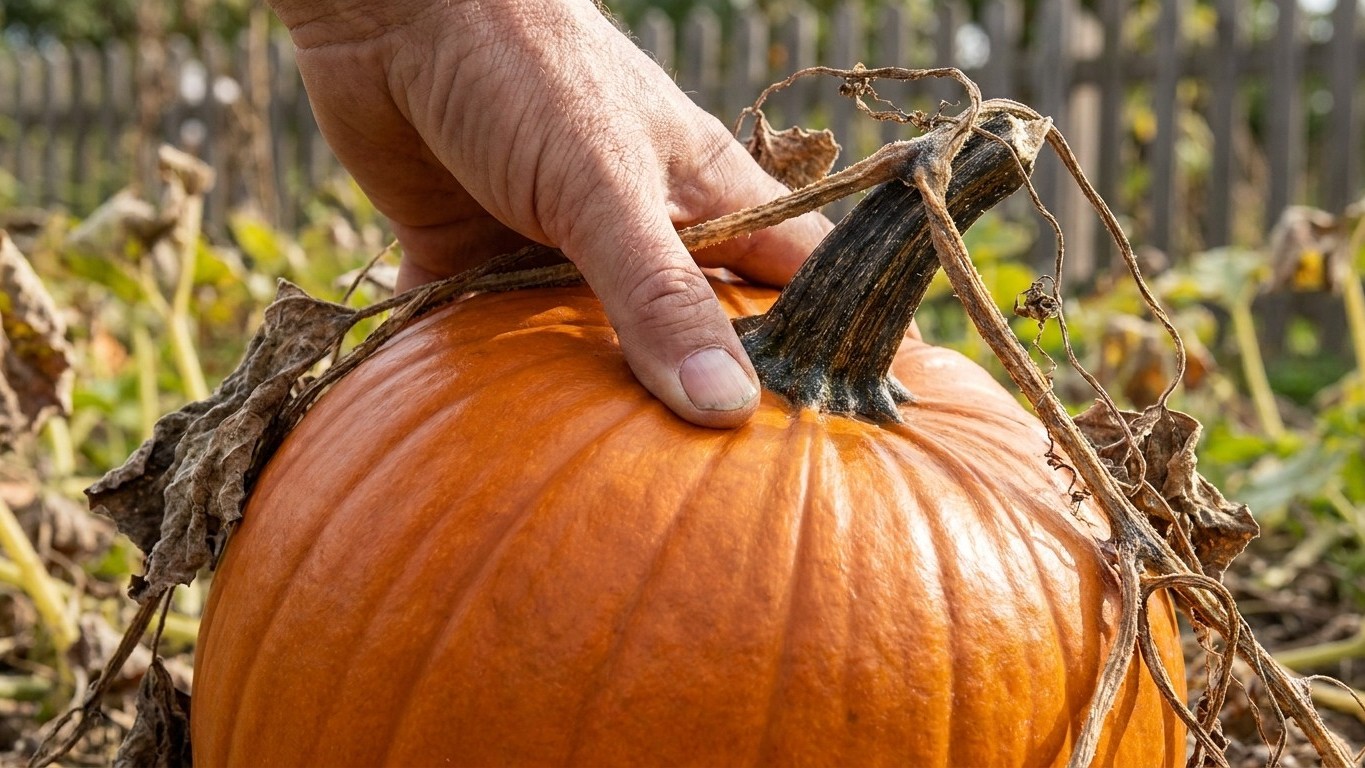

Three signs tell you a pumpkin is close: the skin has fully colored, the vine has started dying back, and the rind resists a fingernail pressed into it. That last one is what actually settles the question. According to Utah State University Extension, a pumpkin is ripe when “the skin is hard and not easily broken when pressure is applied with a fingernail,” alongside full color and a vine that’s begun to die back. Color and vine condition set the stage. The fingernail test makes the call.
The short answer
Growers often lean on color alone, and it’s an understandable habit. A pumpkin that’s gone from mottled green to solid orange (or whatever the mature shade is for that variety) looks done. But color can mislead, especially in years with uneven heat or in fruit shaded by dense foliage. A pumpkin can hold decent color before the rind has actually hardened, and picking at that stage sets you up for a soft spot forming within days.
The vine dying back is the second clue, and it matters because it signals the plant itself is done feeding that fruit. Once the vine attached to a given pumpkin starts to brown and shrivel, that fruit isn’t drawing more sugar or building more rind thickness. It’s telling you the growth phase is over. That’s useful information, but it’s still circumstantial. A vine can die back from disease, drought stress, or a stray injury, none of which means the pumpkin under it is actually mature.
That’s why Utah State University Extension puts the fingernail test at the center of the definition. Press a fingernail into the skin. If it dents easily or breaks through, the rind hasn’t hardened yet and the fruit needs more time on the vine. If the skin resists and the nail can’t puncture it without real pressure, that pumpkin has reached the structural hardness that defines ripeness for storage and handling purposes.
Think of it the way you’d judge a winter squash at a farm stand. You don’t just look at it. You press a thumbnail into the neck to see if it gives. Pumpkins work the same way, and the reason this test outranks the other two is that it measures something the eye can’t: how much lignin and cellulose have actually built up in the rind. Color and vine health are indirect signs of that process. The fingernail test measures the result directly.
None of this requires special equipment. It’s a five-second check you can do while walking the patch, and it’s the difference between a pumpkin that survives handling and storage and one that bruises the moment you set it in a wheelbarrow.
What actually decides it
Three separate signs, three separate mechanisms. Full color is a pigment shift, largely driven by declining chlorophyll as the fruit matures and by temperature and light exposure during the final weeks of growth. It tells you the fruit has moved past its green stage. It says nothing about rind strength.
Vine die-back is a plant-level signal. As a pumpkin plant nears the end of its productive cycle, especially on the runner feeding a specific fruit, the foliage and stem tissue near that fruit begin to senesce. Nutrients and water are no longer being routed there in the same volume. This is useful context for a grower watching a patch through its final weeks, but it’s an environmental and physiological cue that can be thrown off by heat stress, pest damage, or a wet season that delays natural die-back even after the fruit itself is mature.
Why hardness is the deciding factor
The fingernail test measures rind hardness directly, and that’s precisely the trait that determines whether a pumpkin will survive being lifted by its stem, stacked with others, or stored for weeks. A soft rind bruises on contact. A hardened rind resists the small dents and scrapes that come with normal handling. Utah State University Extension frames the test in exactly those terms: “hard and not easily broken when pressure is applied with a fingernail.” That phrasing isn’t about appearance. It’s about structural readiness.
Here’s the practical logic: color can arrive before hardness, and vine die-back can arrive for reasons unrelated to fruit maturity. Hardness can’t be faked by outside conditions the same way. A pumpkin either has a rind that resists a fingernail or it doesn’t. When the three signs disagree, and growers report this more often than you’d expect, the fingernail test is the tiebreaker. If the skin’s colored, the vine’s browning, but a nail still sinks into the rind without much resistance, that pumpkin needs more time.
This is also why a single walk-through of the patch, checking color from a distance, isn’t enough. You have to get hands-on with the fruit itself. The other two signs help you decide which pumpkins are worth testing on a given day. The fingernail test is what actually confirms readiness.
How to do it
- Scan the patch for color and vine condition first. Walk the rows and note which pumpkins have reached full, even color and which have a vine at the base showing die-back. This narrows down which fruit are candidates for testing, rather than pressing on every pumpkin in the patch.
- Press a fingernail firmly into the rind. Choose a spot on the shoulder or side of the pumpkin, away from any existing blemish. Apply real pressure, not just a light scratch.
- Read the result. If the nail dents the skin easily or breaks through, the rind hasn’t hardened. Leave that fruit on the vine and check again in a few days. If the skin resists and holds firm against the pressure, it meets the standard Utah State University Extension describes.
- Harvest with the stem attached. Cut the fruit free from the vine in a way that leaves the stem intact on the pumpkin itself. A pumpkin missing its stem is far more vulnerable to rot starting at that open wound.
- Move it somewhere it won’t freeze. Utah State University Extension’s guidance on storage is limited to that single condition: keep harvested pumpkins where they will not freeze. No specific temperature, humidity level, or keeping-time figure is published in that guidance, so don’t treat a number borrowed from another crop as if it applies here.
- Handle gently from that point forward. Even a rind that’s passed the fingernail test can still be dented by rough handling, dragging, or stacking pumpkins directly on top of each other.
What goes wrong
- Judging ripeness by color alone. A pumpkin can look fully orange while the rind is still soft enough for a fingernail to sink in without resistance. The remedy is simple: always run the fingernail test before cutting, regardless of how finished the color looks.
- Trusting vine die-back as proof on its own. A vine can brown from disease, heat stress, or mechanical damage well before the fruit it’s feeding is actually mature, and it can also stay green for a while after the fruit is ready. Use it as a prompt to go check the fruit, not as the final verdict.
- Cutting the stem off, or too close to the fruit. A pumpkin harvested without its stem, or with only a stub left, loses one of its natural barriers against rot entering at that point. Cut with enough stem left attached that the wound is well away from the fruit’s surface.
- Storing pumpkins where they can freeze. A hardened rind still won’t protect a pumpkin from cold-damaged flesh if it sits somewhere temperatures drop below freezing. The only storage instruction that’s actually published here is to keep the fruit somewhere it won’t freeze; treat that as the floor, not a suggestion.
- Assuming a published keeping-time or humidity number exists. It doesn’t, at least not in this guidance. If you’ve seen a specific storage duration or humidity range attached to pumpkins elsewhere, know that it isn’t part of what Utah State University Extension states here, and don’t apply it as if it carries the same authority.
- Skipping the fingernail test on fruit that looks obviously unripe or obviously ripe. Borderline cases are exactly where growers get it wrong in both directions, either picking too early out of impatience or leaving fruit on the vine past the point it needed to come off. The test takes seconds and removes the guesswork either way.
Common questions
Can I use just one of the three signs instead of checking all three?
You can look at color and vine condition first to decide which pumpkins are worth checking, but the fingernail test is what Utah State University Extension identifies as the deciding factor. Skipping it and relying on color or vine die-back alone increases the odds of harvesting fruit that isn’t structurally ready.
Does the stem need to stay attached forever, or just through harvest?
The guidance is to harvest with the stem attached, which protects the fruit from that point forward. A pumpkin that loses its stem later, through breakage or handling, becomes more vulnerable at that opening, so keeping the stem intact through storage and display is worth the extra care.
What temperature should I store pumpkins at?
Utah State University Extension’s published guidance doesn’t include a specific temperature, humidity level, or keeping-time figure. The instruction given is to store pumpkins “where they will not freeze.” Beyond that single condition, no further storage figure is stated in this source.
Is a hard rind the same as a fully ripe pumpkin?
A hard rind is one of three signs Utah State University Extension lists, alongside full color and vine die-back, but it’s described as the one that settles the question when pressure from a fingernail fails to break the skin. All three together describe a mature fruit, with rind hardness serving as the final confirmation.