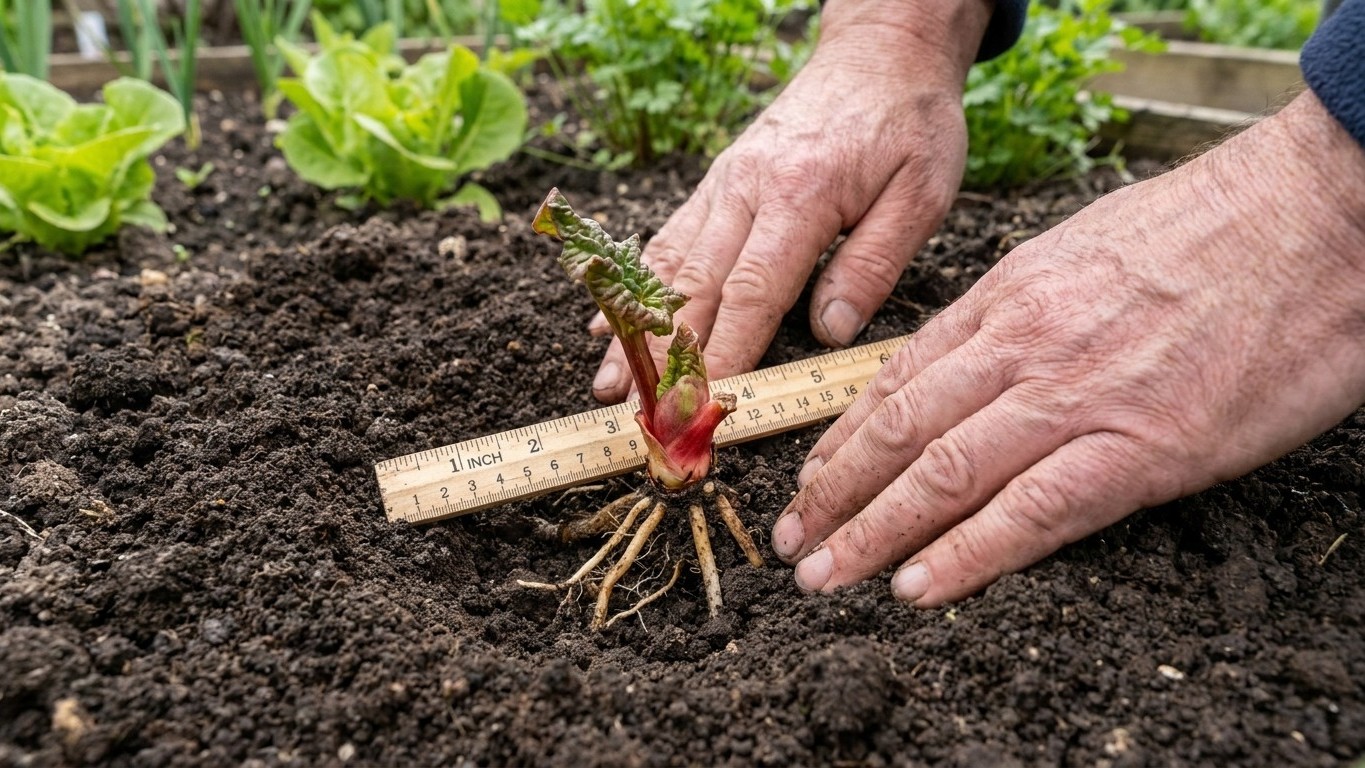

One inch. That’s the exact depth Utah State University Extension recommends for covering a rhubarb crown, and it’s the single number that separates a plant that thrives for a decade from one that never leafs out. Go deeper and you risk delayed maturity, even outright plant death. Rhubarb isn’t started from seed in the garden; it’s planted from crown cuttings, called “starts,” and depth is the first decision that matters.
The short answer
Utah State University Extension is blunt about it: plant a rhubarb crown “so that the leaf bud is 1 inch beneath the soil,” and “cover crowns with no more than 1 inch of soil.” That’s the whole instruction. Not two inches, not “cover generously.” One inch, measured from the soil surface down to where that leaf bud sits, and no more soil piled on top than that.
The cutting itself is worth understanding before you touch a shovel. Rhubarb is almost always purchased as starts, cuttings taken from healthy crowns. Extension says a good cutting “should have at least one leaf bud on top and healthy roots on the bottom.” When you’re choosing one, look for “cuttings with a large leaf bud on the top surface and undamaged root(s) underneath.” A cutting without a visible bud, or one with torn or dried roots, is already starting at a disadvantage before depth ever enters the picture.
Once you have that cutting, the planting sequence is simple: position it so the leaf bud sits one inch under the surface, cover it with no more than an inch of soil, press that soil down firmly around the crown, then water it in well. Extension’s language on what happens if you skip past that inch is not soft. “Planting crowns or established plants excessively deep delays maturity and can result in plant death.” Two outcomes, both bad, and both traced back to a measurement most gardeners would consider too small to matter.
Here’s why it matters more than it looks like it should. Rhubarb already asks for patience. A newly planted crown typically needs a full growing season, sometimes two, before it’s established enough to support a real harvest. An inch of extra soil on top of the bud doesn’t just slow things down a little. It can cost the plant an entire season of growth, or cost you the plant itself. When the reward for correct planting is a perennial bed that can produce for years, an inch of carelessness is an expensive mistake.
What actually decides it

The leaf bud’s need for light and air
The leaf bud is the growing point, the part of the crown that has to push a shoot up through the soil before the plant can photosynthesize and feed itself. Bury that bud too deep and the shoot has farther to travel, burning through the crown’s stored energy before it ever reaches sunlight. A bud sitting exactly one inch down has a short, manageable trip. A bud sitting three or four inches down may exhaust its reserves before it breaks the surface, which is the mechanical reason Extension’s language jumps straight from “excessively deep” to “plant death” without much in between.
Soil moisture and crown rot at depth
Depth also changes what’s happening around the crown after you water it in. Soil that sits directly over a buried crown holds moisture longer than the surface layer, and a crown sitting in consistently damp soil is more prone to rot. Extension’s instruction to press soil firmly around the crown and water well isn’t just about anchoring the plant; it’s about settling the soil so it doesn’t stay loose and waterlogged right where the crown needs to breathe.
Compost depth: preparing the six inches that matter
The one-inch rule only works if the soil beneath it is already in good shape. Extension recommends that before planting, gardeners “control all perennial weeds and incorporate 2 to 4 inches of well composted organic matter 6 inches deep.” That’s a separate measurement from the planting depth itself, but it sets up the root zone the crown will spend years growing into. Skip that step and even a perfectly measured one-inch planting depth is sitting on compacted, weed-choked ground that can’t support the root system Extension expects rhubarb to develop.
Containerized plants follow the same rule
For gardeners starting with a containerized rhubarb plant rather than a bare crown cutting, the depth principle carries over directly. Extension instructs growers to “cover the top of the root-ball with 1 inch of garden soil,” the same one-inch ceiling that applies to crown cuttings. The plant form changes; the depth math doesn’t.
How to do it
- Choose a sunny site and control all perennial weeds before doing anything else, since established weeds will compete with a young rhubarb crown for years if left in place.
- Incorporate 2 to 4 inches of well composted organic matter into the soil, working it in 6 inches deep so the root zone has loose, fertile ground to grow into.
- Plant early in spring, before new growth begins, while the crown is still dormant.
- Space plants every 3 feet in a row, with rows set 4 feet apart, since mature rhubarb grows over 3 feet in height and width and needs room so it doesn’t crowd out other crops.
- Select a cutting with a large leaf bud on the top surface and undamaged roots underneath; reject any cutting missing a visible bud or showing damaged roots.
- Position the crown so the leaf bud sits 1 inch beneath the soil surface.
- Cover the crown with no more than 1 inch of soil, matching the same 1-inch rule for containerized plants, whose root-ball should be covered with 1 inch of garden soil.
- Press the soil firmly around the crown to settle it against the roots.
- Water well immediately after planting to help the soil settle further and give the crown the moisture it needs to start rooting.
What Goes Wrong
- Crown planted too deep. This is the failure Extension warns about directly: excessive planting depth delays maturity and can kill the plant outright. The remedy is prevention rather than correction, since a crown already buried too deep is hard to fix mid-season; measure to the leaf bud before covering, and stop at 1 inch of soil on top.
- Cutting purchased with no visible leaf bud or damaged roots. A crown lacking a large top bud or showing torn roots underneath starts the season already compromised. The fix happens at selection, not after planting: choose only cuttings with a clear leaf bud and intact roots.
- Soil never prepared before planting. Skipping the incorporation of 2 to 4 inches of composted organic matter 6 inches deep, or leaving perennial weeds in place, sets a crown into compacted or contested ground. The remedy is to prepare the bed properly before the crown ever goes in; it’s far harder to amend soil around an established rhubarb plant later.
- Plants crowded closer than recommended. Rhubarb spreads over 3 feet in height and width at maturity. Planting closer than every 3 feet, or rows tighter than 4 feet apart, invites competition for light and root space as the plants fill in. The remedy is spacing correctly from the start, since transplanting a mature crown to fix crowding is disruptive to an established root system.
- Thin stalks on an otherwise growing plant. This symptom can trace back to more than one cause. If the crown was planted too deep, the plant may be putting most of its limited energy into simply reaching the surface, leaving little for stalk thickness. If plants are overcrowded past the recommended 3-foot spacing, competition for light and nutrients can also produce thinner stalks. And if the plant is still young, simply not yet established, thin stalks may reflect a root system that hasn’t matured enough to support thick growth, which correcting depth and spacing at planting time helps prevent going forward.
Common questions
Does rhubarb grow from seed or from crowns?
Rhubarb in the home garden is almost always started from crown cuttings, not seed. Utah State University Extension describes these cuttings as coming from healthy crowns, each with at least one leaf bud on top and healthy roots on the bottom. Home gardeners should look for a cutting with a large leaf bud and undamaged roots rather than sowing seed.
How deep should a containerized rhubarb plant be set in the ground?
The same 1-inch rule applies. Extension instructs gardeners to cover the top of the root-ball with 1 inch of garden soil, matching the depth used for bare crown cuttings.
Are rhubarb leaves safe to eat?
No. The leaves contain oxalic acid and are toxic if eaten, causing sickness and, in serious cases, kidney failure. Livestock are susceptible too. The stalks are the edible part of the plant; the leaves should be discarded, not composted into anything intended for consumption or fed to animals.
How long should canned rhubarb be processed at high altitude?
This is a national canning guideline rather than a rhubarb-specific one: jars should be processed for 20 minutes at elevations between 1,000 and 6,000 feet, and for 25 minutes above 6,000 feet, to ensure safe preservation.