
Meta description: Growing roses in pots means solving three things ground-grown bushes don’t face: how deep the container needs to be, what the compost has to do, and how the root zone survives winter when it’s not insulated by open ground.
A rose in a container lives with less soil buffering its roots than the same plant would have in a bed, so every decision about depth, mix, and winter cover carries more weight. Get the pot and the compost right and a rose can thrive for years in a container. Get them wrong and the plant limps along, undersized and stressed, no matter how much you feed it.
Why this matters
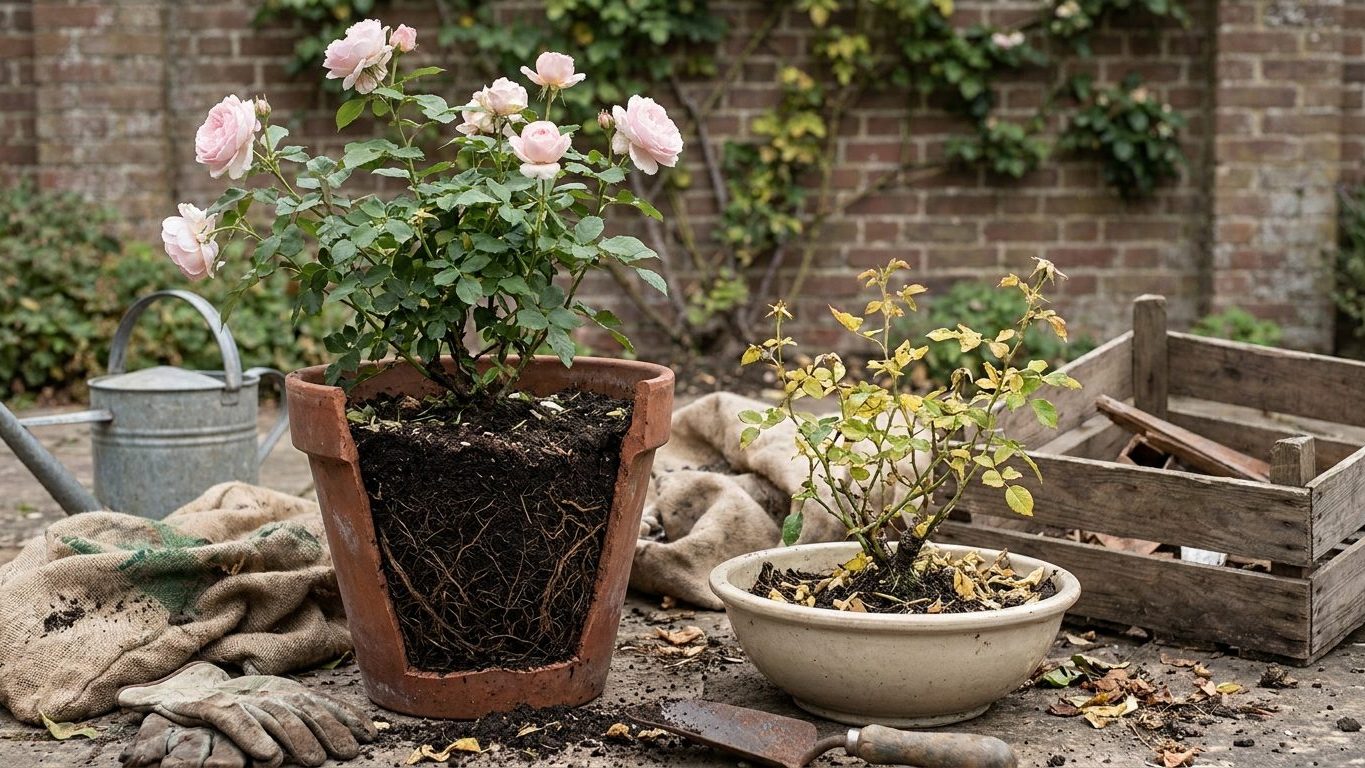
Roses root downward, not outward, which is the opposite of how a lot of container plants grow. That single fact should drive every pot decision: depth matters more than width. A wide, shallow pot looks generous but starves a rose of the vertical root run it actually wants, while a container that’s deep enough lets the plant establish the way it would in open ground, even if the diameter is modest.
Skip this and the consequences show up fast. A rose in a too-shallow pot dries out between waterings because there’s less soil volume holding moisture near the roots that matter. Use garden soil instead of a proper compost-based mix and drainage suffers, pushing the soil toward the alkaline end of the acceptable range (the genus tolerates acid, below 6.0, through neutral, 6.0 to 8.0) and past roughly 7.5 you start seeing iron chlorosis, the yellowing between leaf veins that no amount of fertilizer fixes. And because a container has no surrounding earth to buffer temperature, the same rose that survives winter fine in the ground can lose its root union or crown to a hard freeze once it’s isolated in a pot above grade.
When to do it
There’s no calendar date that works nationally here, since a container rose’s schedule depends on the reader’s own hardiness zone (roses as a genus span USDA zones 5a through 11b) and on how far along the plant’s growth is, not on the month.
Repot when roots start circling the drainage holes or when growth has visibly slowed despite regular feeding, both signs the current pot has run out of room. The best window is between growth flushes, after one bloom cycle has finished and before the next round of new shoots takes off, so roots aren’t disturbed while actively pushing new growth. For winter prep, wait until the leaves have dropped and the wood has ripened, meaning the canes have hardened rather than staying soft and green; moving a plant into shelter while it still carries soft growth does the rose no favors. Check the plant’s tag first, because a budded rose protects the graft union while an own-root rose protects the crown instead, and that changes exactly where you’re aiming the insulation. For zone-specific dates and depths, the state pages under the main rose growing guide carry those specifics; this page can’t, since they vary by region.
How to do it
Start with the container itself. Choose a pot that’s deep before you worry about width, since a rose’s root system runs down more than it spreads sideways. Whatever material you pick, drainage holes are non-negotiable: a rose sitting in standing water develops root rot regardless of how good the compost is above it.
Building the mix
A container mix for roses should be loam-based rather than pure garden soil, which compacts in a pot and squeezes out the air roots need. A practical blend combines:
- A loam-based potting compost as the bulk of the mix, since roses tolerate clay or loam in the ground and do best with something similar in structure in a pot
- Coarse grit or perlite worked through the mix to keep drainage open
- A slow-release, rose-specific fertilizer mixed in at planting, since container feeding washes out faster than in open ground
Test the mix’s pH if you can. The acceptable band runs from acid, below 6.0, through neutral, up to 8.0, and staying inside that range matters more in a container, where there’s no surrounding soil to moderate an extreme.
Planting and settling in
Set the rose so the graft union (on a budded plant) or the crown (on an own-root plant) sits at the same depth it was growing before, not buried deeper just because the new pot has room. Backfill around the roots with the mix, firming gently as you go so there are no large air pockets, then water thoroughly until it runs from the drainage holes. That first deep watering settles the compost around the roots better than any amount of hand-firming.
Winter protection in a pot
A container rose’s roots are exposed on every side, not just the top, which is why potted plants need more insulation than the same variety in the ground at the same zone. Once the wood has ripened and leaves have dropped, move the pot against a sheltered wall or into an unheated garage or shed if your zone calls for it, mound extra compost or mulch over the union or crown depending on what the tag says, and consider wrapping the pot itself, since cold reaches roots through the container walls in a way it never does through open soil. The state-level pages linked from the main guide carry the depth and timing specifics for your zone, since a plant in zone 5a needs far more cover than one in zone 9b.
What goes wrong
The single most common failure is a pot that’s wide but shallow, chosen because it looks proportionate to a mature shrub rather than because it fits how roses actually root. The plant survives but never thrives, drying out fast because the soil volume near the working roots is too small.
Using ordinary garden soil instead of a loam-based container mix is the second big one. It compacts over a season or two of watering, drainage slows, and the plant starts showing the yellowing between veins that signals alkaline drift. Overwatering looks like extra care but isn’t: gardeners worried about a container drying out often water on a fixed schedule rather than checking the soil, and a rose sitting in soggy compost develops root problems that later show up as wilting, which then gets misread as a need for even more water.
Wrapping the pot or moving it into shelter too early, before the wood has actually ripened, traps moisture around leaves and canes that are still soft, creating exactly the damp, still conditions that favor botrytis and powdery mildew. And feeding late into the season pushes a last flush of soft growth that has no time to ripen before cold arrives, the opposite of what winter protection is supposed to achieve. Skipping the tag check on graft union versus own-root crown means protecting the wrong point on the plant, insulating a spot that never needed it while leaving the vulnerable one exposed.
Doing it differently
Not every rose belongs in a container, and the difference isn’t cosmetic. Miniature roses and many ground cover types, which stay smaller within the genus’s documented 1 to 8 foot height and 1 to 6 foot width range, adapt well to pot culture because their root systems match a container’s limits. A large old garden rose or a vigorous rugosa bred for open-ground spread is fighting its own nature in a pot, no matter how deep the container is.
Climbing roses can work in containers, but they need the pot anchored and paired with a freestanding support, since the plant’s height quickly outgrows whatever the container alone can stabilize; practical setup options are covered separately under climbing rose supports. Ramblers, which flower from old wood, and climbers, which flower from new wood, also need different pruning timing once established in a pot, which affects how much wood you’re carrying into winter.
A raised bed sits between a container and open ground: more root run than a pot, but still somewhat exposed compared to a full in-ground planting, so winter cover still matters more than for a rose planted directly in a border. Whichever method you choose, recurring pest and disease trouble, from powdery mildew to black spot, tends to show up regardless of container or bed, and the common patterns are broken down on the rose problems page.
Common questions
What size pot do roses actually need?
No single measurement is published here, because it depends on the cultivar’s mature size, which for the genus ranges from 1 to 8 feet tall and 1 to 6 feet wide. The rule that holds regardless of variety is depth before width, since roses root downward rather than spreading laterally.
Can a potted rose stay outside all winter?
It depends on your hardiness zone, and roses as a genus are documented across zones 5a through 11b, but container roots are exposed on all sides in a way in-ground roots aren’t, so a potted rose generally needs more insulation than the same variety planted in a bed in the same zone.
What compost mix works best for roses in containers?
A loam-based potting mix with added grit or perlite for drainage, kept within the documented pH range of acid (below 6.0) to neutral (6.0 to 8.0), gives roots the structure and airflow that plain garden soil doesn’t hold up in a pot over time.
Are rose thorns dangerous around a patio or walkway pot?
They’re prickles, not true thorns: they grow from the outer skin of the stem, which is why they snap off sideways instead of breaking like a woody, modified stem would. They can still scratch, but they aren’t the structural thorn the word implies.