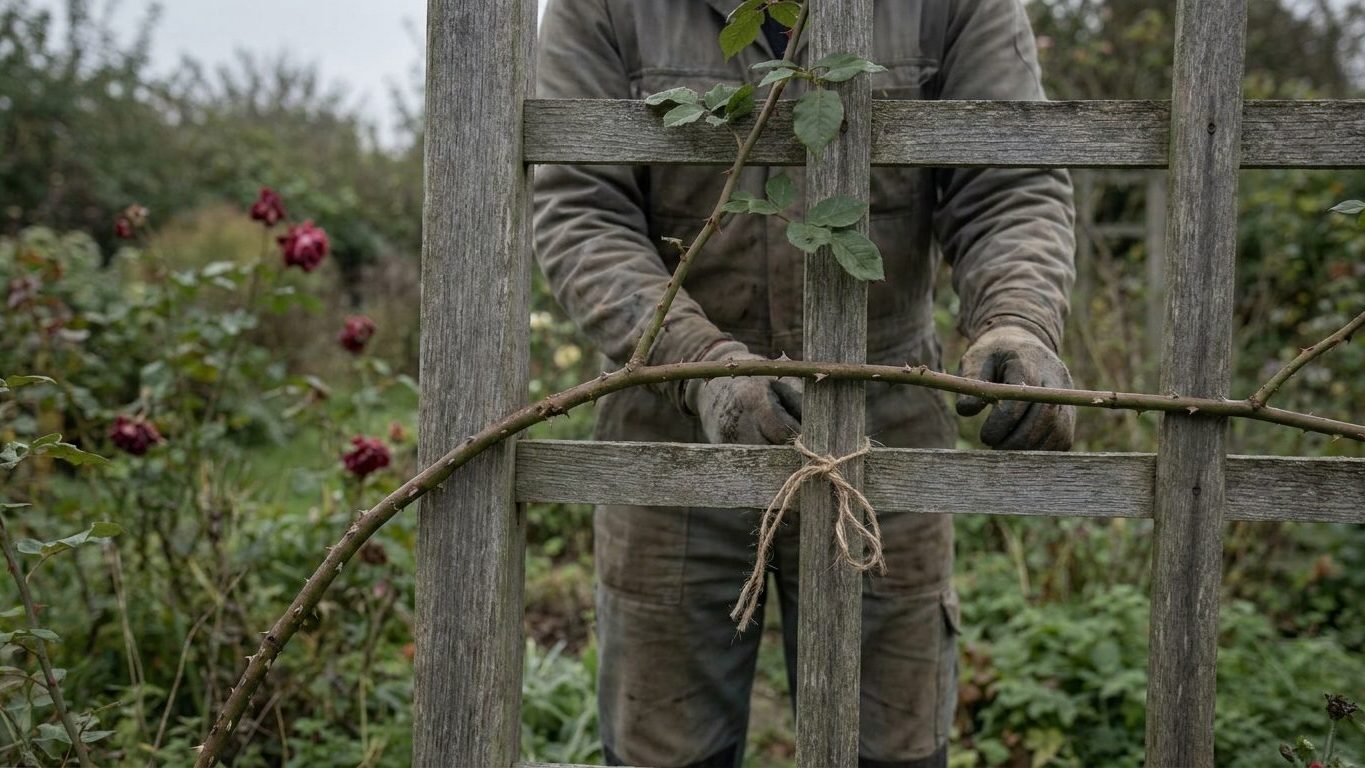

Training a climbing rose means fixing its canes to a support and guiding them horizontally rather than letting them shoot straight up. Bending the main canes to near-horizontal breaks the plant’s habit of pushing all its energy into one tall tip, forcing flowering side shoots along the entire length instead. Ties go just below a leaf node, loose enough to allow the cane to thicken, and get checked every few weeks through the growing season.
Why this matters
A climbing rose has no tendrils and no way to grip a wall or trellis on its own. The long canes will lean on whatever they touch, using their prickles more like hooks than anchors, but they need a person to place them where they’ll actually flower. Bending a cane toward horizontal is the single biggest lever a home gardener has over bloom count on a climber, because it interrupts the plant’s tendency to send all its growth energy to the tip of the cane and instead pushes dozens of shorter flowering laterals along the whole run.
Skip this step and the plant still grows, just badly for the purpose you planted it for. Canes trained straight up a post concentrate flowers in the top few feet while the base stays bare and woody. A tangled, untrained mass at the base also blocks airflow, which raises the risk of the diseases already documented on roses: powdery mildew, black spot, and botrytis all take hold faster where canes are crowded and wet air can’t move through. Since climbers bloom on new wood, an untrained plant often channels its effort into height instead of the flowering side shoots you actually want.
When to do it
Watch the cane itself, not the calendar. A young cane is still green, flexible, and bends without resistance. As it ripens into woody tissue it stiffens, and past that point bending it sharply will crack the bark instead of curving it. Train while the wood is still soft enough to arc, not once it has hardened into a rigid, brittle cane.
The other cue is growth stage rather than season. New basal canes that shoot up from the base after the plant is established, or after the yearly late-winter pruning most roses need, are the ones to place on the support first. Established framework canes already tied in place mostly stay put, you’re really training the newest growth each year as it appears. Because the right window shifts with your climate and USDA zone, the exact timing for that annual pruning and training pass is a local question, best answered on your state’s own rose guide rather than a single national date.
If you’re unsure whether a shoot is worth training at all, check where it emerged. A vigorous cane rising from below the graft union on a budded rose is a rootstock sucker, not a flowering cane, and training it in wastes a tie on growth you’ll eventually want gone. The guide to rose suckers covers how to tell the two apart before you commit a season of ties to the wrong stem.
How to do it
Install the support before you start bending canes, not after. A trellis, a set of horizontal wires on eye bolts, or an arbor all work, as long as the framework is fixed to something solid rather than a fence panel that will flex in wind. Space horizontal wires roughly a forearm’s length apart, about 12 to 18 inches, up the height of the support.
From there, the process runs in a few repeatable steps:
- Pick the framework canes. Choose 3 to 5 of the strongest, healthiest canes coming from the base to act as the permanent skeleton, and remove thin, crossing, or damaged growth so it doesn’t compete for space on the support.
- Bend gently, don’t force. Curve each framework cane into a gentle arc toward horizontal, following a fan shape or a loose serpentine along the wires. Stop bending the moment you feel resistance rather than pushing past it.
- Tie below a leaf node. Use a soft material, jute twine, cloth strips, or a flexible rubber tie, looped in a figure eight so the cane can still move and thicken without the tie cutting in.
- Space the ties as you go. One tie roughly every foot of new growth keeps the cane secured without over-tying, and it’s easier to adjust a few loose ties than to unwind one tight one later.
- Let side shoots stand upright. The vertical shoots that sprout off a horizontal main cane are the flowering wood. Leave them growing up rather than tying them down, and give them a light cut back to a few buds during the plant’s yearly pruning, since climbers flower from new wood on that framework.
Done right, a trained climber looks like a fan or lattice, with the oldest canes running near-horizontal close to the base and younger vertical shoots studded evenly along their length. Nothing should be crossing, rubbing, or bunched at a single point on the support. Wear gloves throughout, since prickles on established canes are sharp enough to tear skin even though, structurally, they’re outgrowths of the stem’s outer skin rather than true woody thorns.
Field tip: revisit ties during active growth, not just once a year. A tie that fit fine in spring can be buried in bark by midsummer as the cane thickens, and loosening it early costs nothing compared with cutting out a girdled cane later.
What goes wrong
The most common failure is a tie left too tight for too long. As the cane thickens season over season, a snug tie doesn’t stretch with it, and the tissue swells above the constriction while sap flow below it slows. The cane often dies back above that point, which can look like disease damage but is really a tying problem. Check any tie showing a visible bulge on either side.
Training every cane straight up rather than toward horizontal is the second common error, and it’s the one that quietly limits flowering for years without ever looking like a mistake. All the blooms end up clustered in the top few feet, the base stays woody and bare, and the plant appears healthy the whole time.
The mistake that looks like extra care but isn’t: pruning off the vertical side shoots along the framework because they seem messy or overgrown. Those shoots are the flowering wood on a climber. Removing them in the name of tidiness trades this year’s blooms for a neater-looking cane structure, and it’s an easy trap for a gardener trying to do a thorough job.
Rigid wire ties or zip ties cause the same girdling problem as an old, forgotten tie, only faster, since they don’t give at all as the cane grows. And training a rootstock sucker into the framework by mistake means investing a season of ties into growth that won’t carry the flowers you planted the rose for in the first place, one more reason to check the base of the plant before deciding what to train.
Doing it differently
A climbing rose in a container needs its own free-standing support, since there’s usually no fence or wall within reach. An obelisk or tripod tied firmly into the pot’s structure works, though the limited root space also caps how large the plant will get, so a compact climbing cultivar suits a container better than one bred for a wide wall. The guide to rose types covers how climbing habits differ across cultivars if you’re choosing one for a pot.
Against a wall or solid fence, eye bolts with horizontal wire let you fan canes wide with a gap for air movement behind them, which matters given how readily powdery mildew and black spot spread on canes held tight against a damp surface.
Rambling roses get a genuinely different approach, not just a variation. Because ramblers flower from old wood while climbers flower from new wood, a rambler’s older canes are kept in place for years as the main flowering structure, rather than renewed annually the way a climber’s framework is. Mixing the two training styles up is a common source of disappointing bloom on whichever type gets the wrong treatment. For the full picture of how climbing, rambling, and the other rose groups differ in growth habit, the main rose guide and the rose types overview lay out where each one fits.
Common questions
Are rose thorns dangerous?
They can scratch and puncture skin, but technically they’re prickles, not true thorns. Prickles grow from the outer skin of the stem, which is why they snap off sideways rather than staying rigid the way a true woody thorn would.
Do I need to tie a climbing rose every year, or just once?
It’s an ongoing task. New canes appear each growing season and need placing on the support while they’re still flexible, and existing ties need periodic loosening as canes thicken to avoid girdling.
Can I train a climbing rose flat against a wall?
Yes, using wires or a trellis fixed a few inches off the surface with eye bolts. That gap keeps air moving behind the canes, which lowers the odds of powdery mildew and black spot taking hold in the still, damp air right against the wall.
What’s the difference between training and pruning a climbing rose?
Training is where you place the canes on the support, pruning is what you cut. Most roses need a yearly pruning pass in late winter, and the exact timing depends on your USDA zone, which is a question for your state’s own guide rather than a single date that applies everywhere.