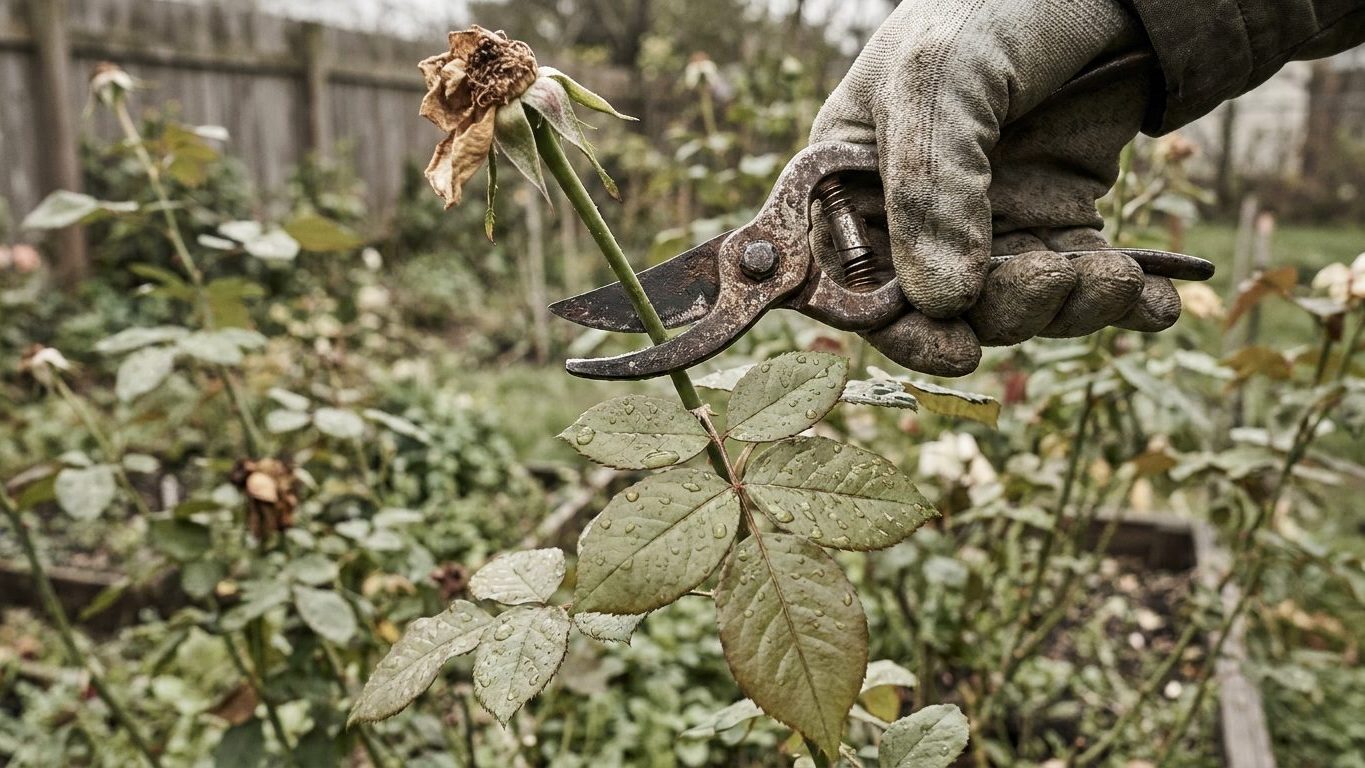

Cut just above the first five-leaflet leaf below the spent bloom, angling the cut so water sheds away from the new bud. Do this through the growing season on repeat-flowering roses, then stop about a month before your area’s first frost so the plant can shift its energy into ripening wood instead of pushing soft new shoots.
Why this matters
Every deadheading cut is a signal to the plant, not just tidying. Leave a spent bloom on the stem and the rose puts energy into forming a hip, an accessory fruit that eventually turns from green to red. That’s a dead end for repeat bloom: the plant has finished its reproductive job and slows down on new flower production. Cut the spent bloom off correctly, and the plant reads it as an invitation to send out another flowering shoot instead.
Skip deadheading, or do it badly, and the effects show up fast. A once-blooming or once-flowering rose won’t be affected much either way, but repeat bloomers on once-a-season shrubs will visibly taper off. Cut in the wrong spot, and the answer is often a weak, spindly shoot that takes weeks to produce a bud, if it produces one at all. This isn’t cosmetic maintenance. It’s the mechanism that keeps a repeat-flowering rose repeating.
When to do it
The trigger isn’t a date on the calendar, it’s the flower itself. Once the petals have dropped, curled brown, or turned to mush after rain, that bloom is done contributing anything to the plant’s appearance and it’s time to cut. Some gardeners deadhead earlier, as soon as petals start to fade, to keep the bush looking clean and to redirect energy sooner rather than later.
Watch for the shift from flower to fruit. As petals fall, the base of the bloom (the receptacle) starts to swell if left alone. That swelling is the first visible sign the plant is committing to hip formation instead of another flush of bloom. Catch it before that swelling gets very far and you lose almost nothing in terms of redirected energy.
There’s also a stopping point, and it matters as much as the starting one. Every deadheading cut pushes a new shoot, and a new shoot needs time to grow, flower, and ripen before cold weather arrives. Stop deadheading toward the end of summer so any late growth has a chance to firm up rather than staying soft and vulnerable. The exact timing depends on your USDA hardiness zone, since roses are documented as hardy from zone 5a through 11b and the length of the growing season varies enormously across that range; check your state page for the specific cutoff window that applies where you garden.
How to do it
The tool matters more than most people assume. A clean pair of bypass pruners, not anvil-style shears, makes a precise cut without crushing the stem tissue. Crushed tissue heals slower and invites disease in. Wipe the blades with rubbing alcohol between plants, especially if you’ve been working around anything showing leaf spots or powdery mildew, so you’re not moving disease from one bush to the next on the blade itself.
Finding the right leaf
Rose leaves further down the stem often have three leaflets; the ones you want have five. That’s not a coincidence. This site’s documented anatomy notes that rose flower parts, and much of the plant’s structure, run in multiples of five, and the five-leaflet leaf marks a node with a strong, well-developed bud eye behind it. Trace the stem down from the spent bloom until you hit the first leaf with five leaflets. That’s your target, not the first leaf you see, and not just a snip below the petals.
Making the cut
Cut about a quarter inch above that five-leaflet leaf, angled at roughly 45 degrees so the high side of the cut is above the bud and the low side slopes away from it. This angle lets rain run off instead of pooling on the cut surface, which reduces the chance of rot setting in at a fresh wound. Cutting too close to the bud can damage it; cutting too far above leaves a stub of dead wood that has to die back on its own before the plant seals it off.
Done correctly, the cut surface should look pale and slightly moist, not shredded or crushed. Within a week or two you should see a new bud swelling just below the cut, right at the leaf axil you chose. If nothing happens after a couple of weeks in the growing season, check whether you cut into old, woody stem rather than a section that was still actively growing.
Handling prickles and hips as you go
The sharp structures along rose stems are prickles, not true thorns. They grow from the outer skin of the stem, which is why they can be rubbed off with a thumbnail, unlike a true thorn, which is a modified woody stem. That distinction matters for the job at hand mostly in practical terms: wear gloved hands anyway, since a snapped-off prickle can still leave a splinter-like point, but don’t expect leather gauntlets to be strictly necessary on a lightly-prickled cultivar.
If you deliberately leave some blooms unclipped late in the season to form hips for fall color or wildlife interest, that’s a legitimate choice, not a mistake, as long as you understand you’re trading it against further bloom on that stem. Hips are edible and shift from green to red as they mature.
What goes wrong
The most common error is cutting right below the flower head, at the first leaf, regardless of how many leaflets it has. That first leaf is often a three-leaflet leaf with a thin, underdeveloped bud behind it. The resulting shoot is weak, sometimes it doesn’t break at all, and the plant wastes a cycle of growth on a dead-end stub.
The mistake that looks like extra care but isn’t: deadheading too late into the season, chasing every last spent bloom right up to the first hard frost warning. Every cut is an invitation for a new shoot, and a shoot pushed out that late has no time to ripen. Soft, unripened growth is exactly what gets killed back hardest over winter, sometimes taking healthy wood below it down too. Stopping deadheading earlier, even though it feels like you’re neglecting the plant, is the more disciplined move.
Another frequent error is stripping every dead-looking stem down to the crown while deadheading, on the theory that tidier is better. Dead stems cut back to 12-24 inches and left standing provide nesting sites for stem-nesting native bees. Removing all of it removes habitat for no horticultural benefit. Deadhead the spent blooms; leave the standing dead stem structure alone unless it’s diseased or a safety hazard.
Doing it differently
Container-grown roses often need slightly more frequent deadheading than the same cultivar in a raised bed or in-ground, simply because pot culture tends to push more, shorter flushes rather than fewer, larger ones; the mechanics of the cut don’t change, just the frequency you’re checking the plant.
Once-blooming types, including many old garden roses and true ramblers that flower from old wood, don’t need deadheading for repeat bloom at all, since they aren’t going to rebloom that season regardless. On these, deadheading is purely cosmetic or aimed at hip production, and skipping it entirely is a legitimate choice, not a shortcut.
Climbing roses that flower from new wood behave more like the repeat-flowering shrubs and hybrid teas: deadhead them the same way, cutting to the first five-leaflet leaf, to encourage further flushes along the cane. Miniature roses and some ground cover types have proportionally shorter stems, so the same five-leaflet rule applies, but you may be cutting an inch or two below the bloom rather than several inches. The rule doesn’t change with plant size; the distance to the target leaf does.
Greenhouse-grown roses, where the growing season is extended artificially, don’t follow the same late-summer stop rule; without exposure to shortening day length and dropping outdoor temperatures, there’s no seasonal signal telling the plant to stop pushing growth, so deadheading can continue as long as active flowering does.
Common questions
Are rose thorns dangerous?
They are prickles, not true thorns. They grow from the stem’s outer skin rather than being a modified woody stem, which is why they snap off sideways instead of breaking like a splinter of wood. A scratch can still get irritated or infected like any puncture wound, so wearing gloves while deadheading is still worth doing.
Should I deadhead roses that only bloom once a season?
Once-blooming types, including ramblers that flower from old wood, won’t produce a second flush no matter what you do, so deadheading them is optional. Some gardeners still remove spent blooms for appearance, or leave them on purpose to let hips form for fall color.
Will deadheading fix powdery mildew or black spot?
No. Powdery mildew overwinters in dormant buds and on stems, not in leaf litter, and black spot overwinters both in fallen leaves and in lesions on the canes themselves. Removing spent blooms doesn’t touch either source, so disease management needs its own separate approach.
When should I stop deadheading for the year?
Stop toward the end of summer, giving the plant enough time before your first frost date to ripen any new growth that the last cuts pushed out. The exact cutoff depends on your USDA hardiness zone, since the growing season length varies widely across the 5a-11b range roses are grown in; check your state’s rose page for the specific window.