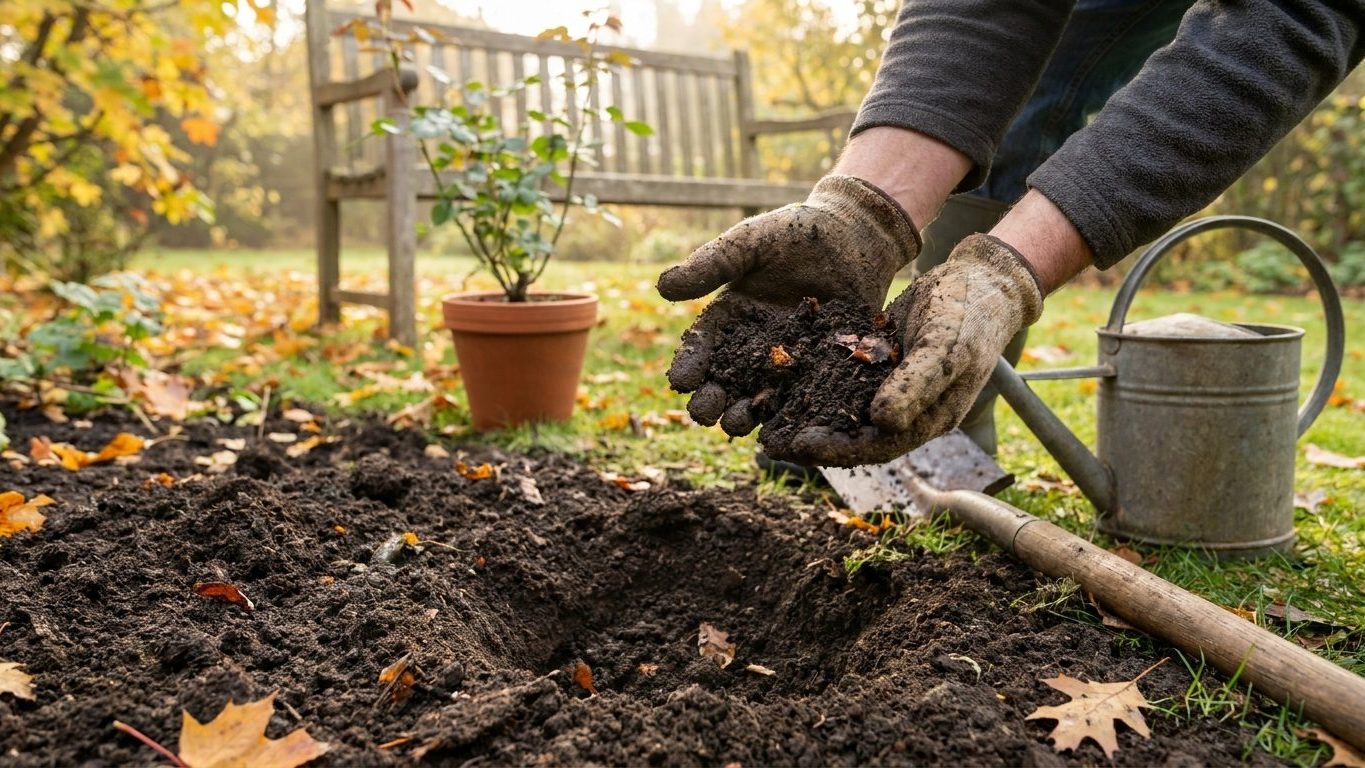

Roses want clay or loam soil that drains well, with a pH somewhere between acid (below 6.0) and neutral (6.0-8.0). Before you plant or amend, dig a test hole, fill it with water, and time how fast it disappears. If it’s still standing after a few hours, you need to fix drainage before you fix anything else. Compost, not lime, is usually the first thing to dig in.
Why this matters
Soil structure decides whether roots can breathe. Clay holds water and nutrients but compacts easily, squeezing out the oxygen roots need. Loam does the same job with more air pockets. When drainage fails, roots sit in water, oxygen runs out, and the plant starts losing feeder roots long before you see wilting on top. By the time leaves droop, the damage below ground is already done.
pH changes what the plant can actually absorb, not what’s technically in the soil. On strongly alkaline ground, above roughly 7.5, iron becomes locked into a form roses can’t take up, and new leaves turn yellow between green veins, a classic sign of iron chlorosis. Skip a pH check and you can spend a season feeding a rose that isn’t hungry, it’s just locked out of what’s already there.
When to do it
Soil work belongs before the plant goes in the ground, not after. If you’re adding a new rose to an existing bed, test and amend that planting hole before the root ball touches soil, since disturbing roots later to fix drainage does more harm than the drainage problem itself.
For roses already established, watch the plant instead of the calendar. Yellowing between the veins on new growth points to a pH problem worth testing. Water that pools on the surface for more than a few minutes after rain, or a rose that’s stalled at a fraction of its expected size for the cultivar, both point to a drainage problem worth digging into. Neither symptom fixes itself with fertilizer. Both call for a shovel and a soil test, not a feeding schedule.
If you’re moving or dividing an established rose, that’s your window to correct the bed underneath it. Once it’s settled back in and pushing new growth, reworking the soil around living roots stops being an option.
How to do it
Start with a simple percolation test. Dig a hole about a foot deep and a foot wide, fill it with water, let it drain once, then fill it again and time the second drain. Water that disappears at roughly an inch an hour is workable. Much slower than that, and you’re dealing with a drainage problem that amendment alone may not solve; much faster, and the soil may be too sandy to hold nutrients long enough for roots to use them.
Next, test pH with a home kit or a lab test through your local extension office. Roses tolerate the acid-to-neutral range documented for the genus, so unless the reading comes back strongly alkaline, above about 7.5, resist the urge to correct it. Adjusting pH is a slow process measured in seasons, not a one-time fix, and overcorrecting causes its own problems.
Building the planting hole
- Dig a hole roughly twice the width of the root ball, but no deeper than the roots themselves sit, so the crown or bud union ends up at the depth marked on the container.
- Loosen the soil at the bottom and sides of the hole rather than leaving smooth, compacted walls that roots struggle to push through.
- Mix the excavated soil with compost or well-rotted organic matter at roughly a one-to-one ratio, rather than filling the hole with pure amendment, which creates a soft pocket that drains differently than the surrounding ground.
- Backfill in stages, watering as you go to settle soil around the roots and remove air pockets.
If the percolation test showed standing water, raising the bed a few inches with additional soil and organic matter, rather than digging deeper into clay, is usually the more reliable fix. Digging a deep hole in poorly draining clay just creates a sump that collects water from the surrounding ground.
Finished right, the backfill should look darker and looser than the undisturbed soil around it, crumble easily in your hand, and hold its shape without turning to mud when squeezed. A two- to three-inch layer of mulch over the root zone, kept a few inches back from the crown, finishes the job by moderating moisture swings at the surface.
| Amendment | What it does | Watch for |
|---|---|---|
| Compost or aged manure | Improves structure in both clay and sandy soil, adds organic matter | Use finished, well-rotted material; fresh manure can burn roots |
| Coarse sand or grit | Opens up heavy clay for better drainage | Mixing sand into clay without enough organic matter can create a cement-like texture |
| Elemental sulfur | Lowers pH gradually on strongly alkaline soil | Slow to act; retest before adding more |
What goes wrong
The most common failure is planting into a hole that looks improved but sits inside unchanged clay, essentially a bathtub with no drain. Water fills the amended pocket after rain and has nowhere to go, and the rose ends up wetter at the roots than if you’d left the soil alone. You’ll recognize it afterward by a rose that grows well for a season or two, then declines with dark, mushy roots when you dig it up.
Overcorrecting pH looks like extra care but often backfires. Adding lime to soil that’s already in the acid-to-neutral range documented for roses, just because a gardening forum said roses like it sweet, can push pH high enough to trigger the iron chlorosis you were trying to avoid. Test before you amend, and retest a season later before adding more of anything.
Planting too deep is another quiet failure. If the bud union or crown ends up buried several inches below grade, the plant sits in wetter, cooler soil than it’s built for, and growth stays weak no matter how good the surrounding soil is. Check the depth against the nursery container before backfilling, not after.
Finally, mulch piled directly against the crown holds moisture against the base of the plant and invites rot, the same problem you dug and amended to avoid in the first place.
Doing it differently
Containers change the math entirely. There’s no surrounding soil to blend with, so the potting mix itself has to handle both drainage and nutrition, and it needs drainage holes that actually work, checked before the rose goes in, not after. A mix built for containers, heavier on bark and perlite than a typical garden bed, drains faster than garden soil and needs more frequent watering as a result.
Raised beds solve the standing-water problem for gardeners sitting on heavy clay, since the bed sits above the native soil rather than depending on it to drain. A raised bed filled with a blended soil and compost mix genuinely outperforms amending native clay in place when drainage test results come back poor, rather than being just a different way to reach the same result.
Greenhouse or high-tunnel roses face a different problem: soil that never gets rained on naturally builds up salts from repeated fertilizing. Periodic heavy watering to flush the root zone matters more there than it does outdoors, where rain does that job on its own.
Whatever the setup, check the plant tag for rootstock. Budded roses need the union protected through winter; own-root types, common among today’s landscape shrub roses, protect the crown instead. That distinction has nothing to do with soil type, but it changes what you’re protecting once winter comes.
Common questions
Are rose thorns dangerous?
They’re prickles, not true thorns. Prickles grow from the outer skin of the stem, which is why they snap off sideways rather than breaking like a woody thorn would. They can still puncture skin, so gloves are worth wearing, but they’re not the modified stem structure the word “thorn” technically describes.
Do roses need lime every year?
Not automatically. Roses tolerate soil from acid, below 6.0, through neutral, 6.0 to 8.0. Add lime only if a test shows soil below that range, and retest before adding more, since pH shifts slowly and repeated additions without checking can push it too far the other way.
Can I fix clay soil without raising the bed?
Yes, by working compost or organic matter into the existing soil rather than layering it on top, and by loosening a wider area than just the planting hole so roots aren’t confined to a soft pocket surrounded by unchanged clay. A raised bed is faster, but it’s not the only fix.
Why are my rose’s new leaves yellow between the veins?
That pattern usually points to iron chlorosis, documented on strongly alkaline soil above roughly 7.5. Test your soil pH before assuming a fertilizer problem, since adding more nutrients won’t help if the existing iron is already locked out of reach.