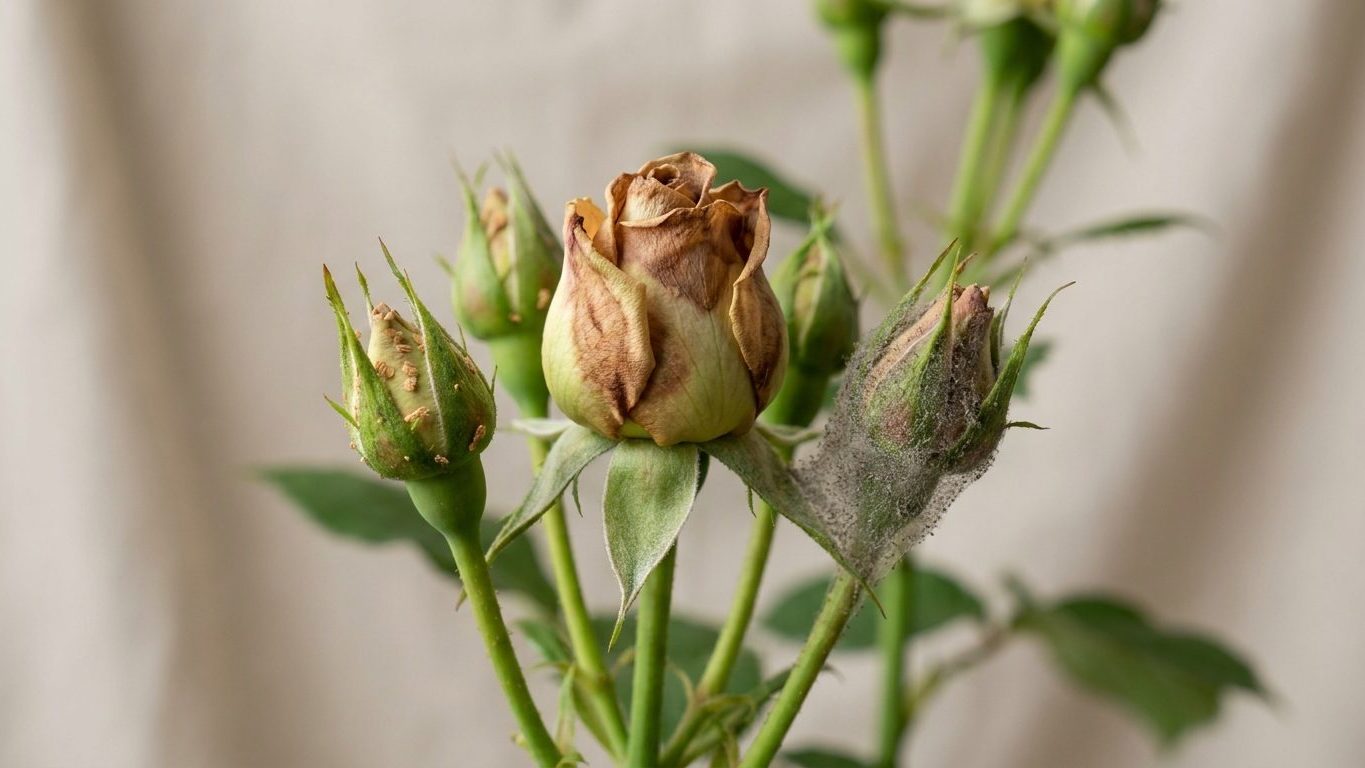

Buds that swell, then stop, then turn brown and mushy without ever unfurling are the signature of botrytis blight, a fungal disease that thrives in cool, damp weather and attacks the softest tissue on the plant first. It moves fast once conditions turn humid, but it rarely kills an established rose outright.
What you are looking at
Botrytis blight on roses starts almost always at the bud, not the leaf. This matters because it separates it immediately from most other rose diseases, which colonize foliage first and work their way up. A bud infected with botrytis stalls partway through opening, the outer petals turning tan or brown at the edges while the center stays tightly closed. Left alone for a few humid days, the whole bud collapses into a soft, water-soaked mass. It is fast: a bud can go from a faint discoloration to full rot in three to five days of damp weather.
Brown-edged petals on a stalled bud
The first visible sign is a scattering of small tan or reddish-brown flecks on the outer petals, usually starting at the tips where moisture collects longest. The flecks are irregular in shape, not the neat circles or angular patches seen with leaf-spot diseases, and they spread inward as the petal tissue collapses.
Gray fuzzy mold on a collapsed bud
Under humid conditions, especially after a stretch of overcast, damp days, the rotted bud develops a fine gray, almost dusty coating. This is the fungus fruiting, producing the spores that spread the disease to neighboring buds and open blooms. It brushes off easily with a finger, which is one of the more reliable field tests for botrytis.
Spotting on open flowers and cane lesions
On blooms that do manage to open, especially light pink, white, or pastel varieties, botrytis shows up as small, irregular brown-red spots on the petals, sometimes called “petal blight.” Darker red roses often mask the spotting, which is one reason the disease gets misdiagnosed as simple weather damage. On stems, especially where a spent bloom was left too long, sunken tan cankers can form just below the old flower, occasionally girdling and killing the cane tip. The rot moves downward from the bud toward the stem, not the reverse.
What it is not
Three things get mistaken for botrytis on roses often enough that it is worth settling the question before reaching for a fungicide, because the wrong diagnosis means the wrong fix, and sometimes no fix is needed at all.
Thrips damage
Thrips are tiny insects, barely visible without a hand lens, that feed inside developing buds and cause similarly stalled, browned blooms. The tell is texture and origin: thrips damage shows as streaky, silvery-brown scarring along the petal edges with no fuzzy growth at any point, and the petals often look ragged or torn rather than rotted. Tap a suspect bud over a sheet of white paper; thrips will fall out as tiny slivers that move. No gray mold, no insects falling out, and the damage stays dry rather than turning soft and water-soaked, points to botrytis instead.
Bud balling
This is not a disease at all, it is a weather response, and it happens most in high-petal-count varieties after a rain followed by a hot, sunny stretch. The outer petals absorb moisture, stick together, and then the sun essentially bakes that outer layer into a hard brown shell while the inner petals stay green and never open. There is no fungal growth, no soft rot, and no spread to neighboring buds. A ball-shaped, dry brown husk with a green, undeveloped center is balling. A soft, spreading, gray-fuzzed collapse is botrytis. Treating balling with a fungicide wastes product and time; the actual fix is variety choice and deadheading before a rain-then-sun cycle sets in.
Downy mildew
Downy mildew is a different organism entirely and it announces itself on the leaves first, with irregular purple-to-black blotches bounded by leaf veins, giving them an angular, almost stained-glass edge. Heavily infected leaves drop within days, sometimes stripping a bush bare. Botrytis, by contrast, starts at the bud and only reaches leaves as a secondary, minor spotting. If the leaf drop is sudden and the blotches are angular and dark, that is downy mildew territory, and it calls for different management, including different fungicide chemistry, than a bud-rot problem. Mixing the two up means treating the leaves while the buds keep rotting, or the reverse.
Where it comes from and when it strikes
The culprit is Botrytis cinerea, a fungus so widespread it is sometimes just called gray mold, and it is not picky about hosts. It attacks hundreds of ornamental and food crops, which means inoculum is almost always present somewhere in a garden, on dropped leaves, spent blooms, mulch, and plant debris from entirely unrelated plants.
The fungus survives the off-season as tiny, hardened resting structures called sclerotia, tucked into old plant debris and the top layer of soil, and as mycelium in infected canes. Spores form on that debris whenever conditions turn humid, and wind or splashing water carries them onto fresh buds. This is a necrotrophic fungus, meaning it strongly prefers tissue that is already dying or damaged, which is why spent petals, bruised buds, and winter-killed cane tips are the usual entry points rather than vigorous, undamaged growth.
Weather is the switch that turns a dormant spore population into an active outbreak. Botrytis needs extended periods of leaf and petal wetness, cool temperatures, and stagnant air to establish itself; it slows down considerably in hot, dry conditions and in gardens with good airflow. A stretch of overcast, drizzly days in spring or fall, especially where roses are planted close together or against a wall that blocks breeze, is close to an ideal setup. Greenhouse and high-tunnel roses face the same risk indoors, since those structures naturally hold humidity longer than open garden beds.
What to do about it now
Start by removing every infected bud and any fallen, browned petals from the ground and the plant, and get that material into the trash rather than the compost pile, since home compost rarely reaches temperatures that kill botrytis sclerotia. This single step, done consistently, cuts the spore load available to reinfect the next flush more than any spray applied afterward.
Deadhead spent blooms promptly rather than letting them fade on the bush; those dying petals are exactly the tissue this fungus prefers to colonize before jumping to healthy buds nearby. Open up the interior of the plant with a light prune, removing crossing or crowded canes, so air moves through instead of sitting still around the buds. Switch to watering at the base rather than overhead, and if overhead watering is unavoidable, do it early enough in the day that foliage and buds dry before evening.
A bud that has already collapsed into gray-fuzzed rot cannot be saved; cutting it off and destroying it is the only useful move at that point, and there is no treatment that reverses established rot. Fungicides labeled for botrytis blight, including chlorothalonil and several biofungicide products based on beneficial bacteria or fungi, can protect the next round of buds if applied before or at the very first sign of infection, but they work as a preventive shield on healthy tissue, not a cure for what has already turned to mush. Roses are ornamentals, so there is no food-safety question here; the only cost of an outbreak is fewer, uglier blooms this season, not anything unsafe to touch or grow near edible plants.
Keeping it out next season
Sanitation carried through the dormant season matters more for botrytis than for most rose problems, because the fungus rides through winter on debris left in the bed. Clear fallen leaves, spent petals, and pruned cane trimmings out from under the plants at the end of the season, and clean any stakes, ties, or supports that touched infected tissue, since dried spores can persist on those surfaces.
Spacing plants so mature foliage does not touch its neighbor, and pruning for an open, vase-shaped center rather than a dense thicket of canes, does more for long-term prevention than any single spray schedule. A two- to three-inch mulch layer over the soil reduces splash-up during rain or irrigation, which is one of the main ways spores travel from old debris onto fresh buds.
Cultivar choice carries real weight here. Rugosa-type roses and many modern shrub roses bred specifically for disease tolerance carry noticeably lower susceptibility to botrytis blight than old hybrid teas with dense, high-petal-count blooms, since tight petal clusters trap moisture longer. In parts of Europe, the ADR (Allgemeine Deutsche Rosenneuheitenprüfung) rating system evaluates new rose introductions for disease resistance, including botrytis tolerance, and roses carrying that designation on their catalogue tag have been through multi-year field trials for exactly this kind of problem. When buying new stock, choose transplants from a reputable nursery with clean, unblemished canes and no sign of old cane cankers, since infected nursery stock is one of the more common ways this fungus enters a garden that never had it before.
Common questions
Can a bud with botrytis still open into a usable flower?
Rarely. Once the outer petals have collapsed and softened, the bud typically cannot complete its opening, and any partially opened flower usually carries visible brown spotting on the petals. It is best cut and discarded rather than left on the plant.
Does botrytis spread to the rest of the plant if left untreated?
It can, particularly to nearby buds and to cane tips just below a rotted bloom, but it rarely moves into the main woody structure of an established rose the way a vascular disease would. The bigger risk is a garden-wide buildup of spores on debris, affecting future flushes rather than killing the plant itself.
Is botrytis blight the same fungus that causes gray mold on strawberries and tomatoes?
Yes, it is the same species, Botrytis cinerea, which is why gardens with vegetables, fruit, or even cut flowers stored indoors can carry a steady background source of spores that eventually finds its way to roses.
Will a fungicide applied after buds start rotting fix the problem this season?
No. Fungicides labeled for botrytis protect healthy, unopened buds from new infection; they do not reverse rot that has already set in. The realistic goal for an active outbreak is removing infected material and protecting the next flush, not saving the current one.