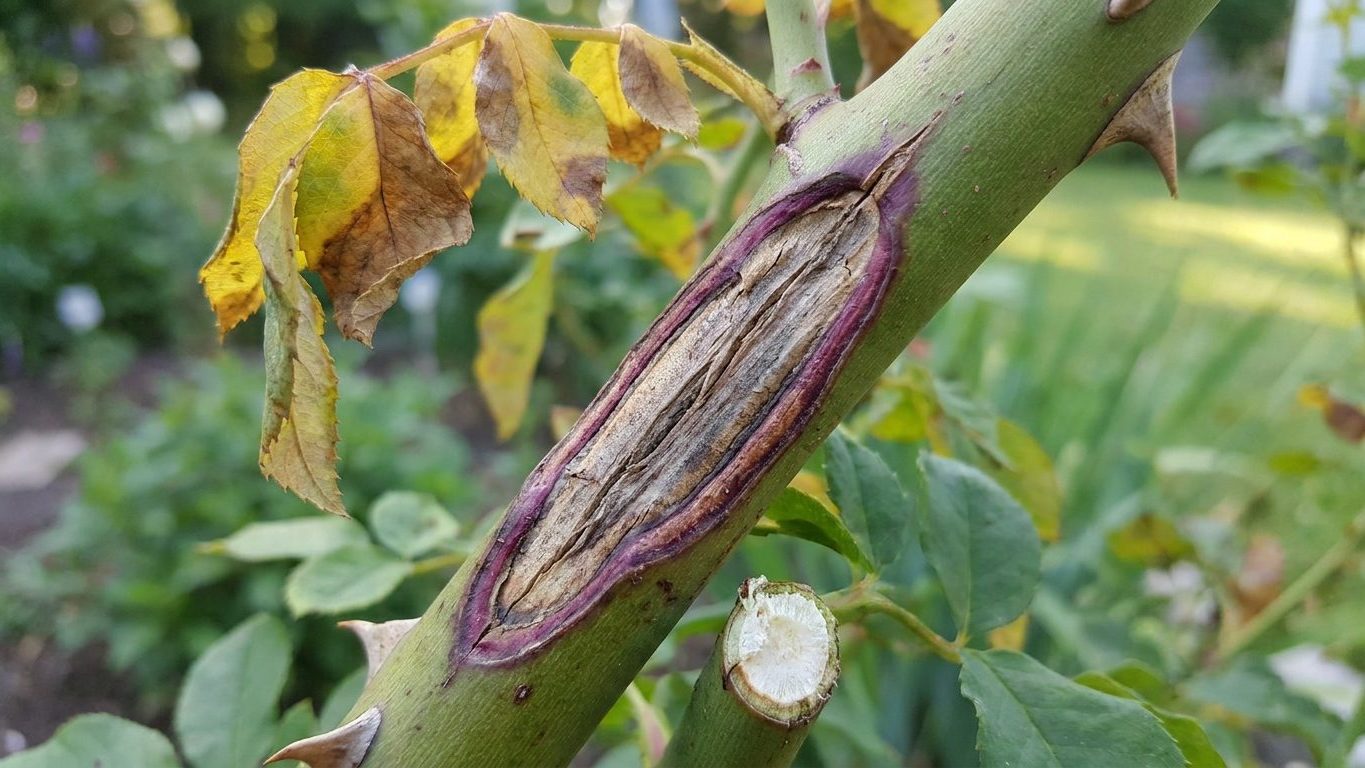

Rose canker shows up as a sunken, discolored patch on a cane, usually starting right at an old pruning cut or a wound. It girdles the cane from the inside, cutting off water and nutrients to everything above it. A single cane can die in a matter of weeks once the lesion wraps all the way around. The fix is to cut well below the discoloration, into clean white pith, and disinfect your pruners between every cut.
What you are looking at
This is a cane disease, not a leaf disease, and it moves fast once a lesion girdles the stem. A cane can wilt and die within a few weeks of the canker closing all the way around it, even though the rest of the plant looks fine. Watch the canes first, especially anywhere you made a pruning cut, tied a stake, or where hail, insects, or a cane borer left a wound.
Early lesion at a pruning cut or wound
The first sign is a small, water-soaked or reddish-brown spot right at the cut surface or wound site. It’s flat at this stage, barely raised or sunken, and easy to miss if you aren’t looking closely at the cut ends after pruning.
Mature sunken canker with a dark margin
Left alone, the spot deepens into a sunken patch, tan or grayish-brown in the center with a distinct purple-to-reddish or dark brown border ringing the edge. The lesion is oval to elongated, running with the grain of the cane rather than across it, and the bark often looks slightly shriveled or cracked over the sunken area.
Girdled cane with wilting foliage above
Once the lesion has expanded around the full circumference of the cane, everything above it wilts, then browns and dies, even while the base of the plant and other canes stay green. This one-cane, above-the-lesion collapse is the clearest field sign that you’re dealing with a canker and not a root or whole-plant problem.
Old canker with black speckled fruiting bodies
On older, dead cankers, tiny black specks appear scattered across the sunken tissue, like ground pepper. Those are the fungus’s fruiting bodies, and they’re a reliable confirmation that you’re looking at a canker fungus rather than simple winter injury.
What it is not
Three things get mistaken for cane canker often enough that the mix-up is worth walking through, because each one calls for a different response.
Black spot (Diplocarpon rosae)
Black spot lives on the leaves, not the canes. The lesions are round, black, with a fringed or feathery edge and a yellow halo spreading into the surrounding leaf tissue, and heavily infected leaves yellow and drop. It can eventually appear on young green canes as dark blotches, but the leaf symptom always comes first and is the dominant sign. Treating a cane canker like black spot means spraying foliage while ignoring the wound on the stem that’s actually killing the cane, and the cane dies anyway.
Botrytis cane blight (gray mold)
Botrytis attacks in cool, damp weather and produces a fuzzy gray-brown mold you can actually see growing on the surface of the lesion, especially after rain or heavy dew. The canker itself tends to be less sharply sunken and less cleanly bordered than true cane canker, and it often starts at flower or bud tissue before working down into the stem. Wipe a finger across it: if it comes away dusty gray, that’s botrytis spore, not a canker fungus. Confusing the two matters because botrytis responds to improved air circulation and removing spent blooms promptly, while a true canker needs the infected wood physically cut out.
Winter dieback (freeze injury)
Freeze injury browns a cane from the tip downward in a smooth, even gradient, with no discrete sunken patch, no sharp dark border, and no black speckled fruiting bodies anywhere on the dead tissue. It’s a physiological injury, not an infection, and it stops progressing once you prune back into live, green pith. Mistaking canker for winter dieback means leaving infected wood in place because you assume the plant will simply grow past it, when in fact the fungus keeps spreading and can girdle a second, healthy cane through contact or through the next pruning cut.
Where it comes from and when it strikes
Rose cane canker is caused by fungi in the Coniothyrium group (sometimes described under the names common canker and brand canker), along with related cane-infecting fungi that behave similarly. These organisms survive between seasons inside infected cane tissue and in pruning debris left on or under the plant. They don’t need to travel far to find a new host: rain splash, wind-driven spores, and contaminated pruning tools carry the fungus from an old canker to a fresh wound just inches or a few feet away.
Wounds are the doorway. Pruning cuts, winter-cracked bark, hail damage, insect tunneling, and even the friction from a loose tie or stake all give the fungus an entry point it can’t get through intact bark. A cane weakened by winter injury or by heavy nitrogen fertilization (which pushes soft, fast growth with thinner cell walls) is noticeably more vulnerable than a cane that went into winter hardened off properly.
Cool, wet weather with extended periods of leaf and cane wetness favors infection and spore spread, which is why canker tends to show up most after a stretch of rainy weeks or a hard winter followed by a damp spring. Dense, poorly ventilated plantings make it worse, since canes and cuts stay wet longer after rain or dew when air can’t move through the bush. None of this requires a specific temperature threshold to matter in the yard; what matters is how long the wood stays wet and how many fresh wounds are exposed while that happens.
What to do about it now
Cut first, and cut low. Once you spot a canker, follow the cane down and remove it well below the visible discoloration, ideally several inches into wood that shows clean, uniform white or pale green pith with no staining. A canker often extends further inside the cane than it appears on the bark surface, so if the pith at your cut still looks streaked or off-color, keep cutting lower.
Disinfect your pruners between every single cut, not just between plants. A wipe with rubbing alcohol or a household disinfectant takes seconds and is the single cheapest thing you can do to stop spreading the fungus from an infected cane to a healthy one on the same bush.
Remove and destroy everything you cut out, along with any dropped canes or debris sitting at the base of the plant. Don’t compost it; the fungus survives in dead tissue and pruning debris is exactly how it carries over to next season. Improve airflow around the remaining canes by thinning crowded growth, and switch to drip or soaker-hose irrigation if you’ve been watering overhead, since wet foliage and wet canes are what let the fungus establish in the first place.
There’s no fungicide that cures a canker already inside the wood; protectant fungicide sprays applied to fresh pruning cuts can help prevent new infections but won’t reverse one that’s already girdling a cane. A wilted, girdled cane above the lesion is not coming back, and the honest move is to cut it out rather than wait and see. Since roses are grown ornamentally rather than for food, there’s no harvest safety concern here the way there would be with a vegetable crop.
Keeping it out next season
Sanitation does more work here than any spray. Clean up fallen leaves, cut canes, and debris around the base of every rose bed at the end of the season, and disinfect pruners, loppers, and ties before you put them away, not just before you use them again in spring.
Roses don’t carry the letter-code resistance ratings you see on vegetable seed packets (there’s no VFN-style system for cane canker). Instead, nursery catalogs describe cultivars in plain language, calling out own-root roses as generally more vigorous and better able to grow past minor cane injury than grafted plants, since a grafted rose loses everything above a girdled union while an own-root plant can often resprout from below it. Choosing vigorous, own-root stock from a reputable nursery, and inspecting canes for existing lesions before you plant, avoids bringing the problem into your beds in the first place.
Prune with intention: make clean, angled cuts just above an outward-facing bud, avoid leaving ragged stubs, and don’t over-prune in a way that creates more wounds than necessary. Space plants so air moves freely between them once they’re mature, since crowded canes stay wet longer after rain and are pruned less thoroughly because they’re harder to reach. Going into winter, protect canes from cracking and dieback by hilling soil or mulch around the base and avoiding late-season nitrogen fertilizer, which pushes soft growth that hardens off poorly and cankers easily the following spring.
Common questions
Can a rose cane recover from canker once it’s girdled?
No. Once a canker wraps fully around a cane, everything above that point is cut off from water and will die. The plant itself usually survives if other canes are healthy, but that specific cane needs to be removed below the lesion, not left in place hoping it recovers.
Should I seal pruning cuts to prevent canker?
Sealing isn’t generally recommended as routine practice; clean, disinfected tools and pruning in dry weather do more to prevent infection than a sealant applied after the fact. If you’re in an area with heavy cane borer pressure, a specific wound dressing may be advised locally, but it’s not a substitute for sanitation.
Is rose canker the same thing as black spot?
No. Black spot is a leaf disease with round, fringed black spots and yellow halos, while canker is a stem disease with sunken, discolored patches at wounds or old pruning cuts. They can occur on the same plant at the same time, but they’re different fungi requiring different responses.
How far below the visible canker should I cut?
Cut until the exposed pith is uniformly white or pale green with no streaking or discoloration. On a badly infected cane that can mean removing several inches of wood below where the discoloration is visible on the bark, since the fungus often travels further inside the cane than it shows on the surface.