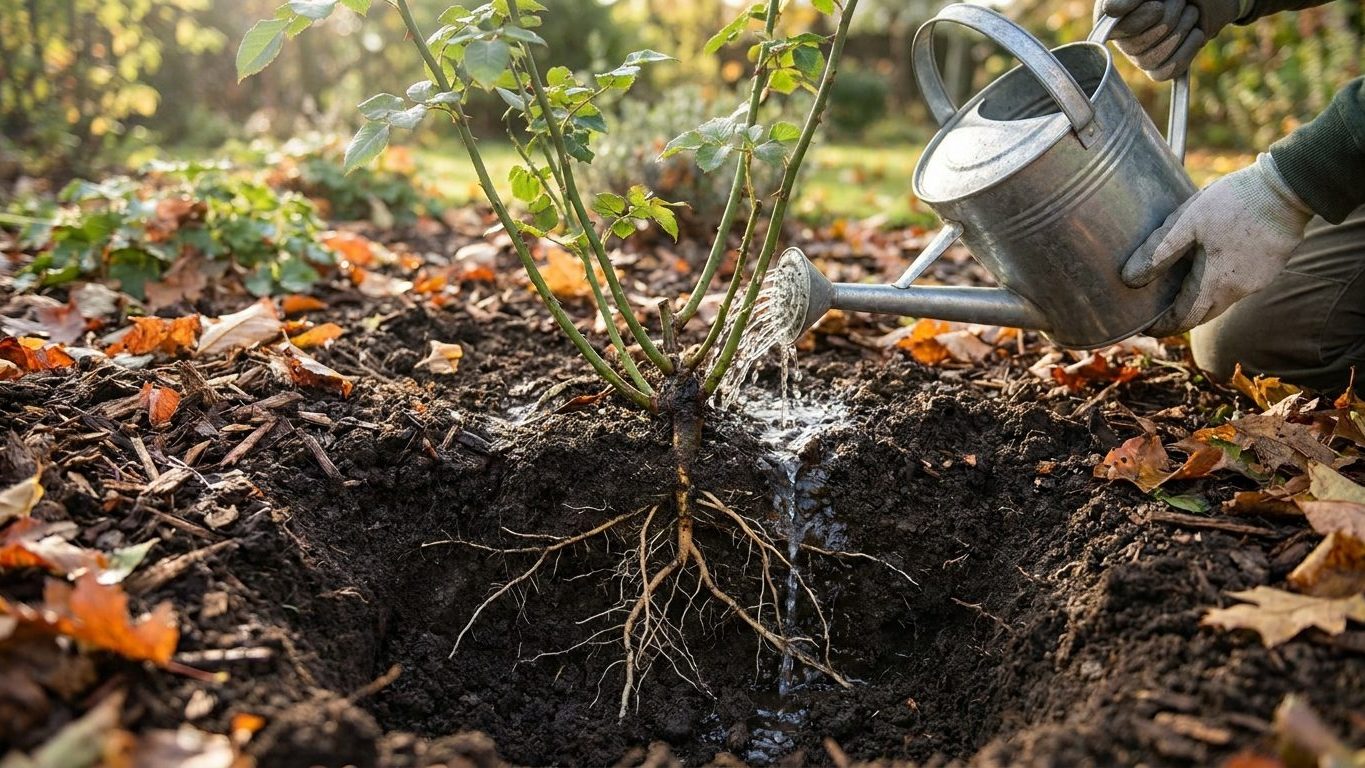

The short answer: in year one, focus everything on roots, not top growth. Water deeply, remove only what’s damaged, skip hard pruning and heavy feeding, and let the plant finish its first bloom cycle on its own terms. Everything else can wait until the second season, once the root system is established.
Why this matters
A newly planted rose is running two jobs at once: growing roots deep enough to survive its first real winter, and producing top growth and flowers because that’s what roses do. Those two jobs compete for the same sugars the plant makes through photosynthesis. Push too much energy into flowers and new canes in year one, and the root system stays shallow and thin, which is exactly the plant that struggles or dies the following winter.
Roses are rated HIGH maintenance for a reason, and that rating starts on day one, not in year three. Skip the basics now, like checking soil moisture and watching for the first signs of blackspot or powdery mildew, and you’re not saving work, you’re deferring a bigger problem. A rose that goes into its first dormancy with weak roots and disease pressure already established has a much harder time breaking bud the following spring. Getting this first year right is what makes every later year easier.
When to do it
Forget the calendar and watch the plant instead. The first real signal is new leaf growth pushing from the canes, which tells you transplant shock has passed and the roots have started to function. That’s the point where routine watering checks and light monitoring for pests and disease should begin in earnest, not before.
The next signal is the first flush of flower buds. Let that first round of blooms open fully, since it’s a useful gauge of how the plant is settling in. Once those flowers fade, that’s your cue for the first deadheading cut, not before the flowers have finished doing their job. If you’re picking blooms for a vase, cut only once the sepals have folded back and the first one or two petals are starting to unfurl; a bud cut tighter than that often never opens at all.
As for pruning, most roses need it yearly in late winter, but the exact window depends entirely on your USDA hardiness zone, which runs from 5a through 11b for roses as a genus. A grower in a mild zone and a grower in a cold one are not pruning in the same week, or sometimes not even the same month. That timing is local, not universal, so check the state-specific guide for your zone rather than a generic date.
How to do it
First-year care breaks down into what you actively do, and what you deliberately leave alone.
What to do
- Water for roots, not a schedule. Push a finger two inches into the soil near, but not against, the base of the plant. Water deeply when it’s dry at that depth rather than on a fixed number of days a week. Roses in clay or loam soil with a pH between acid (below 6.0) and neutral (6.0-8.0) generally hold moisture well once established, but that first-year root zone is still small and dries out faster than it will later.
- Confirm sun exposure. Roses need full sun, six or more hours of direct light a day. If the plant is putting out weak, stretched growth reaching toward one direction, that’s a sign it’s not getting enough.
- Remove only damaged wood. Any cane that’s broken, crushed, or clearly diseased should come off, cut back to healthy tissue. That’s it for year one pruning. Leave the rest of the framework alone so the plant has leaves to feed the roots.
- Deadhead lightly after the first flush. Once blooms fade, cut back to the first set of five-leaflet leaves below the spent flower. This encourages the next round of bloom without removing large amounts of wood.
- Check the tag for rootstock. Many hybrid teas, grandifloras, and climbers are budded onto a rootstock, with a visible graft union at the base. Most landscape shrub roses sold today, including Knock Out and Drift types, are own-root and have no union at all. Winter protection targets the union on a budded rose and the crown on an own-root one, so knowing which you planted matters before the first freeze.
- Feed lightly, once, after the first flush finishes. A light application of a balanced rose fertilizer at that point supports the next round of growth without pushing excess soft growth late in the season.
What to leave alone
- Don’t prune for shape or size in year one. That comes once the plant has a full season of established roots behind it.
- Don’t remove every dead stem you find. Cut dead wood back to 12-24 inches and leave it standing where it doesn’t pose a safety issue; hollow stem-nesting native bees use exactly that height of standing dead wood.
- Don’t handle the plant expecting thorns. The sharp structures on rose stems are prickles, outgrowths of the outer stem skin, which is why they snap off sideways rather than staying rigid like a true woody thorn. Sturdy gloves still matter, but you’re not dealing with the same structure the word “thorn” implies.
What goes wrong
The most common first-year mistake is treating fertilizer like a growth accelerant. Heavy or frequent feeding pushes soft, sappy growth that won’t ripen before frost, and that soft growth is exactly what dies back and invites disease over winter. More is not better here.
A close second is hard pruning too early, done with good intentions. Cutting a first-year rose back hard to “shape it up” removes the leaf area the plant needs to build its root system, and it looks like diligence when it’s actually setting the plant back a full season.
Removing all dead wood, rather than leaving 12-24 inches standing, is another one that looks like tidiness but costs the local pollinator population a nesting site for no horticultural benefit.
Blanket winter protection is a fourth trap. Mounding soil or mulch over the wrong structure, protecting a crown when the plant is actually budded, or vice versa, leaves the part that actually matters exposed. Check the tag before you assume.
Finally, watch for the two-spotted mite and southern red mite, which are arachnids, not insects, along with named pests like Japanese beetle, rose chafer, and rose thrips, and diseases including botrytis, blights, powdery mildew, leaf spots, and anthracnose. Black spot overwinters both in fallen leaves and in lesions on the canes themselves, so raking leaves alone won’t stop it; powdery mildew overwinters in dormant buds and on stems, not in leaf litter, so that same rake job does nothing for mildew at all.
Doing it differently
Growing method changes some of the specifics without changing the underlying principle of protecting root development first.
| Method | First-year adjustment | Why |
|---|---|---|
| Containers | Check soil moisture more often, roughly every other day in warm weather | Limited root volume dries out faster than ground soil |
| Raised beds | Easier to correct soil pH toward the acid-to-neutral range before planting | Amended soil drains and warms faster, speeding early root growth |
| Greenhouse or high tunnel | Extended growing window, but same restraint on pruning and feeding still applies | Faster top growth without matching root growth creates the same imbalance, just sooner |
Rose type also matters for pruning approach, though not for size, since dimensions run 1 to 8 feet tall and 1 to 6 feet wide across the genus depending on cultivar, and there’s no reliable per-group figure beyond that. Ramblers flower from old wood, so cutting back the previous season’s canes in year one removes next year’s flowers. Climbers flower from new wood, so the framework can be trained more actively without that same penalty. Disease resistance is also a per-cultivar trait, not a per-group one; some old rambler varieties are mildew-prone while a modern shrub rose like Knock Out was bred specifically for resistance, so the group name alone tells you very little.
Common questions
Are rose thorns dangerous?
They’re not true thorns at all. They’re prickles, outgrowths of the stem’s outer skin, which is why they break off sideways rather than staying rigid. They can still puncture skin, so gloves are worth using, but they’re not the woody, stem-derived structure the word “thorn” technically describes.
Should I fertilize a rose right after planting?
Hold off until after the first bloom flush fades, then apply a light, balanced feeding. Feeding immediately after planting, before roots have established, tends to push soft top growth the young root system can’t yet support.
Do I need to prune a first-year rose in late winter like an established one?
Only lightly, removing damaged or diseased wood. Full structural pruning waits until the plant has a season of root growth behind it. The exact timing window still depends on your USDA zone, so check the state-specific pruning guide for your area.
What do I do with the rose hips in fall?
You can leave them or cut them; either is fine. The hip is an edible accessory fruit that turns from green to red in fall, but it has no role in triggering the plant’s dormancy, which follows day length and cold rather than fruit formation. What does matter is that continued deadheading keeps pushing new shoots, so stopping the cuts late in the season is what actually helps the plant avoid soft, unripened growth heading into winter.