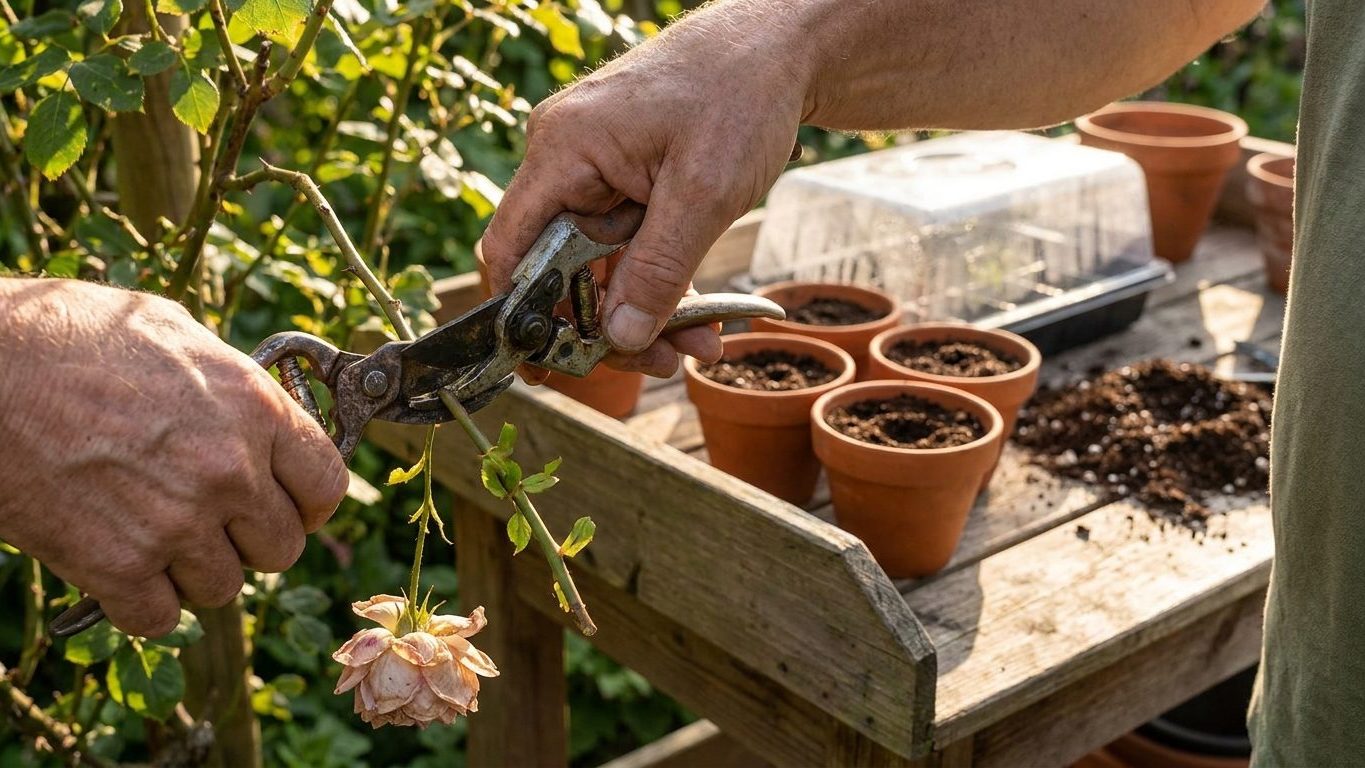

Stem cuttings root reliably from this-season wood that has just finished flowering, cut with several leaf nodes, stripped of most foliage, and kept humid and shaded until new roots form. Grafting stays the more reliable route for named hybrid teas, but cuttings are the practical way to multiply own-root shrub roses, heirlooms, and any plant without a tag.
Why this matters
A cutting that roots becomes a clone on its own roots, with no rootstock and no union to protect over winter. That matters because grafting, the propagation method NC State Extension lists as the best strategy for roses, still depends on a compatible rootstock and some grafting skill. A cutting sidesteps all of that. It also means the new plant will always match the parent exactly, which is the only way to preserve an heirloom rose that has lost its tag or a rugosa you can’t identify by name.
Skip the timing and the method matters here, and the failure is quiet: the cutting looks fine for a few days, then the leaves yellow, the base blackens, and it’s gone. There’s no second chance with that piece of stem. Do it badly, with soft tip growth or no humidity control, and you’ll lose most of what you cut. Do it right, and a single flowering stem can hand you two or three new plants for the cost of a pot and some potting mix.
When to do it
Skip the calendar. Take cuttings right after a flush of bloom fades and the petals drop, not before. That’s the point at which the stem just below the spent flower has firmed up enough to hold a bend without snapping, but hasn’t hardened into the gray, woody cane of last year. Squeeze the stem gently between two fingers: if it’s still floppy and green all the way through, it’s too soft and will wilt before it roots. If it resists bending at all, it’s already old wood, and rooting odds drop.
Roses bloom in flushes through the season, so this window repeats every time a batch of flowers finishes. That gives you several chances rather than one. There’s no single planting date to aim for here, since bloom timing depends on your zone, your cultivar, and how the plant has been pruned; watch the plant itself rather than a calendar. Roses are hardy from USDA zones 5a through 11b, and a plant blooming in a zone 9 garden in April is at a completely different stage than the same cultivar in a zone 5 garden in June. Check your state page for the pruning and dormancy timing that frames your bloom season locally.
How to do it
Selecting and taking the cutting
Choose a stem roughly the thickness of a pencil that just carried a flower, with at least three or four leaf nodes below the spent bloom. Using clean, sharp bypass pruners (not scissors, which crush the stem tissue), cut a section about 6 to 8 inches long, angling the cut just below a node. Wear light gloves for this part: the sharp structures along the stem are prickles, not true thorns, and they grow from the outer skin of the stem, but they still catch skin and clothing.
Trim off the spent flower or forming hip at the top. Strip the lower leaves, leaving only the top one or two leaflets. If those remaining leaves are large, cut each one roughly in half with clean scissors: this cuts water loss through the leaf surface without stopping photosynthesis entirely, which the cutting still needs while it has no roots.
Rooting and aftercare
Fill a small pot with a loose, well-draining mix, potting soil cut with perlite or coarse sand works, and moisten it before planting. Dip the cut end in rooting hormone if you have it (optional, but it improves the odds), then push the cutting about 1 to 2 inches into the mix so at least one leaf node sits below the surface, since roots form at the nodes.
Water it in, then cover the pot with a clear plastic bag propped up on a few sticks, or the top half of a cut plastic bottle, to hold humidity around the leaves. Set it somewhere bright but out of direct sun, direct light under plastic cooks the cutting fast. Keep the mix moist, never soggy, and vent the cover for a few minutes every couple of days to prevent rot. Take more cuttings than you need: not every one roots, so a batch of five or six from the same stem gives you a realistic shot at ending up with two or three plants. New leaf growth after a few weeks is a promising sign, though it can also mean the cutting is drawing on stored energy rather than new roots, so wait for a gentle tug test to show resistance before you call it rooted.
What goes wrong
Errors in cutting selection
Soft, bright green tip growth feels like the most vigorous material to cut, but it’s the least likely to root. It wilts before it can form roots and usually rots at the base within a week. The opposite mistake, cutting from wood that’s already hardened into a gray, woody cane, fails just as often, just more slowly; that wood is what grafting exists for. And a stem showing leaf spots, anthracnose, or powdery mildew is a poor donor: propagating from it just gives you a smaller, infected plant instead of a healthy one.
Errors in aftercare
Leaving every leaf on the cutting looks like generosity toward the plant, more leaves, more energy, but it’s the mistake that looks like extra care and isn’t. Every leaf left on is a surface losing water the cutting has no roots to replace, and it’s the single most common reason cuttings that were otherwise cut correctly still wilt and die within days.
Skipping the humidity cover produces crisped, browning leaf edges within a couple of days. Overwatering produces the opposite symptom later on: a soft, blackened, mushy base when you check the cutting, a sign of rot rather than dryness. Direct sun under a plastic cover shows up as scorched, cooked-looking leaf tissue, usually within a single afternoon.
Doing it differently
The setting changes how much manual humidity control you need to provide.
| Setting | Humidity control | Best suited for |
|---|---|---|
| Individual container with plastic bag | Manual, needs venting | One or two cuttings, close monitoring |
| Greenhouse | Largely automatic | Larger batches, less daily attention |
| Raised bed nursery row, shaded | Ambient, soil holds moisture | Bulk propagation, skips the later transplant |
Variety type changes the outcome, too. Most landscape shrub roses sold today, Knock Out and Drift types among them, are already grown on their own roots commercially, so a cutting reproduces exactly what you’d buy at a nursery. Hybrid teas and grandifloras are typically budded onto a rootstock for vigor, so a cutting-grown plant of one of those may end up smaller than the grafted original, since it’s missing that rootstock boost. Check the base of your parent plant for a graft union to know which case applies.
If the plant is a rambler, remember it flowers on old wood, so cutting into last year’s canes for propagation material means sacrificing next year’s bloom on that cane; take cuttings from this year’s new growth instead once it’s flowered. Climbers flower on new wood, so this season’s flowering stems are exactly the right material either way.
Common questions
Are rose thorns dangerous when taking cuttings?
They’re prickles, not true thorns; they grow from the stem’s outer skin rather than being a modified woody stem, which is why they snap off sideways. They still scratch, so gloves are worth wearing while you handle stems.
Can you root a cutting from a florist bouquet rose?
It’s unpredictable. A stem you’ve watched grow on your own plant gives you a known maturity stage to cut at; a florist stem’s history and handling are unknown, and success is much less consistent.
How long does a cutting take to root?
That timeline isn’t published in the source used for this guide. In practice it varies with warmth, humidity, and cutting condition, but treat several weeks as the point to start checking with a gentle tug rather than expecting a fixed date.
Is grafting really better than growing from cuttings?
NC State Extension lists grafting as the best propagation strategy for roses, largely because rootstock adds vigor that many named hybrid teas depend on. But for own-root shrub roses, heirlooms, or simply multiplying a plant you already have for free, a cutting is the more practical choice.