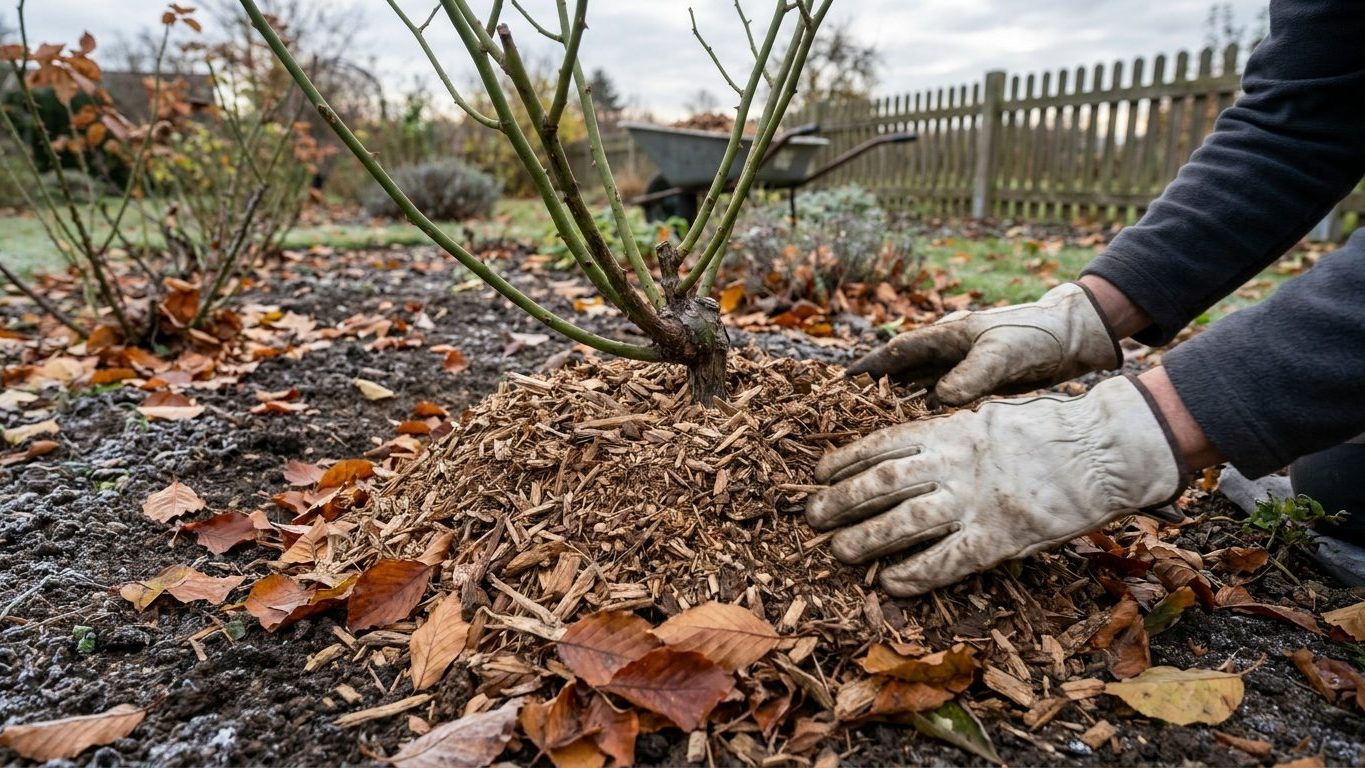

Mounding protects the graft union on a budded rose, or the crown on an own-root plant, from repeated freeze-thaw cycles that can kill the tissue that produces new canes each spring. The right moment follows the plant’s own dormancy, not a date on a calendar, and the right material depends on what’s cheap and dry where you garden. Depth and timing are local questions; the mechanics below apply everywhere.
Why this matters
A grafted rose, a hybrid tea, grandiflora, or many climbers, carries a swollen knob near the soil line where the desired variety was budded onto a hardier rootstock. That union is the plant’s single point of failure. If it freezes and splits, the top growth you paid for dies, and whatever sprouts from below is the rootstock, usually a plain, thorny thing nobody chose. Own-root roses, which now include most landscape shrub types sold at garden centers, have no union to worry about, but they still have a crown, the swollen base where stems meet roots, and that crown is what stores the energy for next year’s growth.
Skip mounding where winters bring repeated hard freezes and thaws, and the risk isn’t a slightly weaker bloom season. It’s losing the plant’s identity entirely, or losing it outright if the crown itself is damaged. Do it badly, piling wet material against green wood too early, and you trade one problem for another: rot sets in before the cold ever arrives. The goal is narrow and specific, insulate one small zone of tissue, not blanket the whole plant.
When to do it
Watch the plant, not the forecast. Mounding belongs after the rose has gone fully dormant: leaves have dropped or turned papery, no new shoots are pushing, and deadheading has stopped producing flushes. Any rose still putting out soft growth that will not ripen before frost isn’t ready to be covered. Burying green, actively growing tissue traps moisture against it and invites the rot that mounding is supposed to prevent.
The real trigger, according to the underlying principle rather than any single date, is a run of hard freezes, consecutive nights cold enough that the ground itself starts to freeze and stay frozen, not just one early cold snap followed by a week of warmth. Mounding too soon, while the plant can still cycle in and out of active growth, does more harm than good. Wait until the wood has ripened and the plant has hardened on its own, a process that happens gradually as day length shortens and temperatures drop, not something you can force or skip by covering the plant early.
Because the specific run of hard freezes that signals the right week varies enormously by region, this page won’t assign a date. The state-level guide for your area lays out the local pattern and the typical window; use that as your cue, then confirm with the plant itself before you start piling material.
How to do it
Start by clearing the base of the plant. Rake away any mulch, fallen leaves, or debris sitting against the canes, since black spot overwinters both in fallen leaves and in lesions on the canes themselves, and leaving infected material tucked against the crown just gives the disease a head start come spring. This is also the point to do a light cleanup of anything visibly diseased or broken, though the goal is tidiness at the base, not a full pruning pass; most roses get their real cutback in late winter.
Building the mound
Bring in fresh material rather than scraping soil from around the plant’s own root zone. Digging a trench right next to the rose to build your mound exposes roots on the other side and defeats the purpose. Good options include:
- Bagged garden soil or compost, dry rather than soggy
- Coarse mulch, wood chips, or shredded bark
- Clean straw, packed loosely rather than compressed
Heap the material directly over the graft union (on a budded rose) or the crown (on an own-root plant), working it up and around the base in a cone shape rather than a flat pile, so water sheds off the sides instead of pooling on top. A mound that’s doing its job looks like a small, firm hill, not a loose scatter that will blow away in the first wind or a soggy heap that stays wet for days.
Tying and wrapping, if you’re going further
On taller canes, especially climbers or larger shrub types, some gardeners gather the canes loosely with garden twine before mounding, just enough to keep them from whipping in winter wind and tearing at the base. This isn’t required for the mound itself to work, but it reduces mechanical stress at the exact point you’re trying to protect. Avoid wrapping the canes themselves tightly in plastic or burlap down at soil level, since that traps moisture right where you don’t want it.
Once the mound is built, leave it alone. Don’t add more material after every cold snap, and don’t poke around checking on the union underneath; disturbing the pile lets cold air in and undoes the insulating layer of still air the mound depends on. Removal timing, like the initial mounding date, is a local call tied to when hard freezes reliably stop in your area, and that detail belongs on your state’s page rather than here.
What goes wrong
Mounding too early, while the plant is still cycling through mild days and soft growth hasn’t yet ripened, is the most common failure. The material traps warmth and moisture against tissue that isn’t ready for it, and rot sets in before the first real freeze even arrives. You’ll spot this in spring as a soft, blackened union or crown instead of firm, pale tissue.
Using wet or heavy clay soil straight from the garden is a close second mistake. It compacts, holds water, and freezes into a solid block that conducts cold rather than blocking it, the opposite of what a mound is supposed to do. Dry, loose material insulates because it holds pockets of still air; wet, dense material doesn’t.
The mistake that looks like extra diligence but isn’t: leaving the mound in place well into spring, long after hard freezes have ended, because it feels safer to “leave it a bit longer.” By then new growth is trying to push through a foot of buried, decomposing material, and it either rots in the dark and damp or emerges weak and pale from lack of light. Removing the mound on schedule, tied to your region’s typical end of hard freezes, matters as much as building it in the first place. A related version of this same over-caution is fertilizing late in the season to “help the plant along” before winter; that pushes soft new growth that has no time to ripen and becomes the first tissue lost to cold.
Doing it differently
Container-grown roses face a sharper version of the same problem, since roots in an above-ground pot have far less soil mass buffering them from cold than roots in the ground. Moving containers against a house foundation, into an unheated garage, or grouping several pots together and mounding material around the outside of the group is a genuine improvement over leaving them exposed on an open patio, not just a different method for its own sake.
Raised beds sit somewhere in between: the soil warms and cools faster than ground-level beds, so mounding the same way but slightly earlier in the dormancy window, once the plant itself shows it’s ready, tends to track the bed’s faster temperature swings.
Own-root shrub roses, including many of the disease-resistant landscape types sold today, often need less protection than a budded hybrid tea, since there’s no vulnerable graft union sitting above the soil line, only the crown, which sits lower and benefits from the surrounding soil’s own insulation. Ramblers and climbers trained on a structure present a different challenge: their canes can’t simply be mounded in place, so some gardeners loosen ties, lay long canes down along the ground, and mound soil or mulch over the base sections rather than trying to insulate wood still fastened several feet up a trellis. Check the tag or original description for your rose to know whether you’re protecting a union or a crown before deciding how far to go.
Common questions
Do all roses need to be mounded for winter?
No. The need depends on your local pattern of hard freezes and on whether the rose is budded or own-root; some own-root shrub types in milder zones need little to no mounding at all. Check your state page for the local pattern.
What if I don’t know whether my rose is grafted or own-root?
Look at the plant tag or original purchase description, and check the base of the plant for a visible swollen knob or bend just above the roots, a sign of a graft union. Many landscape shrub roses sold today are own-root and have no such union.
Can I use the same mulch I already have in the garden for mounding?
Dry wood chips, bark, or straw already on hand work fine, provided they’re dry and loose rather than compacted or soaked. Avoid using soil scraped directly from around the plant’s own roots, which just relocates the problem.
Are rose thorns dangerous?
They are prickles, not true thorns: they grow from the outer skin of the stem, which is why they can be rubbed off, and while they can scratch or puncture skin, they carry no venom or particular hazard beyond an ordinary cut.