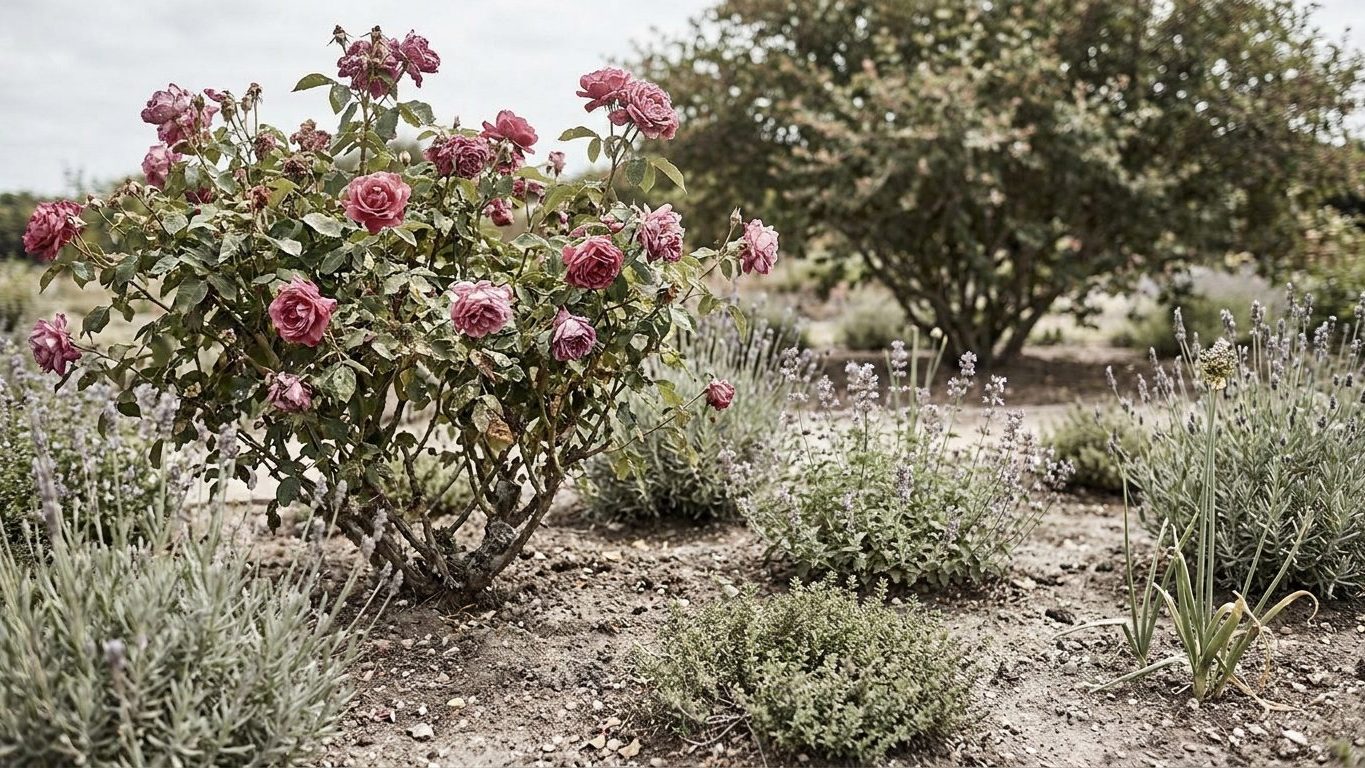

Good companions for roses share the same sun and drainage needs: lavender, catmint, alliums, salvia, and low groundcovers like creeping thyme all grow well alongside them without competing for water or blocking airflow. Skip aggressive spreaders, shade-casting shrubs, and moisture lovers that raise humidity around the foliage, since roses need six or more hours of direct sun and soil that drains between waterings, not soil that stays damp.
Field note: Before buying a companion plant, check its tag for sun exposure and pH first. If those two numbers don’t match what the rose itself needs, the mismatch shows up in bloom count long before it shows up as a diagnosable disease.
Why this matters
Roses carry a HIGH maintenance rating, and most of that workload comes down to airflow and root competition rather than the flowers themselves. A mature shrub can run anywhere from 1 to 8 feet tall and 1 to 6 feet wide depending on cultivar, so a companion planted too close blocks the air movement that keeps foliage dry. Powdery mildew, black spot, botrytis, blights, leaf spots, and anthracnose all spread faster in still, humid air, and a ring of companion plants pressed against the canes creates exactly that microclimate.
Root competition matters just as much. Roses flower repeatedly through the season, pulling steadily on the same soil moisture and fertility a companion draws from. A companion with different water timing or a shallower root system coexists fine; one that needs constant moisture keeps the root zone wetter than the clay or loam soil roses prefer, feeding fungal problems before a spot ever shows on a leaf. Dense flowering companions can also shift pest pressure, since Japanese beetle and rose chafer feed on a wide range of garden flowers and will move to nearby rose buds once one food source is stripped.
When to do it
Wait until the rose has finished its first flush of new leaves before tucking companions in around the base. That flush shows the plant has broken dormancy on its own schedule, and digging around bare canes before it happens risks cutting roots still swelling underground.
Established roses, meaning ones that have already been through at least one full bloom cycle, tolerate underplanting far better than a rose still settling into a new spot. Adding a companion the same year you plant the rose itself, hold off until after the first flowers open, since that’s the sign the root system has taken hold enough to share water without stalling.
Avoid planting aggressive companions right after the yearly late-winter pruning most roses need. That cut redirects stored energy into a burst of new cane growth, and a companion competing hard for nitrogen at the same moment can thin that flush out. Once new canes have hardened past the soft, reddish stage into firmer green wood, the rose is done drawing so heavily on reserves and can share the bed. Pruning timing itself depends on your USDA zone, covered on the main rose guide.
How to do it
Start by mapping the rose’s root zone before digging anything. A mature shrub spreads 1 to 6 feet wide depending on cultivar, and most fine feeder roots sit in the outer half of that spread. Use a hand trowel rather than a spade or tiller within that zone, since a spade can slice through roots you can’t see.
Match sun and soil before matching looks. Roses need full sun, six or more hours of direct light a day, and soil that’s clay or loam with a pH between acid (below 6.0) and neutral (6.0 to 8.0). Check the tag on any companion candidate for the same two figures. A companion rated for partial shade will either stretch toward the light and flop, or slowly shade the rose’s lower canes as it fills in.
| Companion type | Examples | Why it pairs well | Placement |
|---|---|---|---|
| Sun-loving perennials | Lavender, catmint, Russian sage, salvia | Same full-sun, dry-soil preference; low water competition | Outer edge of the canopy, 12 to 18 inches from canes |
| Aromatic herbs | Rosemary, thyme, sage | Shallow roots stay out of the rose’s feeder zone | Front of the bed, full sun |
| Spring bulbs | Alliums, daffodils | Finish blooming and go dormant before roses fully leaf out | Scattered at the drip line |
| Low groundcovers | Creeping thyme, hardy geranium | Shade bare soil without climbing the canes | 6 inches clear of the crown or graft union |
Before planting, check whether the rose is budded onto rootstock or growing on its own roots. Hybrid teas, grandifloras, and many climbers usually carry a visible graft union near the base, a knob where the top growth was budded onto different rootstock; most modern landscape shrub roses have no union at all. Keep companions and mulch at least 6 inches back from whichever structure is present, so winter protection and airflow both stay effective.
Skip these near the base:
- Aggressive spreaders like mint or running bamboo that invade the root zone
- Plants highly prone to the same fungal diseases, since spores travel easily between crowded plantings
- Shrubs or trees tall enough to cut the rose’s light below six hours
- Anything needing consistently wet soil, since rose roots need soil that drains between waterings
Done right, the rose’s canopy still catches full sun unobstructed, companions form a low skirt below knee height, and there’s enough gap to slide a hand through and check for pests documented on roses: Japanese beetle, rose chafer, thrips, and two-spotted or southern red mite.
What goes wrong
The most common mistake is planting too tight against the base, especially when a gardener mistakes it for extra winter care. Piling mulch or companion plants against the crown or graft union looks protective, but it traps moisture right where the plant is most vulnerable, feeding botrytis and blights instead of blocking cold.
Overfeeding the companion bed causes a quieter version of the same problem. Fertilizer meant for a hungry perennial companion also reaches the rose’s roots, and extra nitrogen late in the season pushes soft new growth that won’t ripen before frost. Anyone tracking bloom cycles through deadheading already knows each cut pushes a fresh shoot, so a fertilized companion bed close to the crown compounds that late-season push instead of easing it.
Groundcovers that climb rather than spread cause a smaller but real headache. Vines twisting up through the canes tangle with the prickles, the sharp outgrowths that snap off sideways rather than break clean, and untangling a climbing companion at pruning time damages more wood than it’s worth.
Shade creep is easy to miss until bloom counts drop. A companion that looked knee-high at planting can, two seasons later, lean over the rose’s sunniest side and cut it below the six hours of direct light it needs, thinning flowers long before anyone thinks to check light levels.
Doing it differently
Containers change the math, since both plants share one confined root zone. Pair a potted rose with shallow-rooted trailing annuals rather than perennials, since a taproot will outcompete the rose for limited soil volume in a single season.
Raised beds are usually the easier setup, since amended soil lets a gardener dial in a pH anywhere across the documented acid-to-neutral range for both the rose and its companions at once, and the added drainage cuts down on the fungal problems overcrowding usually causes.
Greenhouse-grown roses are the one setting where skipping companions altogether is often the better call, since enclosed structures already limit airflow and any added planting raises humidity right where botrytis and powdery mildew are already a bigger risk.
Old garden roses and ramblers, which flower from old wood, do best with companions needing little digging once established, since disturbing soil near the canes each year cuts into the wood next season’s blooms depend on. Climbers, which flower from new wood, tolerate more soil work near the base because they’re already pruned hard for fresh growth every year.
Common questions
Are rose thorns dangerous to plants growing nearby?
They’re prickles, not true thorns, growing from the outer skin of the stem rather than woody tissue, which is why they snap off sideways instead of breaking clean. They carry no toxin, so they don’t harm neighboring plants directly. The real risk is mechanical: a climbing companion tangled through the canes can snag and shed prickles when pulled free at pruning time.
Can I plant groundcovers right up to the base of the rose?
Leave roughly 6 inches clear around the crown or graft union, whichever the rose has, and confirm which one is present by checking the plant’s tag before planting anything nearby. Groundcovers spreading up to that line are fine as long as they don’t climb the canes.
Will flowering companions attract the pests that already bother roses?
Sometimes. Japanese beetle and rose chafer both feed on a wide range of garden flowers, so a dense bed of blooming companions can draw extra beetle activity, some of which then moves onto rose buds once a first food source is stripped. Thrips and mites tend to stay more rose-specific and are less affected by what’s planted alongside.
Do companion plants actually help pollinators around roses?
Yes, more directly than the roses do on their own. Fully double rose cultivars, with more than 20 petals, make pollen hard for insects to reach. Pollen-rich companions fill that gap, and leaving spent rose canes cut back to 12 to 24 inches over winter gives stem-nesting native bees a place to shelter, a detail worth pairing with a nearby pollinator patch rather than a fully manicured bed.