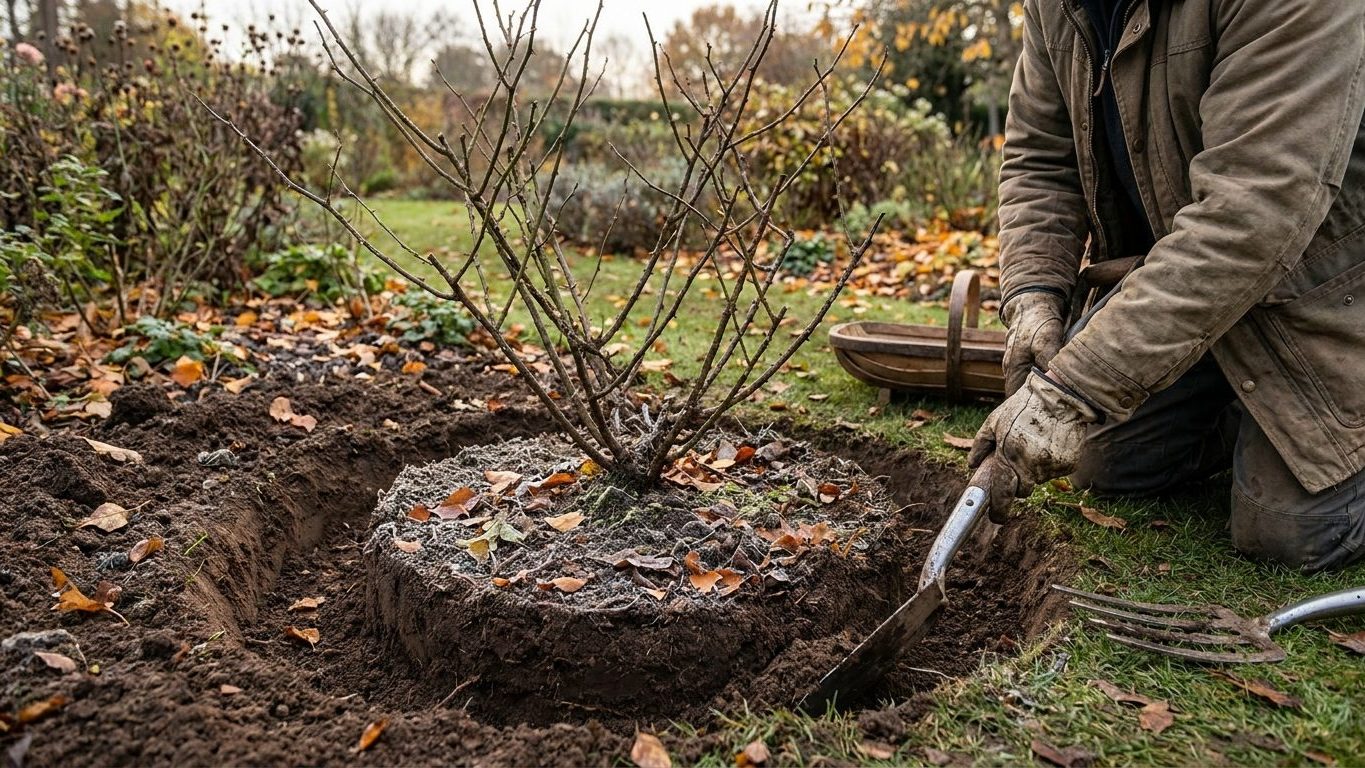

The best time to move a rose bush is while it’s dormant, after the leaves have dropped and before the buds swell for spring growth. The root ball you dig should roughly match the spread of the canes above ground, since that’s the portion of roots doing the daily work of feeding the plant. Take less than that, or move it at the wrong moment, and the bush spends the next season recovering instead of blooming.
Why this matters
Every root you sever during a move is water and nutrients the top growth can no longer count on. A rose is rated high maintenance with a medium growth rate, according to the NC State Extension Gardener Plant Toolbox, which means it doesn’t have much surplus energy to burn on repairing itself. If the root ball you take is too small for the size of the plant, the canes above ground keep demanding more water than the roots can supply, and the mismatch shows up as wilting canes, scorched leaf margins, or buds that never break at all.
Skip the timing and the same problem compounds. Move a rose while it’s carrying leaves, flowers, or hips, and you’re asking it to keep several jobs running (feeding foliage, ripening fruit, healing cut roots) with a smaller root system than it had an hour earlier. A badly timed, badly sized move rarely kills a rose outright, but it commonly costs a full season of bloom, and on a budded rose it can push dieback all the way down to the graft union.
When to do it
Watch the plant, not the calendar. The right window opens once the canes are bare and the buds along them are tight and closed, a sign the plant has gone fully dormant. It closes again once those buds start to swell and show color, because that’s new, soft growth starting to draw on the roots you’re about to disturb. Moving in between those two points, while the plant is doing nothing above ground, is what lets the root system recover before it’s asked to support leaves again.
Avoid the move during active flowering or while hips are forming in fall. Both stages mean the plant is pushing resources upward, and pulling roots out from under it at the same time doubles the stress. A rose that’s already ripening its wood for winter, with growth that has firmed up rather than staying soft, is closer to the safe window than one still pushing tender new shoots that haven’t ripened.
Because dormancy timing tracks your local frost pattern, and this genus spans USDA zones 5a through 11b, the actual weeks when a plant in Minnesota goes dormant look nothing like the weeks in coastal Georgia. Your state-specific rose guide is the place to pin down the exact window; this page covers the mechanics that hold true everywhere.
How to do it
Start with the new hole, not the old plant. Roses need full sun, at least six hours of direct light a day, and soil that’s clay or loam with a pH somewhere between acid (below 6.0) and neutral (6.0 to 8.0). Dig that hole and have it ready before you touch the rose you’re moving, so the roots spend as little time as possible out of the ground.
Sizing and digging the root ball
Look at the spread of the canes and use that as your guide for how wide to dig. A rose with a canopy roughly three feet across needs a root ball in that same ballpark, not a token scoop from one side. Mark a circle around the base of the plant at that radius, then cut straight down with a spade along the full circle before you try to lift anything. Going wide matters more than going deep: work the spade under the root mass at an angle from several points around the circle until you feel the plant loosen, rather than levering hard from one side, which tends to snap the thicker roots instead of freeing them.
Once the ball lifts free, get it onto a tarp, an old sheet, or straight into a wheelbarrow. Keep it moist and out of direct sun and wind while you move it. Exposed feeder roots dry out within minutes, and that damage doesn’t show until weeks later, when the plant suddenly wilts despite regular watering.
Replanting
Set the root ball in the new hole at the same depth it was growing before. This is the point where checking the plant’s tag matters: on a budded rose the graft union needs to sit at the depth appropriate for your zone, and on an own-root rose it’s the crown you’re Protecting instead. Backfill with the native soil, firming it in stages rather than dumping it all at once, so there are no large air pockets left around the roots. Water in immediately and thoroughly, enough to settle the soil fully around the root ball, then add a layer of mulch over the root zone without piling it against the canes.
Done right, the plant looks almost unremarkable in the days after: canes upright, no dramatic wilting, no scorched leaf edges if it still had any leaves on. The real test comes with the next flush of buds, which should swell and break on a normal schedule if the root ball did its job.
What goes wrong
The single most common failure is a root ball that doesn’t match the top growth. Dig a small, tidy ball around a large bush and you’ve guaranteed a water shortage the moment growth resumes; the symptom is wilting canes that don’t recover even after watering, because the roots simply aren’t there to take the water up.
Letting roots sit exposed while you fetch a wheelbarrow or finish digging the new hole is the second. Fine feeder roots die from air exposure faster than most people expect, and because the damage is invisible at the time, it gets blamed on something else weeks later when the plant collapses.
Planting too deep smothers the crown or union; planting too shallow leaves it exposed to temperature swings your zone’s mounding schedule was designed to prevent. Both look like small errors and both are corrected by matching the original planting depth.
The mistake that looks like extra care but isn’t: feeding the plant right after the move. A newly transplanted rose has a reduced root system trying to support the same amount of top growth, and fertilizer pushes that top growth harder, not slower. The result is soft new shoots the roots can’t keep watered, which wilt faster than shoots on a plant left alone to settle in on plain water for the first few weeks.
Doing it differently
Not every rose sits in open ground with roots spread wide through native soil, and the method shifts a little depending on how the plant has been growing.
| Growing method | What changes | Best approach |
|---|---|---|
| Container-grown | Root ball is already confined to the pot’s shape | Slide the whole root mass out intact rather than digging around it; less root loss overall |
| Raised bed | Loose, worked soil makes for easier digging and pH control | Take a generous ball anyway; loose soil doesn’t mean fewer feeder roots to protect |
| Greenhouse-grown | Dormancy cues from day length and cold are muted indoors | Judge readiness by bud tightness and wood that has ripened, not by season |
Rootstock is the other variable worth checking before you dig. Hybrid teas, grandifloras, and many climbers are typically budded onto a rootstock, while most landscape shrub roses sold today, Knock Out and Drift among them, are grown on their own roots with no union at all. An own-root rose that loses a stem below soil level can regenerate from that section; a budded rose depends entirely on the union staying intact, which makes protecting it during the move worth the extra minute of care.
Common questions
Can you move a rose bush while it’s in bloom?
It’s better not to. A blooming or hip-bearing plant is already directing energy above ground, and cutting its roots at the same time asks it to manage two demands with fewer resources than it had a day earlier. Wait until the plant is dormant and the canes are bare.
How much of the root ball should you actually take?
Match it to the canopy spread above ground rather than digging a small, convenient scoop. A wider, shallower ball generally captures more of the working root system than a narrow, deep one, since digging wide around the full circle of the plant is what preserves the roots rather than tearing through them.
Do roses go into shock after being transplanted?
Some stress is normal, usually showing as slower bud break or a lighter first flush of bloom. Wilting that persists past the first couple of weeks, or canes that die back toward the base, points to a root ball that was too small or roots that dried out during the move rather than ordinary settling in.
Does it matter whether the rose is own-root or grafted?
Yes, in what you’re protecting during the move. On a budded rose, the graft union needs to go back into the ground at the correct depth for your zone; on an own-root rose, it’s the crown that matters instead. Check the plant tag before you dig if you’re not sure which one you have.