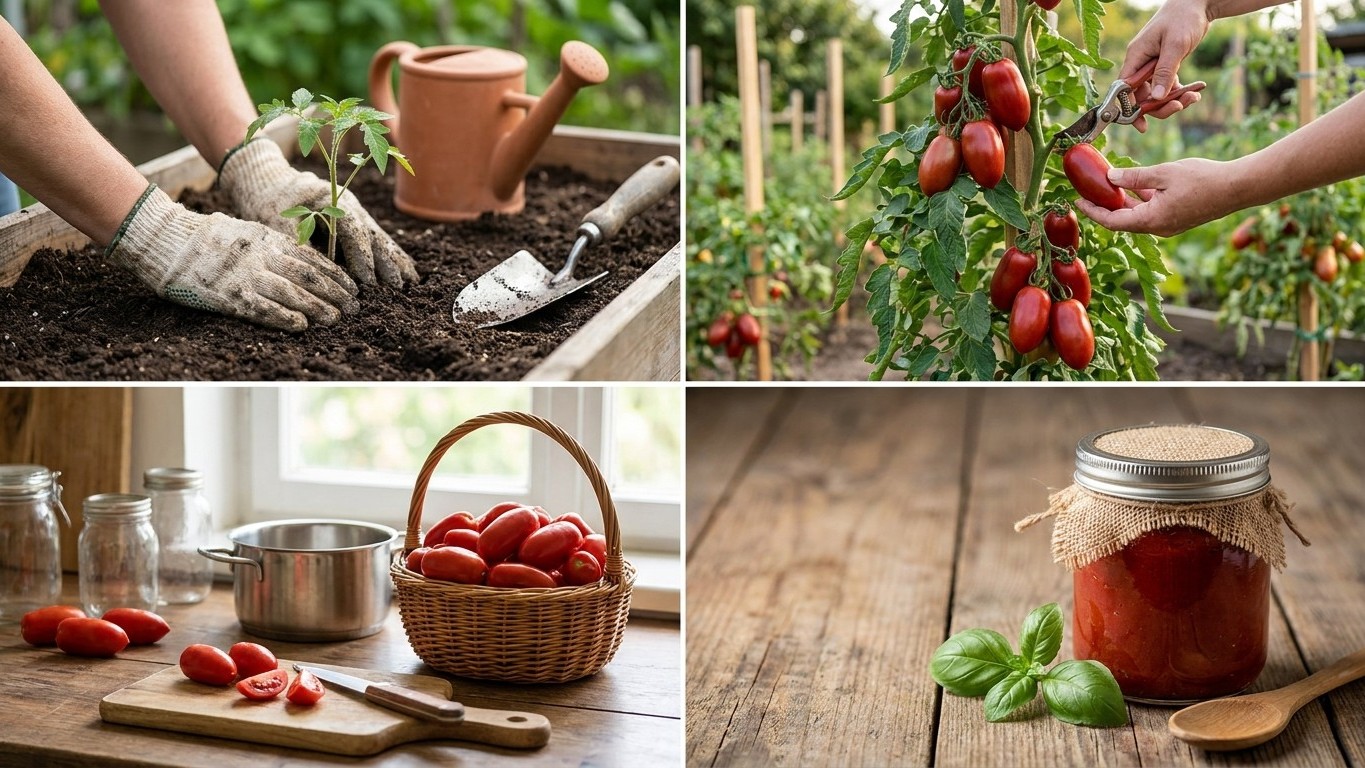

Plum Regal is a determinate paste tomato bred for sauce, canning and dicing, producing oblong red fruit with thick walls and a small seed cavity. Seed catalogues list it at about 75 days from transplant, not from the day you sow the seed packet. Whether that clock actually finishes before your first fall frost depends entirely on where you garden. Before you start trays, pull up your region’s average frost-free window and hold it against that 75-day figure.
What Plum Regal actually is

Plum Regal grows as a determinate plant, meaning it stops extending once it sets a fixed number of flower clusters, then ripens most of its fruit in a concentrated flush over a few weeks rather than trickling out tomatoes until frost. That habit matters for planning: you get one big canning day, or two close together, not a slow drip all summer. It also means the plant stays compact enough for a single stake or a short cage, without the sprawling six-foot cage an indeterminate variety demands.
The fruit itself is classic paste shape: oblong, blocky, deep red at full ripeness, with thick walls and little of the watery gel that slows down sauce-making. Seed catalogues put days to maturity at roughly 75 days counted from transplant, the day a started seedling goes into the garden, not the day the seed goes into a tray indoors. Add another four to six weeks of indoor growing time before that transplant date, and the total time from seed to first ripe fruit runs closer to three and a half months. If you’re still weighing paste types against slicers and cherries, the full rundown of Tomato Varieties lays out how determinate and indeterminate habits change the workload before you settle on one.
What Plum Regal is good for
Paste tomatoes carry less internal moisture than a slicer, and Plum Regal follows that pattern. Cut one open and you’ll find small seed cavities and dense, meaty flesh rather than the loose, juicy gel sacs that make a beefsteak run when you slice it. That difference is the whole reason paste tomatoes exist as a category: less water means less time standing over a pot boiling liquid off before a sauce thickens. Where a salad tomato needs draining or seeding to keep a sauce from turning watery, Plum Regal’s flesh cooks down close to how it comes off the vine.
That’s also why it’s a poor choice for the uses a slicer or cherry handles well. Fresh in a salad, or on a sandwich, the same low water content that speeds up sauce reads as dry and dense rather than juicy and refreshing. Nobody eats a paste tomato straight off the vine the way you’d pop a cherry tomato while walking the garden; the texture and proportions are built for the pot, not the hand.
The stated flavor is described only as good, paired with a deep red color once fully ripe. Beyond that, no specific balance of sweetness to acidity, no brix number, and no side-by-side tasting comparison against other paste varieties has been published, so it isn’t accurate to promise a particular taste profile here. What can be said with more confidence comes from the category itself: paste tomatoes are bred for cooked, concentrated uses rather than fresh eating, and Plum Regal’s listed uses of sauce and canning confirm it was developed with that end point in mind. If you’re canning a batch or reducing a sauce for the freezer, this is the kind of tomato that shortens the job; if you want something to eat raw in a summer salad, look elsewhere in the lineup.
Where it ripens in time, and where it is a gamble
The arithmetic that decides this is simple, even where the local dates are not. Take your frost-free window, subtract roughly two weeks at the start because soil needs to warm before a tomato transplant goes in without stalling, then subtract the 75-day catalogue figure for Plum Regal. Whatever is left is your picking margin, the days between first ripe fruit and the season’s first frost. A margin under thirty days means one flush and no room for a cool year, because a late-summer cold snap can push the first ripe date back further than the margin allows.
Where the margin runs out
At the tight end, Yukon, using the reference station of Whitehorse, shows a set-out in mid June and a first-ripe date in early September, but that timing lands the fruit eight days after the average first frost. That is a negative margin. The same station only accumulates around 600 degree-days across the growing season, which is short of what a tomato plant needs regardless of how many frost-free days it gets, so the verdict there is impossible without a greenhouse or tunnel. Nunavut, at the Rankin Inlet station, is tighter still, three days short even with a July set-out.
Moving one step warmer, Northwest Territories, at Yellowknife, sets out in early June and sees first ripe fruit by late August, leaving a 27-day margin. That is enough for one wave of fruit if the season runs true to average, but a cool year erases it entirely, and Yellowknife’s degree-day total of around 905 is still on the short side for a full paste-tomato crop. Alberta, using Calgary as the reference station, does slightly better: a 29-day margin from an early-June set-out to a mid-August first ripe date, with roughly 1171 degree-days accumulated, still a risky verdict rather than a comfortable one.
Where the margin is wide
At the other end of the scale, margin stops being the limiting factor at all. Texas, at the Houston station, sets out in mid February to mid March and gets first ripe fruit by late May, for a 186-day margin. Louisiana, at New Orleans, does even better at 223 days. In Territories like these the question shifts entirely from “will it ripen before frost” to “will it ripen at all during the hottest stretch,” which the next section covers.
| Territory | Reference station | Margin | Verdict |
|---|---|---|---|
| Yukon | Whitehorse | -8 days | Impossible outdoors |
| Northwest Territories | Yellowknife | 27 days | Risky, one flush |
| Alberta | Calgary | 29 days | Risky, one flush |
| Manitoba | Winnipeg | 33 days | Greenhouse helps |
| Texas | Houston | 186 days | Comfortable |
| Louisiana | New Orleans | 223 days | Comfortable |
For anywhere between those extremes, the same math applies. Look up your area’s frost-free window from a reliable local source, subtract two weeks and 75 days, and see what margin remains. A result under thirty days calls for row cover on standby and a realistic expectation of one harvest wave rather than a long trickle.
The two ways a season goes wrong
A long frost-free window on paper does not guarantee a good crop, and there are two separate ways it can fall short. In cooler territories, accumulated warmth can run out even when the calendar days between last frost and first frost look generous. Degree-day totals in the low hundreds, like the roughly 600 recorded near Whitehorse or the 905 near Yellowknife, mean the plant spends its frost-free days sitting cold rather than actively building fruit, regardless of how many of those days there are. Nights that stay below 50°F stop pollen from setting altogether, which is a separate problem from frost and one a frost-date table never shows.
In hot territories, the failure runs the other direction. Once daytime temperatures push past roughly 86°F, tomato pollen goes sterile and flowers drop without setting fruit, which is why growers in places like Florida, South Carolina and Nevada plan around two separate cropping windows, a spring planting and an autumn planting, rather than one continuous season through the hottest months.
For Plum Regal specifically, the cold-side limit matters more than the heat-side one, because its 75-day maturity is on the shorter end for a paste tomato and it needs less accumulated warmth than an 85- or 90-day variety to finish a crop. In northern gardens it is the better bet of the two problems to have. In the hottest southern territories, its relatively quick turnaround actually helps growers fit a full crop into the spring window before the midsummer pollen shutdown arrives, and again into the shorter autumn window afterward.
What it resists, and what it does not
Plum Regal carries genuine disease resistance, and the grading matters because not all of it means the same thing. It has high resistance to Late Blight, the disease responsible for whole-plant collapse in wet years, and high resistance to both Verticillium Wilt and Fusarium Wilt races 1 and 2, soil-borne problems that otherwise build up in a bed over successive tomato seasons.
Its resistance to Early Blight is graded intermediate, which is a meaningfully different promise. Intermediate resistance slows the disease and reduces how badly it spreads, it does not stop early blight from showing up at all. A grower who treats intermediate resistance as immunity and skips mulching or lower-leaf pruning still ends up with the characteristic dark, ringed spots on the oldest foliage by midsummer, just later and lighter than on an unresistant variety.
The catalogue lists no resistance beyond those four diseases, so common problems like septoria leaf spot, bacterial spot and bacterial speck can still take hold and need the usual foliage hygiene: drip irrigation instead of overhead watering, spacing that lets leaves dry, and removing lower leaves that touch the soil. Growers comparing paste tomatoes for a disease-heavy garden sometimes look at Marbonne alongside Plum Regal, since it carries its own separate resistance profile worth checking against the same list of problems in your soil.
Growing it without the usual mistakes
Support and spacing
Because Plum Regal is determinate, it does not need the tall, reinforced cage or the season-long string trellis an indeterminate slicer requires. A single sturdy stake or a standard tomato cage set at planting time is usually enough, since the plant stops gaining height once it sets its final flower clusters. Space plants far enough apart that the concentrated flush of fruit does not sit in a humid, shaded canopy, which is exactly the condition that lets early blight and bacterial spot take hold despite the plant’s own resistance.
Feeding and the flush
Stop nitrogen feeding once the first fruit clusters are set. Determinate plants that keep getting pushed with nitrogen put energy into leaf growth they no longer need, at the cost of the one fruit set that determines the whole harvest. A balanced feed through early growth, then a switch to something lower in nitrogen once flowering starts, keeps the plant’s energy going into the fruit instead of the foliage.
The mistake its timing invites
Because the entire crop ripens in a short window rather than trickling out, the main mistake growers make with Plum Regal is treating it like a slicer they can pick a few at a time. That leads to overripe fruit splitting on the vine while the grower waits for “enough” to make canning worthwhile. Plan the canning or sauce-making session before the flush arrives, not after.
- Stake or cage at transplant, not after the plant is already sprawling.
- Stop nitrogen once fruit sets, switch to a lower-nitrogen feed.
- Water evenly, since inconsistent moisture on thick-walled paste fruit shows up fast as blossom end rot.
- Set a canning date before the flush ripens, since most of the crop turns at once.
An indeterminate variety like Black Cherry asks for the opposite discipline entirely, since it keeps flowering and needs steady feeding all season instead of a hard stop. Knowing which kind of plant is in the ground changes almost every decision after transplant, from staking to when you put the pruners down for good.
Common questions
How many Plum Regal plants do I actually need for canning?
Most home canners plant more than they think they need for a single determinate variety, since the whole crop ripens together rather than spreading out. A handful of plants, staggered by a week or two in transplant date if you have the space, spreads the flush out enough to manage in more than one canning session.
Can I grow Plum Regal in a container?
Yes, its determinate, compact habit suits a large container better than a sprawling indeterminate variety would. Use the biggest pot you can manage, since even a determinate paste tomato needs a deep root run to support a full fruit load.
Why are my Plum Regal tomatoes cracking before they’re fully red?
Cracking on paste tomatoes usually comes from uneven watering, particularly a dry spell followed by heavy rain or a deep soak once the fruit is already sizing up. Keep watering consistent through the ripening flush rather than catching up all at once.
Is Plum Regal the same as Roma?
No, they are different cultivars with different disease resistance packages, even though both are determinate paste tomatoes with oblong red fruit. Roma carries a different, generally narrower resistance profile, so check the seed packet for the specific diseases each protects against rather than assuming they perform the same.