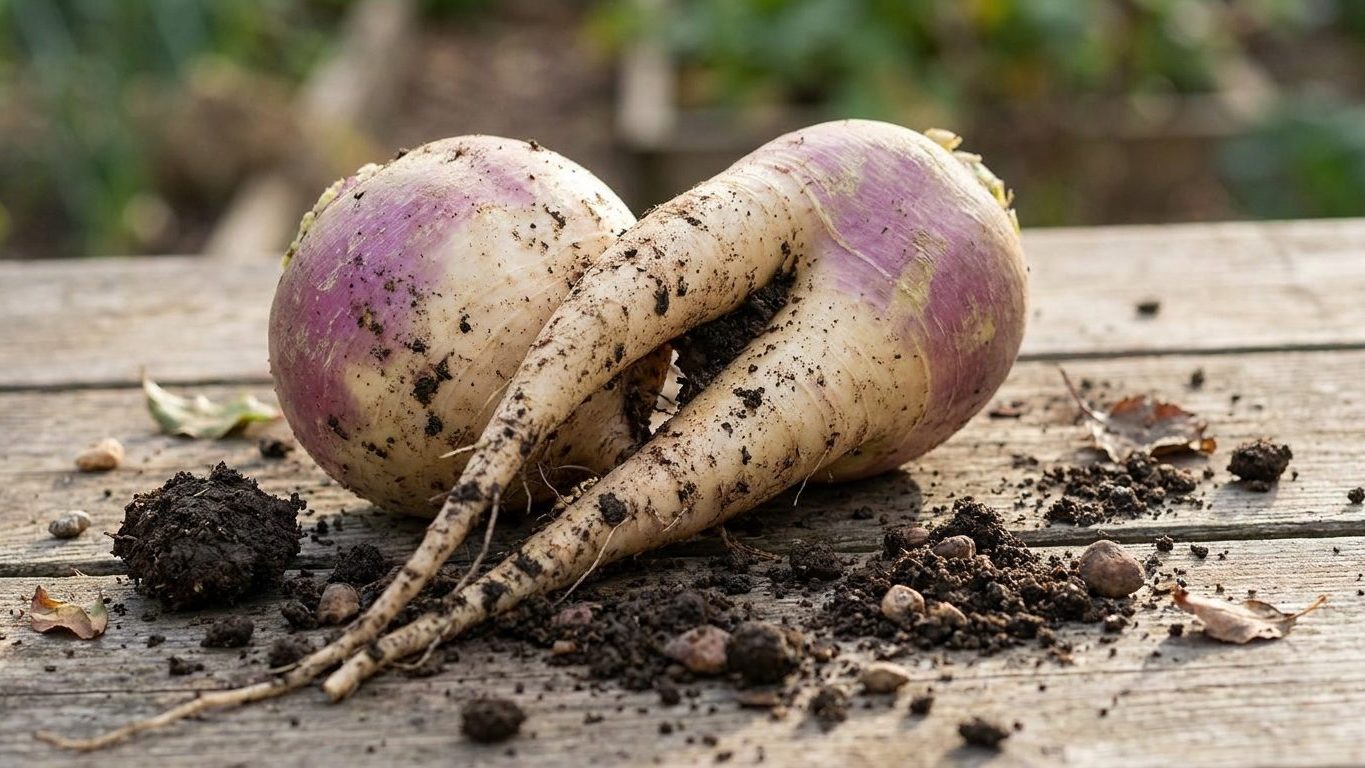

A forked turnip or a split rutabaga isn’t a plant that went wrong. It’s a root that met something it couldn’t grow through, or that grew too fast in one spot and not another. The obstruction happened weeks before harvest, usually in the top few inches of soil, and by the time you pull the root the decision has long since been made.
What is actually going on

A turnip or rutabaga starts as a single taproot pushing straight down. That root is soft and blunt at the tip for only a short window. If it meets a stone, a hard clod, a chunk of undecomposed bark, or a patch of compacted soil during that window, it doesn’t push through. It splits and sends two (or three) growing points around the obstacle. Once split, the root never reunites. You get the classic forked shape, sometimes with a thick main body and a thin second leg, sometimes with two roots of nearly equal size fused at the shoulder.
Forking from a physical obstruction is the most common cause, but it isn’t the only mechanism. Fresh, undecomposed organic matter, especially raw manure worked in shortly before sowing, does something similar for a different reason. It creates pockets of uneven fertility and moisture right where the root is trying to grow. High nitrogen close to the root also pushes the plant toward leafy top growth and hairy, branching roots instead of one clean taproot. That’s a stress-and-imbalance fork rather than a mechanical one, but the visible result looks much the same at harvest.
A related but separate problem is splitting, sometimes called growth cracking. This happens after the root has already sized up, when a dry spell is followed by heavy watering or rain. The outer tissue has hardened and can’t expand fast enough to match the sudden swelling inside, so it splits open along the root, usually lengthwise. It’s a moisture problem, not an obstruction problem, and the fix is different: even, consistent watering rather than clearing the soil.
Neither forking nor splitting is a disease, but the open wounds they create are an invitation for one. Turnips and Rutabaga are brassicas, in the same family as cabbage, kale, and mustard, and they share that family’s full list of soil-borne diseases and root pests. A split root sitting in damp soil is exactly the kind of entry point that lets rot organisms in. That’s a separate topic worth its own attention on this site’s turnip and rutabaga pests and diseases guide, and it’s also the reason rotation matters, covered in the brassica crop rotation guide. A gardener who rotates turnips into a bed that grew cabbage the year before hasn’t rotated anything at all.
At harvest, a forked or split root isn’t automatically a loss. Inspect the crack or the fork point closely. If it’s clean, dry, and the flesh underneath looks firm and pale, it can usually still be used promptly. A soft patch, a weeping or slimy spot, or any sign of mold at the crown or in the split ends the question, and that root goes to the compost pile, not the kitchen.
In the garden
Most forking traces back to what happened to the soil before the seed ever went in, not to anything done afterward. The table below walks through the steps that actually prevent it, and what tends to happen when each one gets skipped.
| Step | Why it matters | What happens when it’s skipped |
|---|---|---|
| Loosen soil a full spade depth before sowing | Gives the taproot a clear, uncompacted path straight down | The root hits a hard layer partway down and forks or stops short, staying stubby and thick-shouldered |
| Pick out stones and hard clods from the sowing row | Removes the physical obstacles the young taproot can’t push past | Any stone bigger than a marble sitting in the row becomes a near-certain fork point |
| Work in compost the season before, not raw manure right before sowing | Gives organic matter time to break down into even, stable fertility | Fresh manure creates nutrient hot spots and excess nitrogen near the root, producing hairy, forked, or oddly lobed roots and heavy top growth at the root’s expense |
| Sow directly in place rather than transplanting | Keeps the taproot tip undamaged from the start | Transplanting bruises or bends the fragile root tip, and a bent or nicked tip almost always forks |
| Thin seedlings early, before roots start to swell | Gives each root room to size up without competing for space | Crowded roots deform against each other and against neighboring roots, coming out flattened or twisted rather than forked, but just as unusable |
| Water evenly through the growing period | Keeps the root growing at a steady rate | A dry stretch followed by a heavy soak causes the outer skin to split open once the root swells suddenly |
None of these steps requires a particular cultivar. The mechanism is soil and moisture, not genetics, though some rounder, faster-maturing types are marginally more forgiving of shallow soil than the long-rooted types. For which specific varieties perform well in a given region’s soil and season length, the state’s cooperative extension service runs its own variety trials and is a better source than any general guide.
One more point worth separating out: sandy, loose soils that drain fast are far more forgiving of all of this than heavy clay. Clay holds stones and clods in place, dries into hard chunks that resist a young taproot, and swings harder between waterlogged and bone-dry, which stacks both forking risk and splitting risk in the same bed. If clay is what you’ve got, the loosening step in the table above matters more here than anywhere else on the list.
What it depends on where you are
The mechanism behind forking, an obstruction in the soil or a nutrient imbalance near the root, is the same everywhere in the country. What changes by region is how much pressure gets put on that mechanism, and that comes down mostly to season length, summer heat, and rainfall pattern.
A short, cool growing season limits how long the root spends underground and gives less time for a dry-wet swing to cause splitting, but it also compresses the sowing window, which pushes some gardeners toward transplanting to save time, and transplanting is one of the surer ways to cause a fork. A long, hot summer does the opposite: more time in the ground means more opportunity for a stretch of drought followed by a downpour, which is exactly the splitting scenario described earlier. Regions with heavy, sudden summer rain after dry spells see more splitting complaints than regions with steady, evenly spaced rainfall, regardless of soil type.
Soil texture also varies enormously by state and even by county within a state, glacial till, coastal sand, prairie loam, and Southern clay all behave differently underfoot, and that’s exactly the kind of detail a national guide can’t responsibly guess at. This site’s state-by-state turnip and rutabaga guides go into what’s typical for local soil and climate, and they’re a better starting point than trying to generalize from a national average.
For anything more specific, like the exact timing that works for a particular garden, or a soil test that tells you what’s actually in the ground rather than what’s typical for the region, the local cooperative extension service remains the most reliable source. It’s the one resource that’s both free and calibrated to the reader’s actual dirt, rather than to a national midpoint that may not describe it well at all.
The mistake that costs the most
If there’s one habit that produces more forked and misshapen turnips and rutabagas than everything else combined, it’s working fresh manure into the bed shortly before sowing. It feels like a generous, natural thing to do, and it’s often recommended in a general “feed your soil” way that doesn’t distinguish between manure applied months ahead and manure applied days ahead. The timing is the entire difference.
Raw manure breaks down unevenly in the soil. In the weeks right after it’s worked in, it creates pockets of concentrated nitrogen and salts sitting right where a young taproot is trying to grow straight and steady. The root reacts to that unevenness by branching, by growing hairy side roots, or by forking outright, the same defensive splitting response it has to a stone or a hard clod, except this time the obstacle is chemical rather than physical. On top of the shape problem, fresh manure applied close to sowing carries a real food-safety concern for root crops that will be eaten raw or lightly cooked, since it takes time in the soil for pathogens to die off.
The fix isn’t to skip organic matter. It’s to move it earlier. Work manure into the bed the season before, or use well-finished compost instead of anything fresh, so that by the time the turnip or rutabaga seed goes in, the soil is even, stable, and free of the hot spots that trigger forking. If a bed absolutely needs a fertility boost right before sowing, a light, balanced feeding is a far safer choice than raw manure, and it won’t push the plant toward top growth at the root’s expense the way excess nitrogen does.
Get that timing right, and most of the forking problem disappears before the seed is even in the ground, no matter what the stones and clods in that particular patch of soil decide to do.