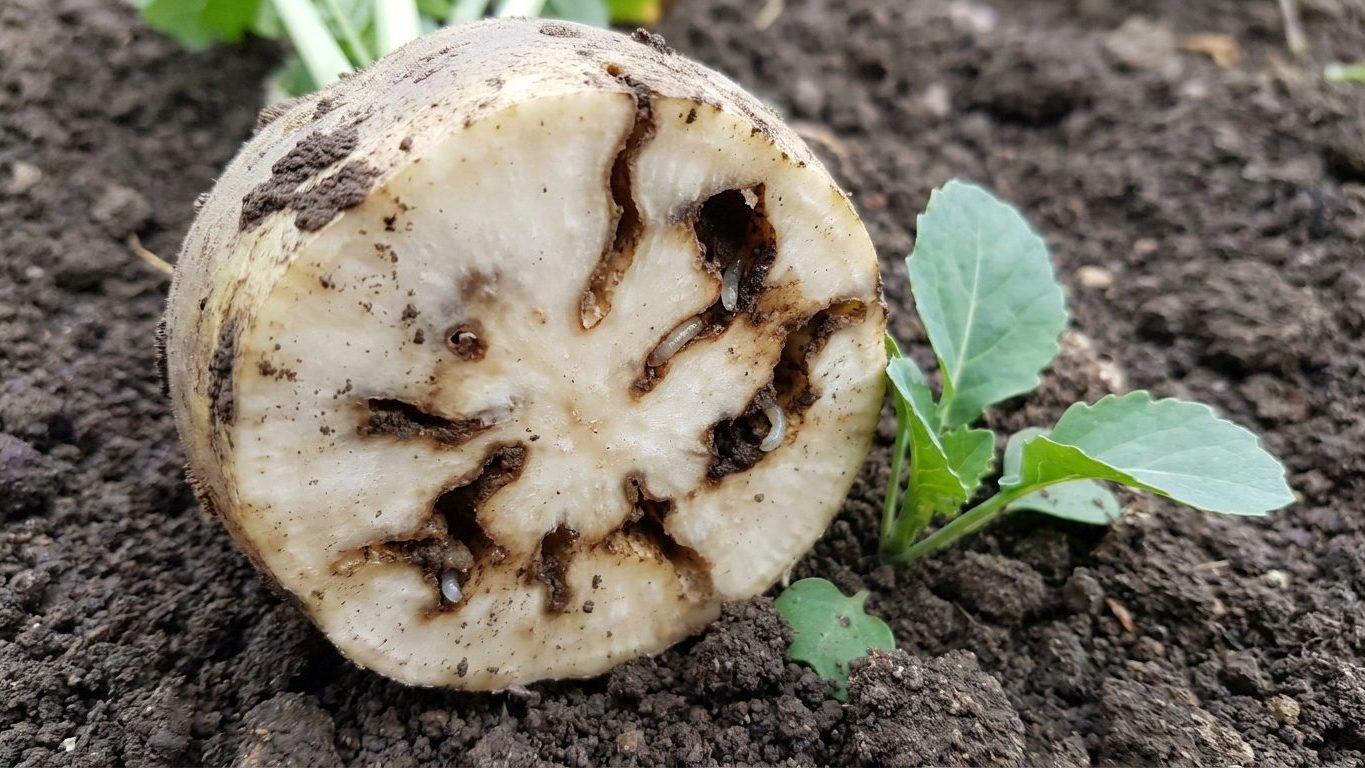

Root maggots are the larvae of a small gray fly that lays its eggs right at the base of turnip and rutabaga plants. The larvae hatch and tunnel straight into the developing root, leaving narrow brown channels that ruin texture and invite rot. By the time you see the damage, the crop is already compromised, so prevention before egg-laying is the only strategy that actually works.
What is actually going on

The fly responsible looks unremarkable, roughly the size of a housefly but slimmer, and it does its damage in a single, narrow window. The adult female is drawn to the smell of a young brassica stem pushing through the soil. She lays her eggs in the soil crack right at the base of the plant, often within an inch of the stem. Within a few days, tiny white larvae hatch and immediately burrow downward, following the root as it thickens. They feed inside the flesh, creating winding tunnels that fill with frass and, soon after, with the bacteria and fungi that turn a tunnel into a soft, weeping rot pocket.
This is a generational pest, not a one-time event. In most regions there are two to four generations between spring and fall, each timed to soil temperature rather than the calendar. The first generation is usually the most damaging because young seedlings have thin, tender roots that offer little resistance to a hungry larva. Later generations tend to hit maturing roots, which is exactly why a fall-planted turnip or rutabaga can look perfectly healthy in September and reveal a maze of tunnels when you finally lift it in October.
Part of what makes this pest hard to manage is that it overwinters as a pupa in the soil, sometimes just a few inches below where last year’s crop grew. Adults emerge in spring when soil temperatures cross a threshold, mate within days, and start the cycle again close to the same patch of ground. That single fact, that the fly’s home base is the soil itself and not the plant, explains why so many otherwise careful gardeners still lose roots to this pest year after year.
Turnips and Rutabaga are brassicas, in the same family as cabbage, kale, broccoli, and mustard, and this fly does not distinguish between them. A bed that hosted cabbage last season and rutabaga this season has not rotated anything from this pest’s point of view, because the pupae simply waited in the soil for the next brassica to show up. Anyone building a planting plan around this pest needs to look at the site’s full brassica history, not just what grew in that exact bed, and the rotation guide on this site walks through how to plan that further out.
In the garden
Managing this pest is less about a single fix and more about stacking several small interventions, each timed to a different point in the fly’s life cycle. Skip one and the others carry more weight than they can bear.
| Practice | Why it works | What happens when it’s skipped or mistimed |
|---|---|---|
| Floating row cover installed at seeding or transplanting | Physically blocks the adult fly from reaching the soil crack where she lays eggs | Even a two-day gap between planting and covering gives the fly enough time to lay; covers put on “eventually” often go on after the damage is already done |
| Delaying planting past the first spring emergence peak | Reduces the number of adult flies active when your seedlings are most vulnerable | Planting at the very first mild week of spring lines seedlings up with peak fly activity in many regions, which is backwards from what most gardeners assume |
| Rotating brassica plantings across the whole yard, not just one bed | Moves new plantings away from soil where pupae are waiting | Rotating within a bed that still borders last year’s cabbage patch does very little, since adult flies can walk and fly short distances easily |
| Removing and destroying spent brassica roots and stems after harvest | Eliminates a food source and hiding spot for larvae still finishing their cycle | Leaving pulled tops in a compost pile at the edge of the garden just relocates the next generation a few feet away |
| Checking the soil surface at the stem base for small white eggs | Gives an early warning before larvae tunnel out of reach | Waiting for wilting leaves as the first sign means the roots are usually already tunneled by the time you notice |
Row covers do the heaviest lifting here, but they only work if the edges are sealed into the soil, since a gap at the corner is an open door. Covers also need to come off before flowering in crops grown for seed, or stay on the whole season for a root crop that’s simply being harvested for eating, since there’s no pollination need to weigh against the protection.
Rotation is worth doing, but only as one layer among several, not as the main defense. A gardener who moves rutabaga to the opposite end of a small yard from where cabbage grew, while skipping the row cover, is still relying on the fly not finding the new bed, and these flies are perfectly capable of covering that distance. The two practices work best together: rotation reduces the size of the local pupae reservoir over a few years, while row covers block whatever adults do show up in a given season.
What it depends on where you are
How much of a threat this pest poses, and how many generations show up in a season, depends heavily on local climate, and this page can’t tell you what that looks like on your street. Regions with a long, cool spring tend to see a slower buildup of the first generation, giving row covers more margin for error. Regions where spring warms quickly into summer heat often compress that first generation into a narrow window, which makes the timing of planting and covering far less forgiving.
Summer rainfall matters too, in a way that’s easy to overlook. Moist soil around the stem base makes it easier for the female fly to lay eggs and easier for young larvae to move through the soil to find the root. In a dry summer with irrigation limited to drip lines away from the stem, that same soil crack can be a much harder target, which sometimes lowers pressure from later generations even without any extra effort from the gardener.
The number of generations per year is not the same nationwide, and neither is the calendar for when the first flight happens. Some regions deal with two generations a season; others, with longer warm periods, see three or four, which changes how many separate windows of vulnerability a fall rutabaga crop has to get through compared to a quick spring turnip.
None of this is guesswork you should have to do alone. State cooperative extension services track local emergence timing, generation counts, and regional pressure for this exact pest, often down to the county level, and that’s the most reliable source for translating the general pattern described here into a planting calendar that fits your soil and your summers. The state-by-state guides on this site are a starting point for finding that local detail, and this cluster site’s parent guide on Turnips and Rutabaga connects the seasonal timing with pest pressure across each stage of growth.
The mistake that costs the most
The single costliest mistake is treating crop rotation as sufficient protection on its own, and skipping the row cover because “we moved it to a different bed this year.” Rotation slows the buildup of pupae in one specific patch of soil over several seasons, but it does nothing to stop an adult fly from walking or flying a short distance to find the next brassica planting, especially in a yard where turnips, rutabaga, cabbage, and kale all rotate through a handful of beds within sight of each other.
What that mistake looks like in practice: seedlings go into a bed that’s technically new for brassicas this year, no cover goes on because the gardener feels the rotation has already solved the problem, and by the time roots are pulled in fall, a share of them show the telltale tunnels running through the flesh. The plants often looked completely fine above ground all season, which is exactly what makes this pest so easy to underestimate until the shovel goes in.
The fix is to treat row cover as the primary tool and rotation as the supporting one, not the other way around. Cover goes on at planting, sealed at the edges, and stays in place through the vulnerable weeks your local extension service identifies for the first flight in your area. Rotation still matters, planned across the whole yard rather than bed by bed, but it buys time and reduces pressure over years rather than guaranteeing safety in any single season.
At harvest, the habit that matters most is inspecting every root before it goes into storage. A tunnel by itself might look minor, but any root showing a soft patch, a weeping spot, or a moldy crown around a tunnel entrance should be set aside rather than stored, because storage conditions that suit good roots suit spreading rot just as well. No amount of careful curing turns a compromised root safe; the inspection at harvest is the only checkpoint that counts, and no cultivar choice, however resistant it’s advertised to be, replaces it. Your state extension service can confirm which varieties have shown better tolerance in regional trials, but tolerance has never meant immunity for this pest.