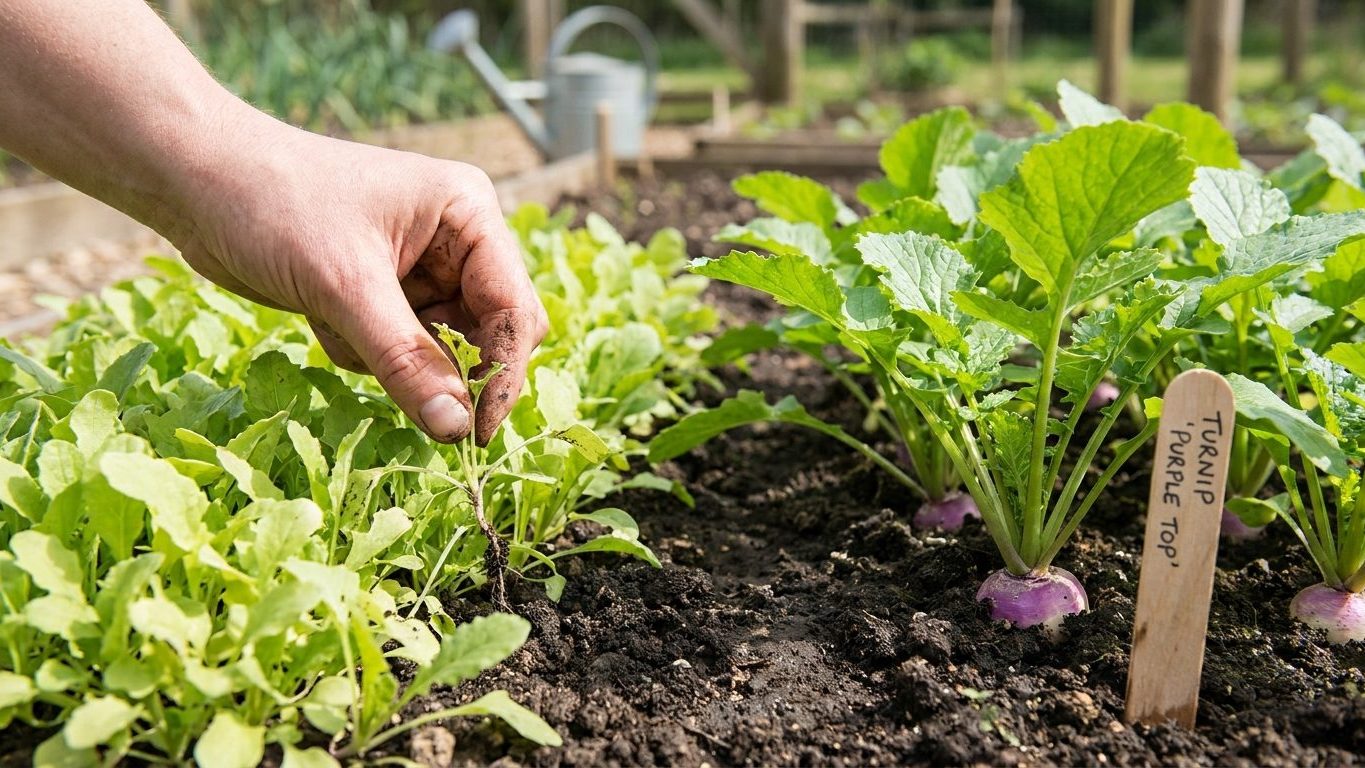

Thin Turnips and Rutabaga as soon as the first true leaves appear, cutting or pinching extra seedlings rather than pulling, and space the survivors according to whether you’re growing a fast salad turnip or a rutabaga bound for winter storage. Wait past that window and the roots you harvest will be small, forked, or barely there at all, no matter how good the soil.
What is actually going on

The thing to understand here is competition: seedlings left crowded compete for the light and the space a root needs to swell. A turnip or rutabaga root isn’t a passive storage tank that fills up regardless of conditions. It’s the plant’s response to having enough room, enough light hitting the leaves, and enough undisturbed soil to push sideways as it thickens. Crowd four or five seedlings into the space one needs, and each plant puts its energy into reaching for light with taller, thinner leaves instead of building a root. The tops can look perfectly green and healthy. Underground, nothing much is happening.
This is why the failure is so easy to miss until it’s permanent. A stand of unthinned turnips looks like a thriving row of greens for weeks. Gardeners check on it, see leafy growth, and assume the roots are catching up somewhere out of sight. They’re not. Once seedlings have spent several weeks growing shoulder to shoulder, the ones that lost the early competition rarely recover even after thinning, because the root’s shape is largely set in that first stretch of growth. Thin at that point and you’ve mostly just cleaned up a bed that was never going to produce well.
Turnips and Rutabaga are both brassicas, in the same family as cabbage, kale, and mustard, and that matters for more than flavor. A crowded stand is also a stressed stand, and stressed brassica seedlings draw the same insects and fungal problems that hit their cabbage-family relatives. Flea beetles in particular go after thin, crowded seedlings hard, and a bed that’s already competing for light has less reserve to shrug off that pressure. Any pest or disease issue you run into on turnips or rutabaga traces back to the same family tree, which is exactly why rotation matters, and why planting turnips into a bed that grew cabbage or kale the year before isn’t really rotating anything at all. That connection deserves its own attention on the rotation guide in this collection, but it starts right here, at the seedling stage, before the problem even looks like a pest problem.
In the garden
Thinning isn’t a single event so much as a short sequence, and the timing of each pass matters more than most gardeners expect. Rutabaga, which needs a longer season and a bigger final root, generally wants more room between plants than a quick salad turnip does. Below is how the stages typically break down, along with what goes wrong at each one.
| Stage | What to do | What happens if you skip or delay it |
|---|---|---|
| First true leaves | Make an early thinning pass, cutting weaker seedlings at soil level rather than pulling neighbors loose | Roots stay crowded through their critical early growth and never fully recover their shape |
| Two to three weeks after emergence (turnips) | Thin to a few inches between plants, closer for salad types, wider for storage turnips | Leaves grow tall and thin, roots stay small and often turn woody |
| Two to three weeks after emergence (rutabaga) | Thin to a noticeably wider spacing than turnips, since the finished root is larger | Plants compete for years’ worth of soil space packed into one season, producing undersized or misshapen roots |
| Final check a few weeks later | Remove any seedling that’s clearly lagging behind its neighbors | A weak plant keeps drawing water and nutrients without ever becoming a usable root |
Pulling rather than cutting is a common shortcut that backfires. Yanking a seedling out disturbs the roots of the plants left behind, and brassica roots in particular don’t like that kind of jostling. Snipping at the soil line with scissors or simply pinching the stem does the same job without loosening the neighbor’s grip on the soil.
The thinnings themselves aren’t waste. Young turnip and rutabaga greens are tender enough to toss into a salad or sauté like any other brassica green, and using them is the easiest way to make peace with the fact that thinning always feels like throwing away food. It isn’t. It’s redirecting that food from a hundred small plants to the fraction of them that will actually make a root worth harvesting.
One more practical note belongs here, since it comes up as soon as the roots start sizing up: a root that looks fine from above can still be compromised below. When it’s time to check what’s in the ground, or later when roots come out of storage, the same rule applies. A soft patch, a weeping spot, or a moldy crown ends the question regardless of how solid the rest of the root feels. Looks alone don’t confirm a root is sound.
What it depends on where you are
Everything above is a mechanism, and mechanisms don’t change by zip code. Crowded roots lose to competition everywhere. What does change, block by block across the country, is timing: how fast seedlings reach that first-true-leaf stage, how long the growing window stays cool enough for rutabaga to size up properly, and how much summer heat pushes a gardener toward earlier thinning or a different planting date altogether.
A short, cool growing season changes the math in one direction. Gardeners working with a compressed window between spring thaw and summer heat, or planning a fall crop ahead of the first hard freeze, often need to thin a little earlier and tighter, because there’s less time for a lagging plant to catch up later in the season. A longer, milder season allows more slack, but it also often means more pest pressure over a longer stretch, since flea beetles and other brassica pests have more generations to work through.
Rainfall patterns shift the picture too. In regions where summer moisture is unreliable, wider spacing between roots reduces competition for the water that is available, while consistently wet regions can support slightly tighter stands without the same stress. None of that changes the underlying rule that crowded seedlings lose their roots to crowded leaves. It just shifts exactly how many inches “wide enough” turns out to be in a given garden.
This page can’t tell a specific reader their frost dates, their soil temperature in a given week, or which turnip or rutabaga types have performed best in trials for their state, because those answers are genuinely local. The state-level guides in this collection cover season length and regional timing in more detail, and a state extension service can confirm which varieties have actually been trialled and recommended for local conditions. That’s not a hedge. It’s the difference between general knowledge that holds everywhere and specific numbers that only mean something with a location attached.
The mistake that costs the most
The single most expensive mistake isn’t spacing plants an inch too close or an inch too far apart. It’s waiting until the roots have already started to swell before thinning at all. By that point the decision has effectively been made for the season, and no amount of careful spacing afterward reverses months of competition that already shaped how those roots grew.
This mistake is easy to make because it feels responsible. A gardener sees a dense row of healthy-looking seedlings and hesitates to cut any of them, reasoning that more plants means more insurance against losses to pests or poor germination. That instinct makes sense for some crops. For turnips and rutabaga, it works against the plant’s biology, because the root’s final shape and size are largely determined in those first weeks of growth, long before anyone can tell by looking which seedlings would have become the best roots.
What to do instead is treat that first true-leaf thinning as non-negotiable, even when the row looks a little sparse afterward and even when it feels wasteful to remove living plants. Thin harder and earlier than feels comfortable, not lighter and later. If germination was patchy and gaps worry you, resow a short section rather than leaving the existing seedlings crowded to compensate. And keep in mind that this decision connects directly to everything else covered on this family of pages, since a bed that’s crowded is also a bed under more pest and disease pressure, feeding straight back into the same brassica rotation concerns that follow turnips and rutabaga through the rest of the garden year.