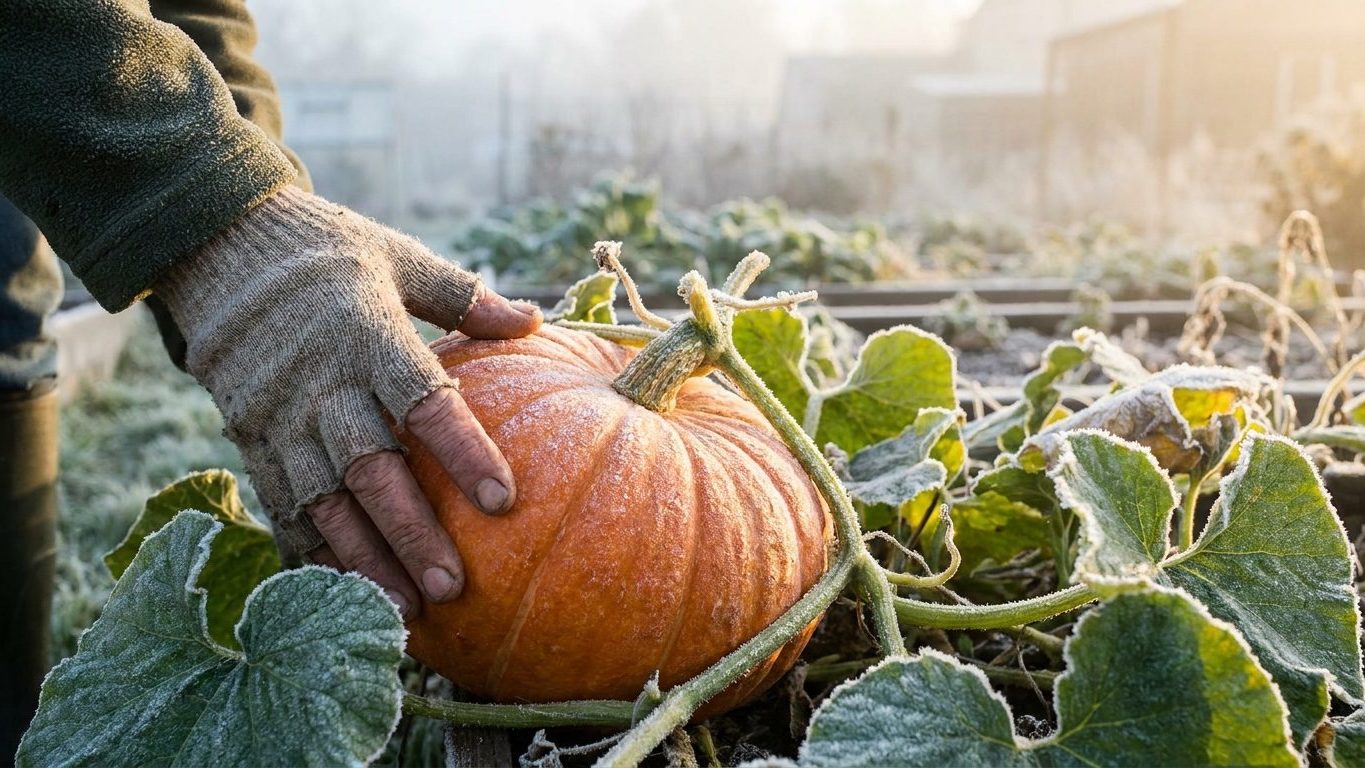

When the forecast turns toward frost, the answer is simple: get the mature fruit off the vine before a hard freeze hits, leave a short stem attached, and let it cure in a warm, airy spot for one to two weeks before it goes into storage. Immature fruit is a separate calculation, one that depends on how close it already was to ripening.
What is actually going on

Frost isn’t one event. It’s two, and the difference matters more than most gardeners realize until the year they lose a shed full of squash to the wrong assumption. A light frost, the kind that leaves a thin white rime on the grass and melts by nine in the morning, kills tender foliage but does very little to a mature, hard-shelled fruit sitting under that same foliage. The leaves collapse, the vine stops photosynthesizing, and that’s largely cosmetic at this stage of the season. A hard frost is a different animal. Once temperatures drop several degrees below freezing for a sustained stretch, ice forms inside the fruit’s cell walls. That damage doesn’t announce itself right away. It shows up days or weeks later as a soft, water-soaked patch that spreads fast, and it means the fruit will not keep no matter how carefully it’s cured afterward.
The practical upshot: a light frost is a warning, not a deadline. Gardeners often panic and strip the patch the moment frost is mentioned in the forecast, when in many cases the fruit could safely ride out one or two light frosts while finishing its final push toward full color and a hardened rind. What actually ends the season is the first hard freeze, and that’s the date to work backward from.
There’s real overlap in botany since some pumpkins and winter squash share the same species, but the growing goals diverge enough that the pumpkin side of this topic deserves its own treatment, and the guides on this site cover that separately.
Curing is where a lot of otherwise good fruit gets ruined by impatience. The process lets the rind harden further and any minor skin wounds seal over, which is what makes weeks of storage possible in the first place. But curing doesn’t fix damage that’s already there, and it doesn’t make a frost-injured squash safe to eat just because the outside looks fine. Any fruit that develops a soft spot, a weeping or slimy patch, or mold at the stem end during curing or storage should be set aside and not eaten, regardless of how solid the rest of it feels.
In the garden
The decisions at the end of the season come down to timing and triage: what’s ready to bring in now, what’s worth gambling on for another week, and what’s simply not going to make it. There’s no universal calendar here since it depends on which type is planted and how the summer went, but the sequence of decisions is the same everywhere.
| Situation | What to do | What happens if handled wrong |
|---|---|---|
| Fruit has a hard rind that resists a fingernail, deep color for its type, and a dry, corky stem | Harvest now, cutting the stem rather than snapping it, and leave a couple of inches attached | Snapping the stem or cutting it flush opens a wound at the exact spot where rot enters first, and that fruit often fails in storage within weeks |
| Fruit is full-sized but the rind still dents under a fingernail | Leave it as long as only light frost is forecast; it may still harden and finish coloring | Pulling it too early locks in thin, soft skin that won’t cure properly and won’t keep past a few weeks |
| Fruit is small, pale, or clearly behind for its type with a hard freeze imminent | Harvest anyway and use it soon rather than trying to store it | Leaving it on a dying vine through a hard freeze guarantees frost damage on top of immaturity, and the fruit is lost either way |
| Vine and leaves are frost-killed but fruit shows no soft spots | Harvest promptly; the fruit itself may still be sound | Waiting too long after the leaves die exposes fruit to sun scald, rodents, and moisture sitting directly on soil |
Checking the stem is the single most reliable field test available, more useful than color in many cases since color varies by type and can mislead. A stem that’s still green and pliable usually means the fruit hasn’t finished maturing on the vine, even if the rind seems firm. A dry, tan, corky stem is the signal that the plant has finished feeding that fruit and it’s ready to stand on its own in storage.
For the immature fruit that gets pulled anyway ahead of a hard freeze, there’s no shame in treating it as a near-term kitchen squash rather than a long-keeper. It can still be good to eat cooked within a short window, it simply won’t hold up to months on a shelf the way a fully cured, mature fruit will. Trying to store it long-term the same as the mature harvest is one of the more common ways gardeners end up with a box of rot by December.
Curing itself asks for warmth, around 80 to 85 degrees when it can be arranged, and good airflow for one to two weeks, followed by cooler and steadier conditions for the storage stretch that follows. Skipping the cure and going straight into a cold basement is a common shortcut that quietly shortens how long the harvest lasts.
What it depends on where you are
Everything above about frost timing and the light-frost-versus-hard-frost distinction holds true nationally. What doesn’t hold true is when any of it happens, and that’s entirely local. Season length, how much heat accumulated over summer, and how much rain fell all shape whether a given planting is sitting at full maturity when frost season arrives or still catching up. Two gardens a hundred miles apart, planted the same week with the same type of squash, can be weeks apart in readiness depending on how the summer treated them.
Heat matters because winter squash types generally need a long, warm stretch to fully harden their rind and develop the sugars that make for good keeping quality. A cool, overcast summer can leave a planting technically at full size but still soft-skinned and immature going into fall, which changes the harvest math entirely. Rainfall matters differently: a wet late summer tends to push fungal pressure on foliage and stems, which can bring the season to a premature end well before frost ever shows up, forcing an earlier harvest than the calendar alone would suggest.
The state-level guides on this site work through regional patterns in more useful detail, and every state’s Cooperative Extension service publishes frost-date guidance and locally trialled variety performance that reflects actual conditions on the ground rather than a national average. That combination, this site’s regional pages plus the local extension office, is a more reliable pairing than any single blanket recommendation could be.
The mistake that costs the most
The single costliest error at end of season isn’t harvesting too early or too late. It’s storing frost-damaged fruit alongside sound fruit and assuming a quick visual check at harvest is enough to sort them. Frost injury inside a squash doesn’t always show on day one. A fruit that looked perfectly fine going into the shed can develop a soft, collapsing patch two or three weeks later, and by then it’s often in direct contact with fruit that was never damaged in the first place. Rot spreads in storage, and one bad squash tucked among a dozen good ones can quietly take several others down with it before anyone checks the pile again.
The fix costs almost nothing: give every fruit a real look before it goes into curing, not just a glance. Run a hand over the whole surface feeling for any give, check the stem end and the blossom end closely since that’s where soft rot tends to start, and set aside anything that touched a hard freeze even if it looks sound on the surface. During the cure and again before long-term storage, go through the batch a second time and pull anything showing a soft spot, a weeping patch, or mold at the stem, no exceptions for fruit that otherwise “looks too good to toss.”
Space matters too. Storing squash in a single crowded pile, rather than in a single layer with fruit not touching, means one failure spreads to its neighbors before anyone notices. A shelf, a slatted crate, or simply spacing fruit apart on a floor costs nothing and buys the single best insurance against losing the whole harvest to one damaged squash that slipped through the first check.