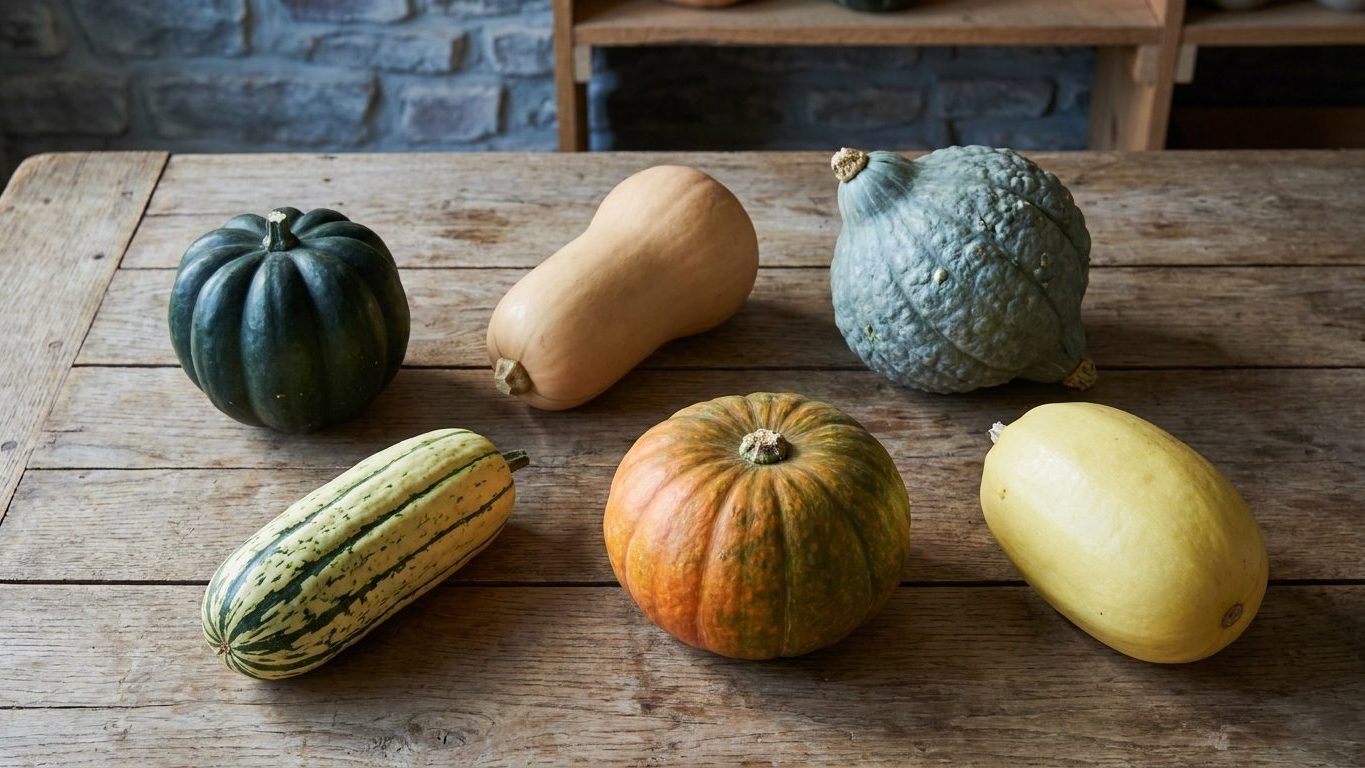

Six families cover almost every winter squash grown in home gardens: acorn, butternut, delicata, hubbard, kabocha and spaghetti squash. They split mainly by rind thickness, which decides how long each one keeps, and by size, which decides how many hills a garden can afford to grow. Pick by how you’ll use and store the harvest, not by the seed packet photo.
What is actually going on

The thing to understand here is that these six types aren’t random varieties someone grouped for convenience. They differ in skin hardness, and skin hardness is the single trait that governs storage life. A thin, easily-dented rind lets moisture escape and lets rot organisms in faster. A thick, waxy rind slows both. That’s the whole mechanism behind why one squash on your counter is done in three weeks and another is still good at Valentine’s Day.
Acorn and delicata sit at the thin-skin end of that spectrum. Their rinds bruise if you press a thumbnail into them, and both types are bred more for eating quality and speed to table than for months of storage. Butternut sits in the middle: a genuinely tough neck and a somewhat softer bulb end, which is why the neck outlasts the base in a root cellar. Hubbard and kabocha carry the hardest, most durable shells of the group, the kind that can look almost armored, and that’s a direct trade against size and days needed in the ground. Spaghetti squash is its own case: a moderately hard rind, but a flesh structure (those separating strands) that has nothing to do with any of the other five and everything to do with why people grow it in the first place.
Days needed to reach maturity also track with this same logic, though the exact number varies by region, seed lot and season. What matters is the pattern: types with thicker rinds generally need a longer season to build that rind fully, and picking one early, before the rind has hardened, is the single fastest way to turn a hubbard or kabocha into a squash that rots in storage within days instead of months. Your state extension service publishes trial results for the specific varieties that perform in your growing region, and that’s the source to check before you commit garden space to any one family.
One distinction worth being direct about: winter squash and carving pumpkins are not the same subject, even though they’re cousins in the same plant family and share a growing calendar. A carving pumpkin is selected for a hollow shell, thin flesh and a stem strong enough to hold a handle. A winter squash is selected for dense, storable flesh you’re meant to eat. Some kabocha and hubbard types get carved for fall displays anyway, and where that overlap happens, it’s worth checking this site’s pumpkin section rather than assuming the two are interchangeable in the kitchen or in the curing shed.
In the garden
Here’s where the six families actually compare, side by side, on the traits that decide whether one is worth the space it takes.
| Type | Season needed | Typical size | Keeping ability | Kitchen character |
|---|---|---|---|---|
| Acorn | Shorter | Small, one-serving | Shortest of the six | Sweet, moist, best roasted whole or halved |
| Butternut | Moderate to long | Medium, elongated | Long, especially the neck | Dense, smooth, soups and purees |
| Delicata | Shorter | Small, oblong | Short | Edible skin, sweet flesh, roasts fast |
| Hubbard | Longest | Large to very large | Very long | Coarse, needs cutting down before cooking |
| Kabocha | Long | Medium, squat | Long | Dry, dense, sweet, good baked or steamed |
| Spaghetti | Moderate | Medium, oval | Moderate | Stringy flesh, pasta substitute |
What happens when each of these goes wrong is as instructive as the numbers. An acorn squash left in a damp basement instead of a cool, dry, well-ventilated spot will soften at the blossom end within a couple of weeks, well before anything looks obviously bad from the outside. Butternut stored with its neck touching a cold concrete floor will often develop a soft patch right at that contact point, so growers who store butternut on slatted shelving or straw see it last considerably longer than growers who stack it directly on the ground.
Delicata bruises so easily that a fall harvested with a wagon and tossed onto a pile can be marked with soft spots by the time it reaches the kitchen, even if it was perfectly sound in the field. Hubbard and kabocha, being tougher, tolerate rougher handling, but a hubbard picked before the rind has fully hardened will shrivel and lose flavor in storage no matter how gently it was handled afterward. Spaghetti squash that’s harvested with a short or torn stem loses its main defense against the entry point rot usually starts from, so a clean cut leaving two inches of stem attached matters more here than the variety choice itself.
Before eating any squash out of storage, the same check applies across every one of these six types: look for a soft spot, a weeping or leaking patch, or mold at the stem end. Any one of those ends the question, regardless of how long the squash has been stored or how good it looked the week before. A squash that still looks firm and dry, with an intact stem, is the only kind worth cooking.
What it depends on where you are
Everything in the table above is a national pattern, and the national pattern is only half the story. Season length is the other half, and it’s entirely local. A garden with a long, warm growing season can bring a hubbard or a kabocha to full maturity with room to spare. A garden with a short or unpredictable season can struggle to finish even a butternut, let alone a large hubbard, before a killing frost ends the growing period.
Summer heat changes the picture too, and not always the way people expect. Some types tolerate heat stress during flowering and fruit set better than others, and a run of very hot weeks at the wrong point in the season can reduce fruit set even when the plants themselves look healthy. Summer rainfall matters just as much, particularly for the thinner-skinned types like acorn and delicata, where excess moisture late in the season can soften the rind right before harvest and undercut the storage life the plant would otherwise have built up.
Soil drainage interacts with all of this locally as well. A garden with heavy clay that holds water after storms creates different disease pressure, particularly around the stem and vine base, than a garden with sandy, fast-draining soil. Neither is automatically wrong for growing winter squash, but the practices that work, from spacing to mulching to how close vines sit to standing water, shift with the site.
This is the point where a general guide has to hand off to local knowledge. The state pages on this site cover the growing conditions and trial results specific to individual regions, and your state’s Cooperative Extension Service publishes the most current data on which varieties within each of these six families have performed well in local trials, along with realistic timing for your particular area. That’s a better source for the specific numbers than any national article, this one included.
The mistake that costs the most
Of everything that can go wrong across these six families, one mistake causes more losses than all the others combined: harvesting before the rind has fully hardened. It’s an easy mistake to make because the squash often looks done. The color has come in, the size seems right, the vine may even be starting to die back. But rind hardness lags behind color and size, and a squash pulled a week or two early can look identical to a mature one while carrying a fraction of the storage life.
The test that actually tells you something is a fingernail press against the skin. On a mature squash, in any of these six families, a fingernail should not be able to dent the rind. If it presses in even slightly, the squash isn’t ready, no matter how good the color looks or how long it’s been on the vine. This matters more for hubbard and kabocha, where the whole reason to grow them is the long storage window, but it applies just as much to acorn and delicata, where an early harvest turns an already-short storage life into almost no storage life at all.
The fix isn’t complicated: wait for the fingernail test to fail, then harvest with a few inches of stem intact, and cure the squash for a short period in a warm, dry, well-ventilated spot before moving it to cooler storage. What it requires instead is patience at exactly the point in the season when a gardener is most tempted to clear the vines and call the harvest finished. A squash left an extra week or two on a healthy vine, ahead of a hard frost, almost always outperforms one pulled early out of impatience or a rushed schedule. That single week is very often the difference between a squash that’s still sound in January and one that’s already soft by Thanksgiving.