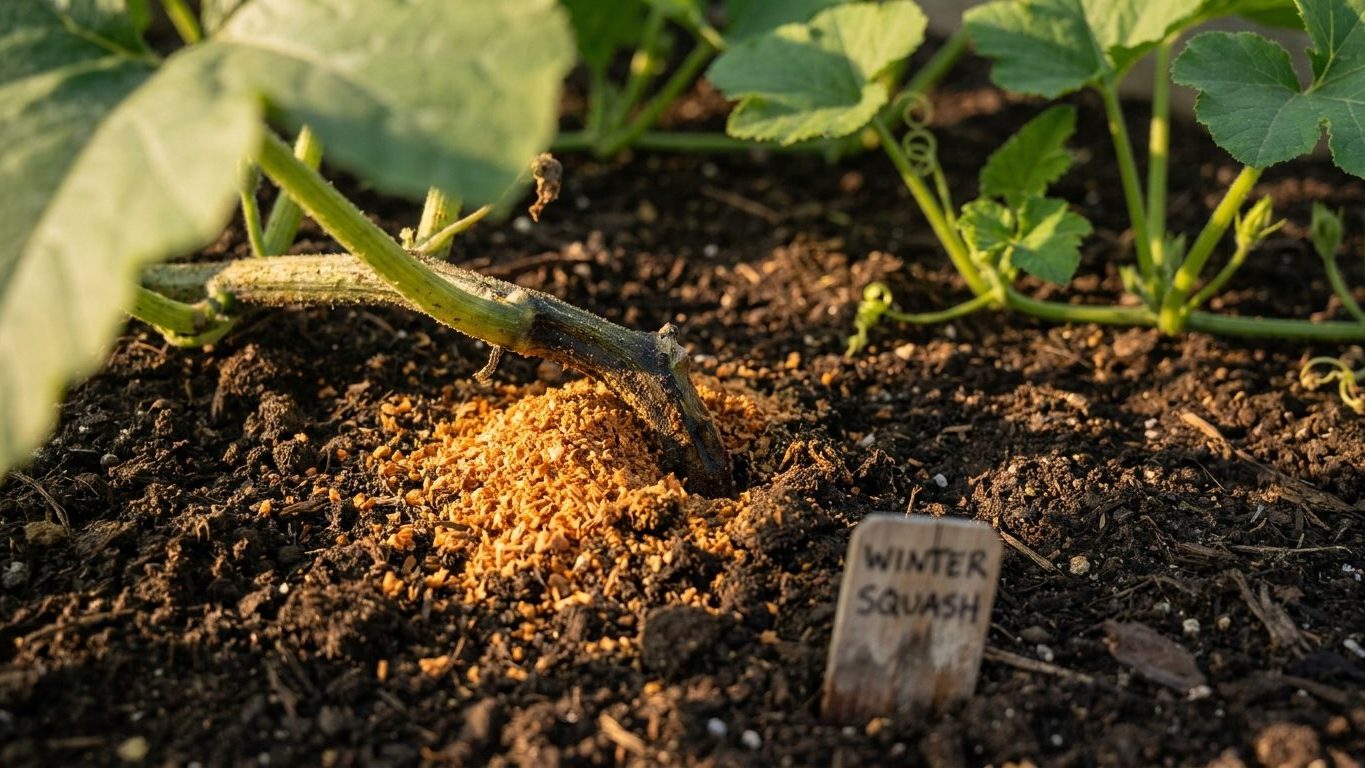

A vine borer doesn’t announce itself with chewed leaves or ragged edges. It works from the inside, and by the time a gardener notices, the fix is often already too late for that vine. The short answer: watch the base of the stem for a sawdust-like sludge, act in the first two weeks after moths appear, and choose squash types that resist the larva rather than fighting it after the fact.
What is actually going on

The thing to understand here is boring, literally: a larva feeds inside the stem and cuts the water supply, and the sawdust-like frass at the base is the only outward sign before the vine collapses. The adult is a day-flying moth, often mistaken for a wasp because of its orange-red body and clear, dark-veined wings. She lands at the base of a young vine, usually within the first six to eight weeks after planting, and lays eggs one by one along the stem near the soil line. Those eggs are small, flat, and brownish, easy to miss unless you’re looking for them.
Once a larva hatches, it tunnels straight into the stem. From that point on, nothing you spray on the leaves reaches it. The larva feeds inside the hollow of the stem for several weeks, and the vine’s plumbing, the tissue that moves water up from the roots, gets shredded along the way. A plant can look fine in the morning and be wilted flat by afternoon, because the damage doesn’t show until the stem simply can’t carry enough water anymore. That sudden, one-vine wilt while the rest of the plant looks healthy is the classic tell, and it’s very different from the slow, whole-plant decline you’d expect from drought or root rot.
This is a different problem from what happens to a carving pumpkin, even though both belong to the same genus and share the same pest. A pumpkin grown for its shell can sometimes survive borer damage well enough to still produce a usable jack-o’-lantern, because the grower isn’t relying on long-term storage of that fruit. A winter squash is grown for its flesh and its keeping quality, so a vine that dies mid-season doesn’t just cost you one fruit, it costs you the sugars and dry matter that squash needs to cure properly. If pumpkin-specific management is what brought you here, the pumpkin growing guides on this site cover that side of the pest in more depth.
None of this means every squash plant with borer damage is a lost cause. Some vines root at the nodes as they sprawl, which gives them a second, independent water supply downstream of the damage. That’s part of why the type of squash you’re growing changes the outcome so much, which is the next thing worth sorting out.
In the garden
Resistance here isn’t a matter of one cultivar being tougher than another. It’s a matter of species, and the differences are large enough to change how much monitoring a garden actually needs.
| Squash type (species) | Typical vulnerability | What happens when it goes wrong |
|---|---|---|
| Acorn, delicata, spaghetti, and other Cucurbita pepo types | High. Hollow, relatively soft stems give larvae an easy path in. | A single larva can collapse the main vine within days; without side-rooting, the whole plant can die before fruit matures. |
| Hubbard, buttercup, and other Cucurbita maxima types | Moderate to high. Often planted as a trap crop for this reason, since moths seem to prefer it. | Losses concentrate on whichever plants the moths favor first, which can strip a small planting fast if it’s the only type grown. |
| Butternut and other Cucurbita moschata types | Low. Solid, more fibrous stems resist tunneling and the vines root readily at nodes. | Even when eggs are laid, larvae often fail to establish, so damage stays minor and localized. |
That table is the reason so many extension programs suggest leaning toward moschata-type squash in areas with heavy borer pressure, and asking your own state’s extension service which varieties within that type have performed well in local trials. A garden in a short-season, cooler climate has different options available than one in a long, hot growing season.
Timing and physical barriers
Beyond species choice, the most effective tools are mechanical, not chemical. Delaying planting by a couple of weeks can let a garden miss the peak egg-laying window in some regions, though the reverse is true elsewhere, which is exactly why timing needs to be checked locally rather than copied from a national calendar. Floating row cover over young vines keeps the moth off the stem entirely, but it has to come off once flowers open so pollinators can reach them, which creates a short, unprotected window that borers can exploit if you leave the cover off too long.
Mounding moist soil over stem nodes as the vine spreads encourages those secondary roots to form before any damage happens, which is cheap insurance rather than a cure. Checking the base of each vine weekly for frass, and slitting a stem lengthwise with a knife to remove a spotted larva by hand, is tedious but it’s one of the few interventions that works after eggs have already hatched. None of this replaces choosing a resistant type in the first place; it just buys time for whatever type you did plant.
What it depends on where you are
How much of this problem shows up in a given garden depends heavily on season length, summer heat, and how many generations of the moth a region supports in a single year. Some parts of the country deal with one wave of egg-laying and are done with it. Others see overlapping generations that keep pressure on all season, which changes how often a stem base needs checking and how long row cover needs to stay in place before it’s safe to remove.
Soil type and winter conditions matter too, since the larva pupates in the soil and overwinters there before emerging as a moth the following season. A garden with heavy clay, or one where the soil is tilled deeply in fall, can end up with different pressure than a neighboring plot with sandy soil left undisturbed. Rainfall patterns during the moth’s active weeks also affect how easily eggs survive on the stem, and that’s not something a general guide can predict for a specific yard.
The state-level guides on this site walk through planting windows and regional pest calendars in more detail, and your own state’s cooperative extension service will have the most current, locally verified guidance on when moths are typically active in your area and which control timing has actually worked in field trials nearby. That local data is worth more than any national rule of thumb, because it accounts for the specific combination of season length and moth generations your garden actually deals with.
The mistake that costs the most
The single costliest mistake is planting only a susceptible type and assuming a wilted vine can wait until the weekend to deal with. By the time a whole vine has collapsed, the larva has usually been feeding for a week or more, and any hand-removal at that point is salvage work, not prevention. The fix isn’t a better spray schedule after the fact, it’s shifting the decision earlier: mixing in a moschata-type squash alongside whatever else you grow, checking stem bases on a fixed weekly schedule from the moment vines start to run, and treating the first sign of frass as an emergency rather than something to monitor for another few days.
Gardeners who lose a season to this pest almost always describe the same sequence: they saw a little sawdust at the base, figured it was nothing unusual, and came back a few days later to a dead vine. That gap between noticing and acting is where the crop is actually lost, not in some later, harder-to-fix stage of the infestation.
It’s worth separating this from a storage problem, because the two get confused. A squash that made it to harvest despite some vine damage isn’t automatically fine to store long-term just because the shell looks intact. Before curing, check the stem end and the skin carefully. Any soft spot, any weeping or damp patch, or any mold at the stem end ends the question regardless of how the rest of the fruit looks, and that squash should go in the kitchen now rather than into a curing pile meant for weeks or months of storage. The guides on curing and storage on this site go into what a properly cured, storage-ready squash should look like once the harvest itself is behind you.