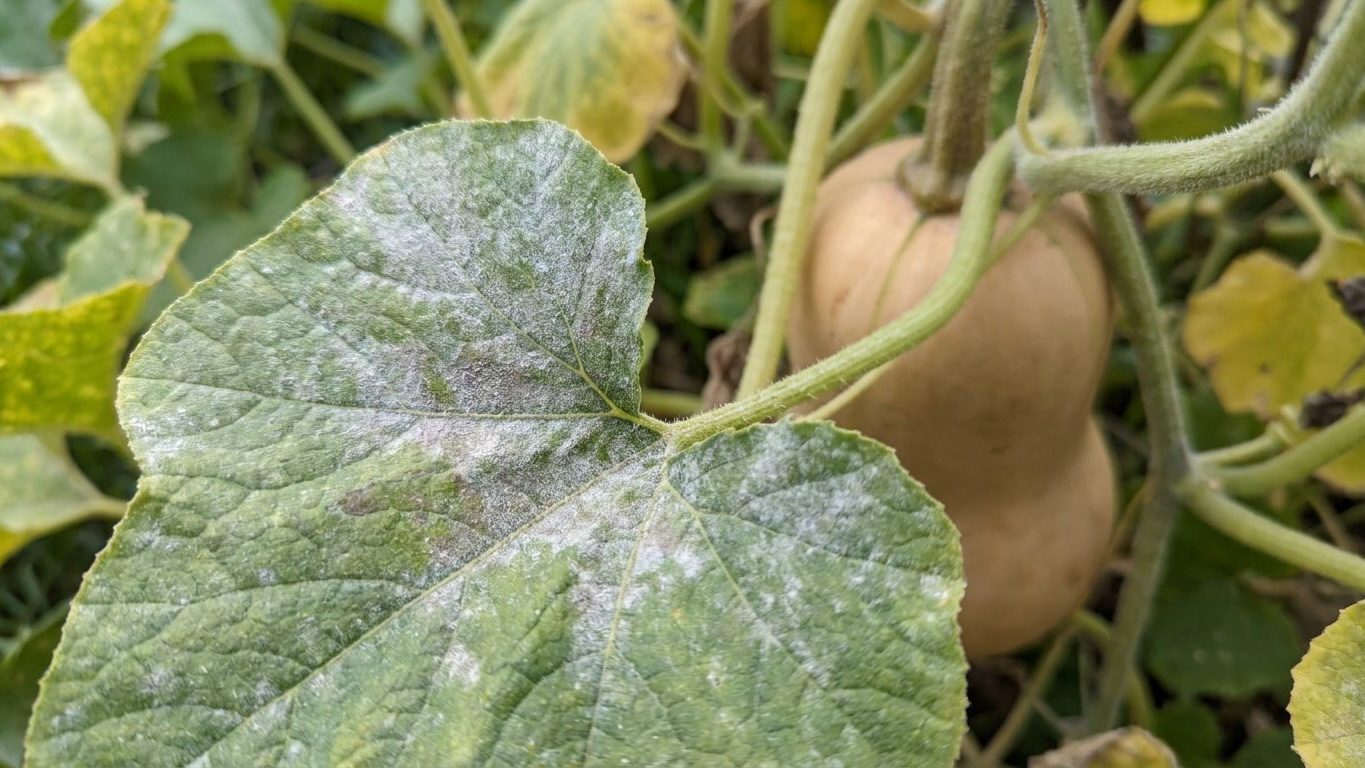

Powdery mildew rarely kills a Winter Squash plant outright. What it kills, when it wins, is time: the weeks the plant needed to keep feeding sugar into the fruit and hardening its rind. Whether that matters this season comes down to one question: had the fruit already finished sizing and curing before the white film took over the leaves, or not?
What is actually going on

The fungus itself is straightforward. Powdery Mildew on winter squash shows up as white to gray, dusty patches, usually starting on the upper side of older leaves near the base of the plant, then spreading to stems and younger growth. Unlike many leaf diseases, it doesn’t need standing water on the foliage to get started. Warm days, cooler nights, high humidity and a dense, shaded canopy are enough. That’s why it often turns up in August, after the plants have sprawled into a thick mat and airflow through the canopy has dropped.
The thing to understand here is that the leaves aren’t just decoration. They’re the plant’s sugar factory, and that sugar does two jobs on its way into the fruit: it builds the flesh that ends up on the plate, and it feeds the process that thickens and hardens the rind, the layer that lets a squash sit in storage for weeks or months without collapsing. A leaf covered in mildew photosynthesizes at a fraction of its normal rate. A defoliated vine stops feeding the fruit almost entirely.
That’s the whole mechanism behind the timing question. If mildew shows up late, after most fruits have already reached full size and their rinds have started to cork and harden, the damage is mostly cosmetic. The vines look rough, but the crop is largely made. If it shows up early, while fruits are still small and the rind is soft enough to dent with a thumbnail, losing the canopy means the fruit stops growing and never finishes curing on the vine. Those squash may still be edible soon after harvest, but they were never built to keep.
One distinction worth being precise about: this is a winter squash problem in the sense of flesh and storage life, not a carving pumpkin problem. A pumpkin grown for Halloween is judged on its shell, its shape and its color holding through October, not on how long it keeps in a root cellar. The same fungus can infect both, and the biology above still applies, but the stakes are different. For handling powdery mildew on pumpkins grown for carving or display, the guides in that section of this site cover it directly rather than repeating the storage-focused advice here.
Nothing about which specific varieties tolerate powdery mildew better than others belongs in a general explainer like this one. Tolerance varies by squash type and by the trial conditions of a given state, and a state extension service that runs variety trials in local soil and climate is a far more reliable source than a name printed on this page.
In the garden
Once mildew is confirmed, the job splits into two parts: slowing the disease, and honestly judging what the fruit already on the vine actually needs. Neither one works well without the other.
| Action | What happens if it’s skipped or done wrong |
|---|---|
| Scout the underside and base of the canopy weekly, not just the top growth | Mildew is well established and has already reduced leaf function before anyone notices the white patches on top leaves |
| Thin overlapping leaves and give plants the spacing recommended for the type being grown | A dense, shaded canopy holds humidity around the leaves and the disease spreads through it far faster than in an open planting |
| Water at the soil level rather than overhead, ideally in the morning | Powdery mildew doesn’t require wet leaves to infect the way some other fungal diseases do, so this step helps humidity management more than it prevents infection directly; skipping it won’t cause an outbreak on its own, but it won’t slow one either |
| Remove only the most heavily infected leaves, a few at a time | Stripping the canopy aggressively to “get rid of it” removes the very leaves still producing sugar for the fruit, which can cost more sizing and curing time than the mildew itself would have |
| Start a preventive fungicidal practice, such as a sulfur-based or potassium bicarbonate treatment, at the very first white speck | Waiting until the infection is heavy makes any treatment far less effective, since these products protect healthy tissue rather than reverse damage already done |
| Judge each fruit by its own maturity signs, not by the state of the leaves around it | Assuming a declining vine means the fruit is “done” leads to harvesting squash that hasn’t actually finished sizing or hardening its rind |
Reading whether the crop can still finish
The maturity signs to check are physical, not calendar-based: the stem near the fruit should start to look dry and corky rather than green and pliable, and the rind itself should resist a fingernail pressed firmly into it instead of denting easily. Color should have developed fully and evenly for the type being grown. If most of the canopy has collapsed to mildew before those signs show up on the fruit, that crop is not going to finish curing on the vine, and it should be treated as fruit for near-term eating rather than long storage. A soft spot, a weeping patch on the rind, or any mold at the stem end ends the question regardless of how the rest of the squash looks. That fruit doesn’t go into storage.
What it depends on where you are
Some of this is universal biology. How much it costs a particular garden is almost entirely local.
Season length is the first variable. A grower with a long, warm season has room to lose several weeks of leaf function to mildew in late summer and still watch fruit finish before frost. A grower whose season is already tight has far less slack. In that second case, mildew arriving even a few weeks earlier than usual can be the difference between a full crop of good keepers and a crop that has to be eaten within weeks of picking.
Summer humidity and rainfall patterns are the second variable, and they explain why the same squash type behaves so differently across the country. Regions with humid, still summer air tend to see earlier and heavier pressure, while drier climates see later onset or milder outbreaks, though dry-climate gardens are not immune, especially where irrigation or dense plantings keep humidity high right at the leaf surface overnight.
Because both of these factors, season length and summer humidity, vary so much by state and even by microclimate within a state, the honest answer to “how worried should I be” isn’t something a national page can give with any precision. It’s worth checking the winter squash guides for the reader’s own state elsewhere on this site, and worth contacting a local state extension service directly, since many run active monitoring and can say whether powdery mildew pressure has been running early or late in a given year.
The mistake that costs the most
The single costliest error isn’t ignoring mildew, and it isn’t overreacting to it either. It’s making the harvest decision based on how the leaves look instead of how the fruit itself is doing.
It plays out the same way most seasons: the canopy starts looking rough, a grower gets nervous watching leaves turn pale and collapse, and decides to pick everything early “before it’s too late.” Some of that fruit was genuinely ready. Some of it wasn’t, and picking it early doesn’t rescue it, it just locks in an unfinished rind and a flesh that hasn’t reached full sugar development. That squash goes into storage looking fine and then breaks down in a few weeks, because the curing process that was supposed to happen on the vine, or in a proper post-harvest cure, never got the chance to finish.
The fix is to separate the two judgments entirely. The state of the leaves tells a grower whether the plant can keep feeding the fruit going forward. It says nothing about whether any individual squash is ready right now. That call comes from the stem and the rind, checked fruit by fruit, not from a glance at the vines. A garden can have half its canopy down to mildew and still produce a shelf full of well-cured, long-keeping squash, as long as the fruit that gets pulled for storage actually met the maturity signs first. The fruit that didn’t isn’t wasted, it just belongs in the kitchen this week rather than in a bin over winter, and that’s a very different outcome than losing the crop.