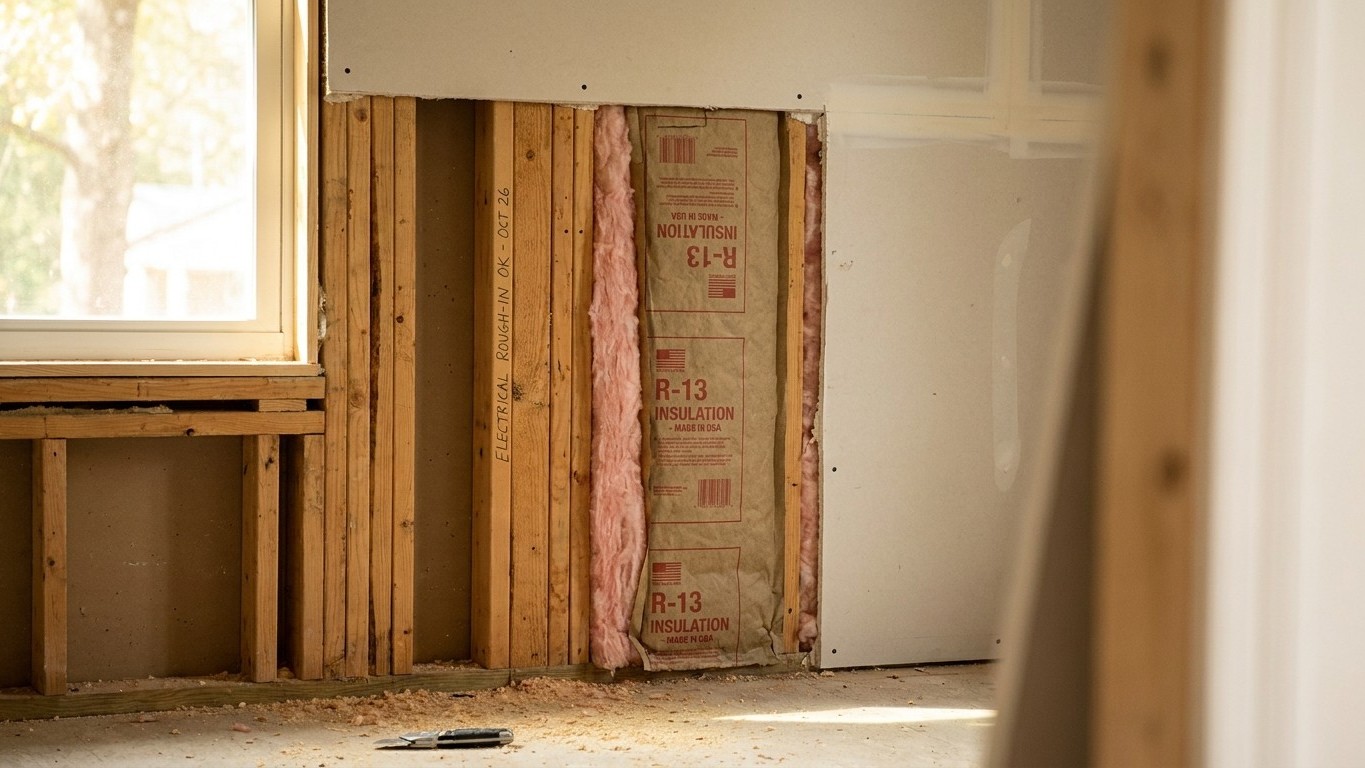

No, not as a blanket requirement. Every one of Georgia’s counties falls into either IECC Climate Zone 3A or Climate Zone 2A, and the 2021 International Residential Code exempts both of those zones from the interior vapor retarder rule in Section R702.7. That doesn’t mean vapor barriers are banned in Georgia, only that the code stops requiring one on the interior side of frame walls across the whole state.
What the code asks for in Georgia

Section R702.7 of the 2021 International Residential Code sets the baseline: a vapor retarder of the class listed in Table R702.7(2) “shall be provided on the interior side of frame walls.” That’s the default rule written for the country as a whole. Then the code lists four exceptions, and one of them reads: “A vapor retarder shall not be required in Climate Zones 1, 2 and 3.” Everything about Georgia’s answer comes down to which of those zones its counties sit in.
Two zones, but one outcome
Georgia splits across two climate zones under Table R301.1 of the 2021 IECC: 118 counties fall in Zone 3A, and 41 counties fall in Zone 2A. In a lot of states that kind of split produces two different answers to the vapor retarder question, because the exception line only covers Zones 1, 2 and 3, and a state that also has counties in Zone 4 or higher would see the rule apply on one side of a county line and not the other. Georgia isn’t that state. Both 3A and 2A sit inside the “1, 2 and 3” exception, so the practical outcome for the interior vapor retarder requirement is the same whether a wall goes up in a Zone 3A county or a Zone 2A one: the code does not require it.
That’s worth sitting with, because it’s easy to assume a state that spans two zones must have a split answer on every code question. Here the zone boundary matters for plenty of other things, insulation R-values, duct sealing thresholds, the ENERGY STAR table a builder pulls the insulation numbers from, but not for this particular exception. The letter after the number (the “A” in both cases, meaning a moist regime) doesn’t change that outcome either; it would matter more if Georgia had a Zone 4C marine county, which it doesn’t.
None of this makes the vapor retarder question irrelevant in Georgia. The exception removes an obligation, it doesn’t forbid anyone from installing a Class II or Class III retarder if a builder or designer decides the wall assembly calls for one. And the other three exceptions in R702.7 (basement walls, below-grade portions of walls, and assemblies where moisture won’t damage the materials) still apply on top of the zone exception, covering situations the zone rule alone doesn’t touch.
What this page can’t do is tell an individual reader what to install in their own wall. The code in force on a given project is whatever edition the local jurisdiction has adopted, which may lag behind the model code or carry local amendments. The only way to get a wall-specific answer is to ask the building department that will actually inspect the work.
Why the answer is the opposite in a warm climate
The exception for Zones 1, 2 and 3 isn’t an oversight or a cost-cutting shortcut. It reflects which direction the moisture is moving. In a cold climate, the warm, humid air sits inside the house all winter, and a vapor retarder on the interior side of the insulation stops that indoor moisture from reaching the cold sheathing, where it would condense. That’s the assembly most people picture when they hear “vapor barrier,” and it’s the right answer for a house in a place with a long, hard winter.
Flip the climate and the water travels the other way. In a warm, humid region, the moisture load comes from outside, through humid air pushing against the wall in summer, and the cool surface it wants to condense on is now on the interior side of the wall. The U.S. Department of Energy’s Building America program spells out what happens when a Class I retarder gets installed there anyway: “If the wall contains a vapor retarder on the interior side of the insulation, the water vapor will condense on this cool, impermeable surface.” The result, in the DOE’s own words, is “ruined insulation, mold, and structural rot of framing members.”
That’s the mechanism behind the whole exception. It isn’t paperwork for its own sake, it’s the code tracking where the water is actually going. A wall built to keep summer humidity out on the outside, with no interior barrier, gets to dry inward when it needs to. Seal that same wall with an impermeable interior layer in a climate where the moisture is arriving from outside, and the wall loses its ability to dry at all. The dampness has nowhere to go, and it sits against the framing and the insulation until something starts to fail.
This is also why a rule that reads a certain way in Minnesota reads the opposite way in a Zone 2A or 3A county in Georgia. Same code, same section number, opposite conclusion, because the climate on each end of the country is pushing moisture through the wall in opposite directions. Anyone comparing notes with a builder from a colder state should expect the disagreement, and shouldn’t assume either one is wrong.
The three classes, and why the word matters
Even where a vapor retarder is required, the code doesn’t treat all vapor retarders as the same product. R702.7 sorts them into three classes by how much moisture they let pass, measured in perms, and the class matters as much as whether one is present at all.
| Class | Example materials | Perm rating |
|---|---|---|
| Class I | Sheet polyethylene, nonperforated aluminum foil | 0.1 perm or less |
| Class II | Kraft-faced fiberglass batts, vapor retarder paint | above 0.1 up to 1.0 perm |
| Class III | Latex or enamel paint | above 1.0 up to 10.0 perm |
Notice what’s on that Class III line: ordinary latex paint. Most homeowners have already applied a Class III vapor retarder to their interior walls without ever thinking of it that way. It’s not the same job as sheet polyethylene, which sits at the tight end of the scale as Class I, but it’s still doing retarder duty by the code’s own definition. Calling polyethylene simply “a vapor barrier” without naming its class misses the point of the whole table: the disagreement between a builder in a cold state and one in Georgia is never about whether to use a vapor retarder at all, it’s about which class, if any, belongs in that particular wall.
One more distinction worth keeping straight: a vapor retarder is not an air barrier. A vapor retarder slows the diffusion of water vapor through a material. An air barrier stops bulk air movement, which carries far more moisture than diffusion ever does. Some products do both jobs at once, but they’re evaluated by different standards, and a wall can have excellent air sealing with no vapor retarder at all, or the reverse.
Where the rule stops
The zone exception isn’t the only place R702.7 backs off the interior vapor retarder requirement. The code lists three more situations where it doesn’t apply, on top of the Zone 1, 2 and 3 exception already covered above:
- Basement walls
- The below-grade portion of any wall
- Construction where accumulation, condensation, or freezing of moisture will not damage the materials
The basement one is the exception most readers actually run into, because so many houses have at least a partial basement regardless of what climate zone they’re built in. A poured concrete or block foundation wall holds groundwater moisture for years after it’s built, and keeps releasing it slowly long after the concrete has cured. That wall needs to be able to dry toward the interior when conditions call for it. Wrap the inside face in an impermeable Class I sheet, and the moisture the concrete is trying to shed has no path out, which is the same trapped-moisture problem described above, just starting from a masonry wall instead of a stud wall exposed to humid outdoor air. For the fuller picture on how that plays out and what does work in a basement assembly, the basement wall guide on this site covers the detail this page doesn’t.
None of these four exceptions amount to a prohibition. Each one removes an obligation under specific conditions, it’s still allowed to install a vapor retarder in a basement wall or a below-grade assembly if the design calls for it; the code simply stops mandating one by default in those situations.
Who actually decides, in Georgia
The 2021 IRC and the exception it carries for Climate Zones 1, 2 and 3 is a model code. It becomes law only once a state or a local jurisdiction adopts it, sometimes with amendments, sometimes on a delay measured in years. Georgia’s counties span Zones 3A and 2A, and both land inside that exception, but the code edition actually enforced on a given project, and any local amendments layered onto it, is whatever the county or city building department has adopted. That’s the office with the final answer, not this page and not the model code itself.
The stakes for getting this right are real, even where the requirement has been lifted. Atlanta Hartsfield’s 30-year climate normal runs about 2,531 heating degree days a year against roughly 2,051 cooling degree days, a heating season with real but moderate demand set against a cooling season nearly as large. Those degree-day figures measure heating and cooling demand, not a temperature reading, and they’re calculated for one station, so a mountain county in north Georgia will run colder than that Atlanta-area reference point suggests. What they show is a state carrying meaningful heating and meaningful cooling in close balance, which is exactly the kind of climate where getting the vapor control decision backwards, treating it like a cold-climate wall when the moisture load is coming from the humid side, does the most damage.
A wall assembled with the wrong vapor control doesn’t announce the mistake right away. There’s no crack, no stain, no obvious sign the day the drywall goes up. The trouble shows up years later, once moisture has had time to work on the framing and the insulation from the inside, by which point the fix means opening the wall back up. That’s the reason this question is worth a phone call to the local building department before the work starts, rather than a guess based on what worked in a different state.