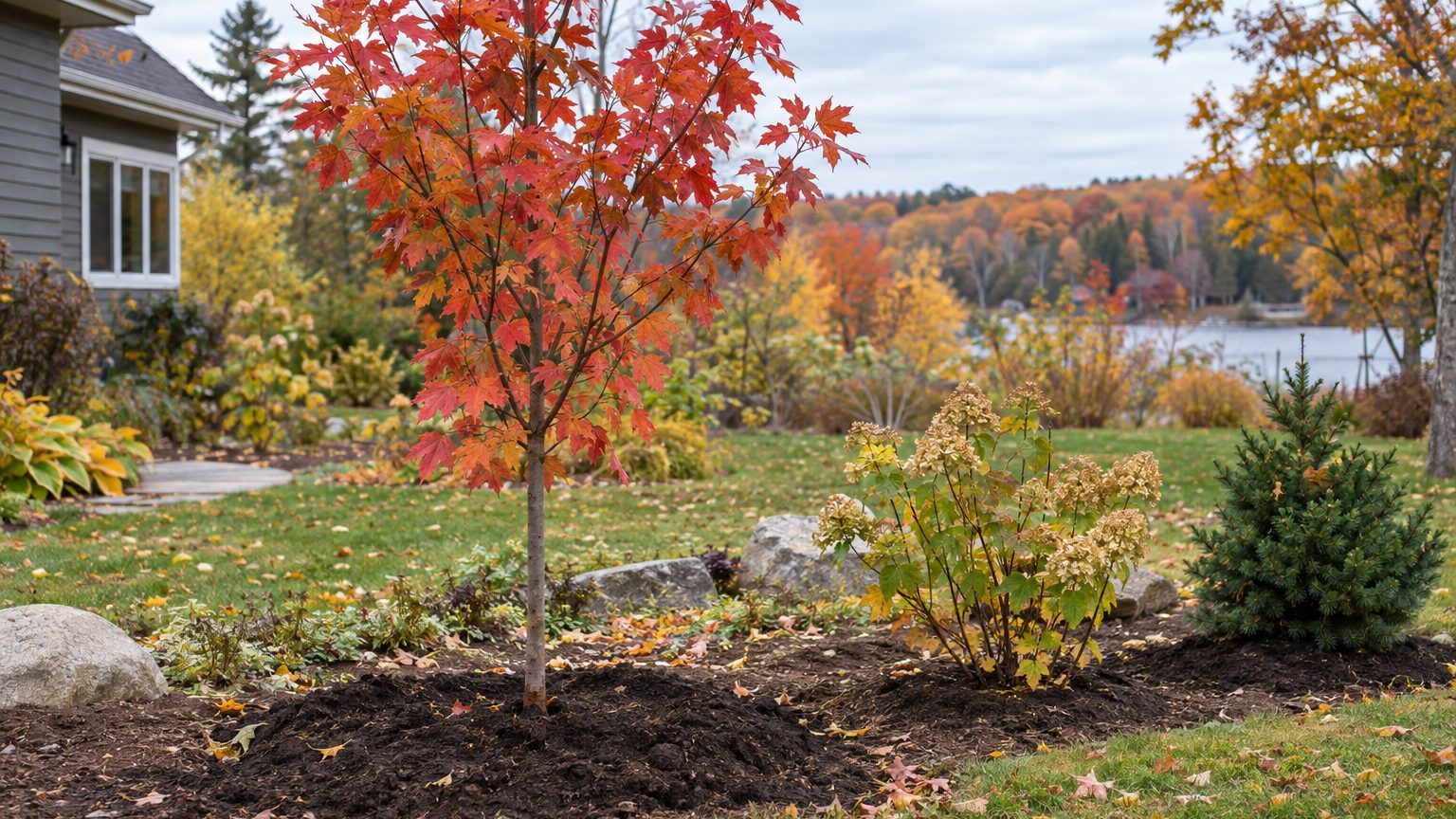

In Georgia, the safe target for fall planting is October 2 to October 20, which is six weeks before the first fall frost (November 13 to December 1 in NOAA’s Atlanta normals). That is the cautious answer. Around Atlanta and on the milder coastal plain, the ground does not lock up in winter, so trees and shrubs set in November, December or even January still root in. The mountains and far north Georgia are where the calendar gets tight.
The deadline in Georgia
Roots do not care what the air is doing. They keep growing as long as the soil is workable and above freezing, which is often weeks after the first cold snap has blackened the tomato vines. That is why fall is such a good planting season: the top of the plant goes quiet while the roots keep working. The practical deadline is not the first frost. It is a few weeks before the soil itself stops cooperating.
The rule most extension programs lean on comes from Cornell Cooperative Extension in Orleans County: “Fall is an excellent time for transplanting, provided you get them to their new home at least 6 weeks before the ground freezes, allowing them time to establish roots before winter dormancy.” Notice what it counts back from. Not the first frost, which is an air temperature, but the day the ground freezes, which arrives later.
Working the date backward from frost
NOAA’s 1991-2020 Climate Normals for the Atlanta station (USW00013874) put the first fall 32°F freeze in a window from November 13 to December 1. That range is the band where the odds of a first freeze run from 30 to 70 percent. Count six weeks back from it and you get a conservative target: October 2 to October 20. Treat that as the safe date, the one that leaves every plant its full six weeks even in a year when the cold comes early.
It is not the true limit. Because the rule really counts from frozen ground, and soil freezes after the air does, the real cutoff usually falls later than this window. Planting in late October or early November is not reckless in most of the state. It just means you are trading margin for convenience.
Where the ground barely freezes, keep planting
Here is the part that surprises people used to northern calendars. NOAA’s Climate Normals for Atlanta show a mean daily minimum of 35.6°F in the coldest month. That is above 32°F, so at the reference station the ground does not freeze, and the six-week deadline does not apply there. In the Atlanta area and on the milder coastal plain, fall and even winter are the best time to plant trees and shrubs. Cool, damp soil, no summer heat stress, and months of root growth before the next summer arrives. Waiting for spring is the worse choice, because a spring-planted tree has to face its first Georgia summer with a small root system.
One caution about that reference point: Atlanta’s airport station is an urban heat island. North Georgia and the mountains freeze several weeks earlier in fall, and their planting window closes earlier to match. The coastal plain runs milder. The table below shows how the window shifts across the state. Check first and last frost dates in Georgia for your own area before you pick a day.
| Part of Georgia | First fall frost | How to use the window |
|---|---|---|
| Atlanta area (NOAA reference station) | November 13 to December 1 | Safe target is October 2 to October 20; the ground does not freeze there, so planting can continue through winter |
| North Georgia and the mountains | Several weeks earlier than Atlanta | Finish earlier than October 2 to October 20; the ground reaches freezing sooner |
| Coastal plain | Milder than Atlanta | Fall and winter planting are both fine |
What to plant late, and what to wait on
Container-grown and balled-and-burlapped plants that are fully hardy in your zone are the ones that establish well from a late-fall planting. The word “fully” carries weight. A plant that sails through Georgia winters with room to spare will settle in and grow new roots all winter. A plant hovering near its limit has no such cushion, and a new transplant is always more vulnerable than an established one.
Good candidates for late planting
Start with the USDA Plant Hardiness Zone Map (2023 edition, built on 1991-2020 normals). It lists Georgia from zone 6a to 9b, and the system rests on a single variable, the average annual extreme minimum temperature. So the zone on your plant tag only helps if you know which one your yard sits in, and the answer differs a lot between a Blue Ridge hillside and a lot near Savannah. Near Atlanta, the figure that settles winter survival is the 35.6°F mean daily minimum of the coldest month, and for the hardy woody plants below it is a comfortable margin.
- Deciduous shade and flowering trees, such as oaks, maples and dogwoods, which have dropped their leaves and lose very little water
- Deciduous shrubs, including hydrangeas and spirea, planted while dormant
- Container-grown hardy perennials, which keep building roots while the crown sleeps
- Bare-root trees and shrubs in true dormancy, planted before buds begin to swell
Leafless plants are the easiest to move late. With no foliage to feed, the whole job of the plant is to grow roots, and Georgia’s cool soil is ideal for that.
Plants to hold until spring
The risky group is smaller but real. Plants that are borderline for your zone should wait, and plant anything that is marginal in your zone in spring, not fall. A tender broadleaf evergreen or a palm set out in November in north Georgia has had no time to toughen up before the first hard freeze.
Evergreens deserve their own caution. Hollies, camellias, southern magnolias, rhododendrons and conifers keep their leaves or needles, and those leaves keep losing water all winter. If the roots cannot replace it, the foliage browns. Evergreens planted early in the window, in the Atlanta area, generally cope. Evergreens planted late in colder parts of the state have the poorest odds, and spring is kinder to them. The decision is simple enough to write on the calendar: deciduous and hardy in fall, borderline and evergreen in the cold north in spring.
Watering and mulch until the ground freezes
A tree planted in fall has one job for its first winter, and it is not to grow. Top growth pauses. The roots are the ones still moving, pushing into the surrounding soil for as long as it stays above freezing. Everything you do in the first few months should protect that quiet work: steady moisture, an even soil temperature, and no pressure to put out new shoots. That means skipping fertilizer until spring and saving any real pruning for later. Fresh leafy growth on a plant with a half-built root system is the wrong priority.
Water deeply, then let the top of the soil dry a little before you water again. A slow soak that reaches the whole root ball and the soil just outside it does more than a daily sprinkle that wets only the top layer. Keep doing this until the ground freezes. In the mountains and colder north Georgia, that day marks the end of watering season. In the Atlanta area, where the ground does not freeze, the watering never has to stop entirely: a dry winter spell with no rain for several weeks calls for another soak, because dormant roots still drink.
Mulch in a ring, not a volcano
Mulch does the quiet work of keeping moisture in and soil temperature even. NC State Extension’s Gardener Handbook (chapter 11, Woody Ornamentals) gives the depth in two lines. On weeds: “A 2-inch to 3-inch layer of mulch suppresses most annual weed seeds and makes it easy to hand-pull any that do germinate.” On trees: “Provide a 3-inch layer of mulch to reduce water loss and maintain uniform soil moisture and temperature around roots.” The two purposes land on the same depth, so a 2-inch to 3-inch layer is the number to use.
More is not better. Deep mulch holds water against the bark, invites rot and gives rodents a warm place to nest. Spread it in a wide, flat ring that extends out over the planting hole, and pull it back from the trunk so bark stays visible at the base. The classic mistake is the mulch volcano, a cone piled against the trunk. Trees often decline slowly from it and the cause goes unnoticed for years. The full technique is in mulching without killing the plant, and the broader planting steps sit in planting and caring for trees, shrubs and perennials.
What goes wrong
The most common failure is simply planting too late for the local climate. In the mountains and colder parts of north Georgia, where frost and freezing soil arrive several weeks earlier than at the Atlanta station, a tree set out in mid-November may get no meaningful root growth before the ground stiffens. Someone using the Atlanta dates for a Blue Ridge yard is working from the wrong clock. In the colder north and mountains, finish before October 2 to October 20 and lean toward the early end of that window.
Cold-country problems, kept in their place
Winter burn on evergreens and heaving of shallow root balls are both problems of frozen ground. Burn shows up when foliage loses moisture that frozen soil will not let the roots resupply. Heaving happens when soil freezes and thaws repeatedly and pushes a small root ball up out of the hole. Those are real concerns in the mountains and the cold northern tier. Around Atlanta, where the coldest month averages a daily low of 35.6°F, they are not the threat to plan around, and worrying about them can push you to delay a planting that would have done fine.
The Georgia problem: a dry fall
What tends to hurt new plantings in Georgia is dryness. A fall with little rain can leave a new root ball drying out faster than the surrounding soil, especially in sandy ground or a container-grown plant whose potting mix repels water once it dries out. The plant looks fine for weeks, then wilts or drops leaves early. The check is easy: push a finger into the root ball, not just the soil beside it. If it feels dry a few inches down, water. Then confirm the mulch is still the 2-inch to 3-inch ring and not a compacted mat that sheds water.
Common questions
Can I plant trees in Georgia in December or January?
Around Atlanta and on the coastal plain, yes. NOAA’s normals show a 35.6°F mean daily minimum in the coldest month for Atlanta, above freezing, so the ground does not freeze there and roots can keep growing. Plant on days when the soil is workable, water in well, and keep watering through dry spells. In the mountains and far north Georgia, midwinter planting is a poor bet.
Is October 2 to October 20 a hard cutoff?
No. It is a conservative target, calculated as six weeks before the first fall frost of November 13 to December 1. The real limit is when the ground freezes, which usually comes later. It is a firmer deadline in colder north Georgia and the mountains, where everything arrives earlier. Statewide timing for other jobs is covered in the Georgia guides.
Does the same timing work in the desert Southwest?
Not at all. Arizona runs on a different logic, because heat rather than a freezing ground shapes the planting season. That calendar is laid out in How Late Can You Plant Trees and Shrubs in Fall in Arizona?, and it is a useful contrast to the Georgia dates above.
Should evergreens go in during fall or wait for spring?
Hardy evergreens can go in during fall around Atlanta, ideally early in the window, and they need attention to watering all winter because their foliage keeps losing water. In the mountains, spring is safer. The tender ones, meaning anything borderline for your USDA zone, are better off waiting no matter where in Georgia you live.