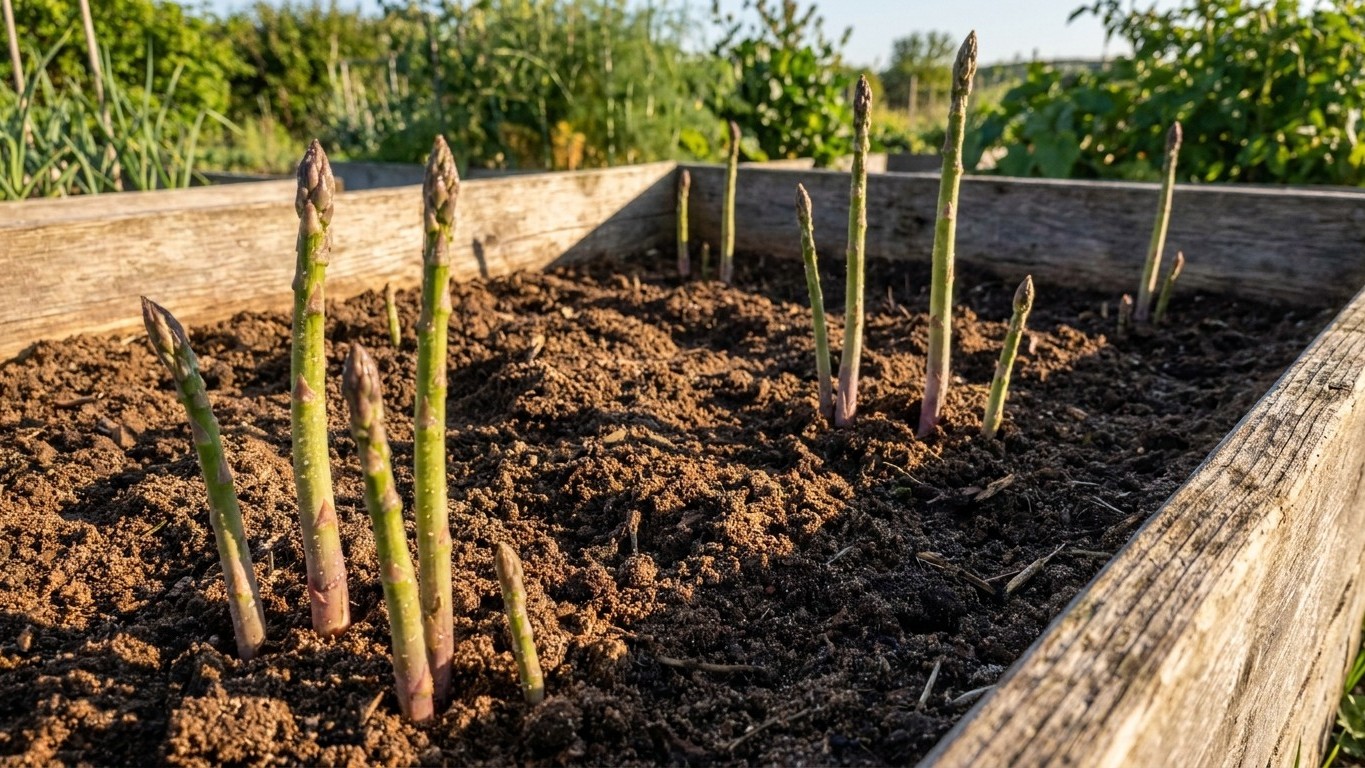

Stop cutting when most of the spears coming up are thinner than a pencil. That signal matters more than any date on a Georgia calendar. Once the spears reach the kitchen, aim for 32 to 35°F with near-saturated air. Above 50°F they toughen fast, and below about 31°F they freeze and collapse. A new bed gets no harvest at all until year 3, so the ground, the rain and the planting date come first.
The short answer
Georgia’s state soil is the Tifton series, an Ultisol: old, heavily weathered, leached, naturally acid and low in nutrients. USDA’s representative values for the surface layer read 84 percent sand, 6 percent clay, 9 percent silt, organic matter around 0.8 percent and a pH near 5.5, which is slightly acid. It is classed as well drained. That matters because an asparagus bed is a fifteen-year commitment. Crowns go into 8-inch furrows, the bed produces for 10 to 15 years, and the one soil requirement in the Utah State University Extension guide is that the ground drains.
On that single test, the dominant soil here passes easily. Water does not sit on 84 percent sand. The risk runs the other way. Sand gives up water and nutrients quickly, and 0.8 percent organic matter has little to hold either one. A tomato bed can be fixed with a few bags of compost each spring. An asparagus bed cannot be dug up and reset without losing years. Build the organic matter in before the crowns go down.
When the ground is not Tifton
Treat the state soil as a starting point, not a diagnosis. Georgia spans hundreds of soil series, and river bottoms, hill country and any lot a builder has scraped or filled can behave nothing like Tifton. A heavy or compacted spot is the real danger, because a drainage problem here cannot be undone later. Fill a test hole with water and watch it. If water is still standing there long after the rest of the yard has dried out, build a raised bed or choose another spot. Then get a soil test for your own numbers. The extension source I am leaning on is silent on pH, so I will not name a target. Our guide, Will Georgia Soil Hold an Asparagus Bed for Fifteen Years?, goes deeper on this decision.
The harvest clock
Nothing gets cut in the first two years, and the rule is not softened for a few tempting spears. Harvest begins in year 3 and runs four weeks. The next season runs six weeks, and after that eight. Each season ends when most spears come up thinner than a pencil, not on a date. For the full planting picture, start with Growing Asparagus in Georgia.
Will the summer here water it for you?
Partly. The bed wants 1 to 2 inches every other week for the first two years, then every three weeks once it is established. Reference-station normals for the Atlanta area, the most recent 30-year set from NOAA NCEI, show about 13.6 inches of rain across June, July and August (50.4 inches over the full year). Here is how to read those numbers against the bed:
- Start with the monthly figures. June averages 4.54 inches, July 4.75 and August 4.3, which makes August the driest summer month. Spread across the season, that works out to roughly 2 inches in an average two-week stretch. On paper, rain alone covers the 1 to 2 inches the young bed asks for.
- Discount for sand. On a Tifton-type surface, rain passes through within the day. A wet summer on sand can still leave roots dry by midweek, and the average hides that.
- Discount for heat and storms. Days at or above 90°F pull water out of the ground quickly. Rain that arrives as one big thunderstorm mostly runs off instead of soaking in. Two inches in a single downpour is worth less than two inches spread over several days.
- Put a rain gauge on your own plot. These are regional normals, not a forecast and not your yard. A slope, a city lot or a rain shadow changes the totals. If the gauge shows less than 1 inch over two weeks, add the difference to reach 1 to 2 inches. If it shows more, leave the hose alone.
- Ease off after two years. Once the bed is established, the rhythm stretches to every three weeks. Most Georgia summers will cover part of that without help, but the gauge decides.
The gardener’s share, then, is not a fixed number of gallons. It is whatever gap the gauge shows, and on sandy ground that gap opens faster than the monthly totals suggest. In August, with the lowest of the three monthly figures and the heat at its worst, expect to be out with the hose more often than in June.
When to put the crowns in
Crowns go in during early spring. In Georgia that lines up with the last spring frost, which falls around March 11 to March 29 at the Atlanta reference station, based on NOAA NCEI normals. That range is the 30 to 70 percent band for a 32°F freeze. By the early dates the odds of another freeze have dropped to roughly 30 percent, and by the late ones they are around 70 percent for the last freeze having already passed. A mean frost date is an average, so some years will beat it and some will not.
Atlanta’s airport is also an urban heat island. North Georgia and the mountains run colder and freeze earlier in fall, and the coastal plain runs milder, so shift your window accordingly and watch your own forecast. Dig the furrow 8 inches deep, set the crowns in, and do not fill it all at once. The furrow is backfilled gradually through the year, 2 inches every other month, until it is level.
Starting from seed is the other route. The notes behind this page do not give a sowing date for Georgia, so I will not invent one. Check the Utah State University Extension guide, Asparagus in the Garden, before committing seed to the ground. Slugs, beetles and other chewers are a separate planning question, covered in What Eats Asparagus in Georgia, and When.
Common questions
When do I stop cutting each season?
Stop when most spears are thinner than a pencil. The first harvest season runs four weeks, the next six and the one after that eight, but those week counts only describe a maturing bed. The pencil tells you when this year’s cutting is over. Leave whatever comes up after that alone.
Can I take a few spears before year 3?
No. The bed is not harvested until year 3, and the guidance does not offer a trial cut. After that it produces for 10 to 15 years.
How do I keep cut spears fresh?
Target 32 to 35°F and 95 to 100 percent relative humidity, the optimum range from UC Davis Postharvest. The window is narrow. Spears toughen quickly above 50°F, and freezing injury, a water-soaked look that leads to extreme softening, is likely at 30.9°F or lower. In a home kitchen the practical translation is to stand the butts in water in the fridge, or wrap them damp. The cut end loses water faster than anything else.
Which variety should I plant?
Four are named in the source, and only their sex is given. Jersey Giant and Jersey Knight are all-male. UC 157 F1 and Purple Passion are male and female. The Utah State University Extension guide publishes no flavor, yield or reason to prefer one, so any recommendation beyond that would be invented.