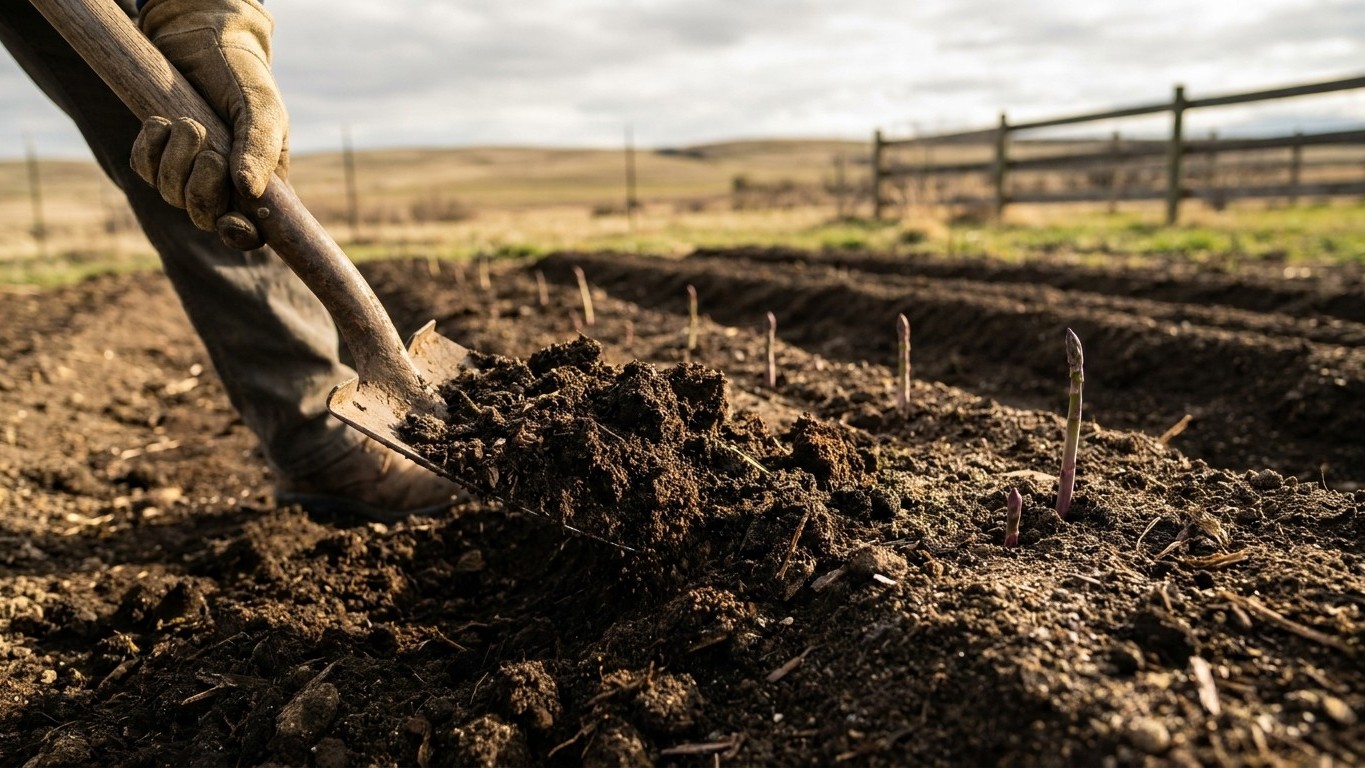

An asparagus bed asks for one thing above all else: ground that drains. Georgia’s representative soil, the sandy Tifton series, does that job well, which means the state’s growing conditions favor the crop. But a bed planted this spring will still be producing spears fifteen years from now, so the real question isn’t whether asparagus can grow here. It’s whether your particular patch of ground can hold up its end of a fifteen-year bargain.
The short answer
Asparagus is planted once and harvested for a decade or more from the same spot. Utah State University Extension puts the productive life of a bed at ten to fifteen years, with no harvest at all in the first two seasons. That single fact changes how a gardener should think about soil, and it’s worth asking directly: Will Georgia Soil Hold an Asparagus Bed for Fifteen Years? With most vegetables, a bad drainage year is an annoyance you fix next season with a different bed or a truckload of compost. With asparagus, the site decision is close to permanent, and so is the timing: When to Plant Asparagus Crowns in Georgia matters almost as much as where. Dig the crowns into ground that stays soggy, and you’re stuck with the consequences for a decade and a half.
So does Georgia’s ground drain well enough? The soil USDA lists as representative of the state is the Tifton series, an Ultisol, which is a category of old, heavily weathered, leached soil that tends to run acid and light on nutrients. The numbers back that up: the surface horizon runs 84 percent sand, 6 percent clay, and 9 percent silt, with organic matter around 0.8 percent and a surface pH near 5.5, slightly acid. Soil that sandy sheds water fast. There’s little clay to hold moisture and little organic matter to slow it down, so a Tifton-type surface counts as well drained, which is exactly the box asparagus needs checked.
That’s the state picture, not your picture. USDA built the Tifton series description from 173 mapped soil components across the coastal plain, and Georgia spans a lot more ground than that: river bottoms with heavy clay, Piedmont hill country, and any yard where a builder scraped off the topsoil and drove equipment over what’s left. If your garden holds water in a puddle an hour after a hard rain, you’re not sitting on anything like the Tifton profile, regardless of what the state soil says. The fix isn’t complicated: a raised bed or a mounded berm, built up eight inches or more above grade, gives the crowns the drainage a heavy or compacted native soil won’t. Given how long the bed will stay put, that’s a modest investment against fifteen years of frustration. A soil test, run before you dig, is the only way to know for sure which situation you’re actually in.
Will the summer here water it for you?
An asparagus bed has a specific thirst, and it changes as the plant matures. For the first two years, while the crowns are establishing and before any spear gets cut, the bed wants 1 to 2 inches of water every other week. After that, once harvesting has started, the ask drops to 1 to 2 inches every three weeks. Georgia’s summer rainfall, measured at reference station USW00013874 over the 1991-2020 normals period, comes in at about 13.6 inches across June, July, and August combined, broken down as 4.54 inches in June, 4.75 in July, and 4.3 in August, the driest of the three.
- Do the math on the young bed first. One to two inches every other week averages out to roughly half an inch to an inch per week. Georgia’s summer normal works out to a little over an inch a week across the season, so on paper the rainfall alone comes close to covering the first two years, at least in an average month.
- Then look at how that rain actually arrives. Southern summer rainfall tends to fall as short, heavy thunderstorms rather than steady soaking rain. On a sandy, fast-draining surface like Georgia’s representative Tifton soil, a downpour can run off or percolate straight past the root zone before the plant gets much benefit from it, even in a month where the total looks generous on paper.
- Watch August specifically. At 4.3 inches, it’s the driest of the three summer months in the normals record, and it lands right when a young bed’s root system is still shallow and least able to ride out a dry stretch.
- Ease up once the bed matures. From year three onward, the every-three-weeks schedule is a lighter ask than the summer normal typically supplies, so an established bed on decent soil should rarely need supplemental water beyond what the sky provides.
- Let a rain gauge settle the argument. Climate normals describe a station’s average, not your yard’s actual week. A five-dollar rain gauge staked next to the bed tells you, in real time, whether last week’s storm actually delivered the inch it looked like it did.
When to put the crowns in
Crowns go into the ground in early spring, planted into furrows about 8 inches deep. In Georgia, spring planting lines up against a last spring frost that, per the NOAA NCEI 1991-2020 normals for station USW00013874, falls somewhere around March 11 to March 29. That’s a band built from 30 to 70 percent freeze probability, not a fixed date, so treat it as a mean to plant around rather than a switch that flips on a single calendar day. Atlanta’s own station sits inside an urban heat island, which nudges its numbers milder than the surrounding countryside; north Georgia and the mountains typically freeze several weeks earlier come fall, while the coastal plain tends to run milder than the state average. Whatever county you’re in, that regional spread matters more than the statewide figure.
Once the crowns are in the furrow, don’t fill it in all at once. The furrow gets backfilled gradually across the year, in roughly 2-inch increments every other month, as the emerging shoots grow tall enough to handle being partly buried again. That staged fill is part of how the plant builds the root crown that will keep sending up spears for the next decade and more.
Utah State University Extension names four varieties, distinguished only by their sex: Jersey Giant and Jersey Knight are all-male hybrids, while UC 157 F1 and Purple Passion are male-and-female types. That’s the extent of what’s published here about the varieties. No flavor comparison, no yield figures, and no stated reason to favor one over another appear in the source, so treat variety choice as a matter of availability rather than a documented performance difference. The source is also silent on any chilling-hour requirement and on a preferred soil pH for the crop, and neither figure should be assumed from Georgia’s hardiness zone or from the state soil’s own pH reading.
Seed is the other route in, planted as an alternative to crowns, though it adds an extra year of waiting before the plants are big enough to treat like a crown planting. Whichever way you start, patience is built into the crop from day one: no harvest happens in year one or year two. Year three brings the first cutting, limited to about four weeks. Year four extends to roughly six weeks, and year five to about eight. In every season after that, the stopping point isn’t a date on the calendar. It’s the spears themselves: when most of what’s coming up runs thinner than a pencil, harvest is over for the year, full stop, regardless of how many weeks you’ve been cutting.
Checking this against your own county
Everything above describes the state as a whole, built from a representative soil series and a single climate station. Your county’s actual frost timing, summer rainfall, and native soil can all sit a good distance from those statewide figures, especially if you’re up in the mountains, down on the coastal plain, or working a river-bottom lot instead of the sandy coastal-plain ground the Tifton series describes.
The University of Georgia Cooperative Extension, part of the USDA’s land-grant university network, keeps county-level agents who can pull local frost records, run a soil test on your actual plot, and confirm whether your ground’s drainage matches what a fifteen-year asparagus bed needs. That’s a five-minute conversation that beats guessing on a decision you can’t easily undo. Find your county office through UGA Extension before you break ground.
Common questions
How many chilling hours does asparagus need in Georgia?
That figure isn’t published in the source used for this article. The source covers planting depth, watering, and harvest timing, but it’s silent on winter chilling requirements, and Georgia’s hardiness zone shouldn’t be treated as a stand-in for a chilling number that hasn’t been documented here.
What soil pH does asparagus actually need?
Also not stated in the source. Georgia’s representative Tifton soil runs a surface pH near 5.5, slightly acid, but that’s a description of the state soil, not a published preference for the crop. A soil test is the way to find out where your bed’s pH actually sits.
Which asparagus variety should I plant in Georgia?
The available guidance names four options by sex only: Jersey Giant and Jersey Knight are all-male, UC 157 F1 and Purple Passion are male-and-female. No flavor or yield differences are published, so the choice comes down to what’s available rather than a documented performance edge.
Can I harvest asparagus the first year after planting?
No. The bed goes unharvested in years one and two while the crowns establish. The first cutting comes in year three, limited to about four weeks, then extends gradually in the seasons that follow.