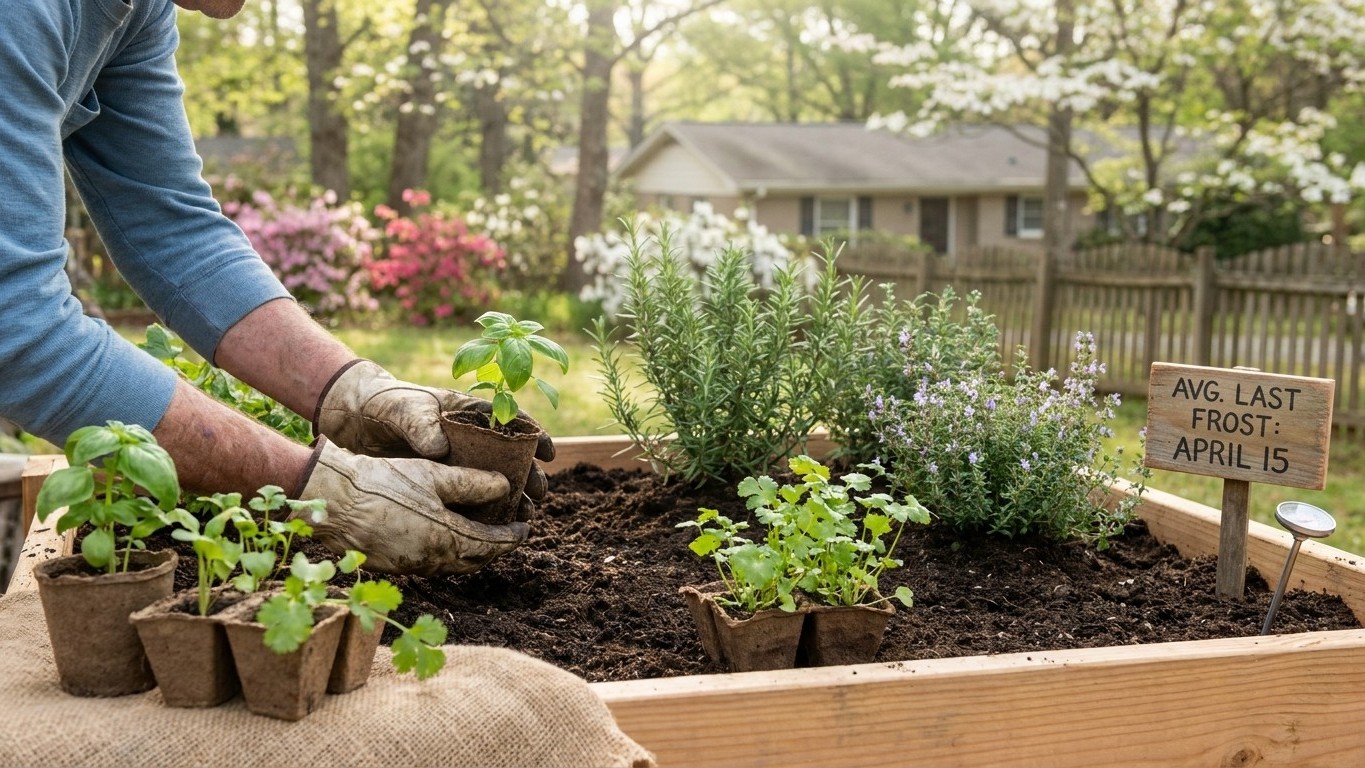

Georgia gardeners get two real planting windows for herbs: a spring one after the last frost (March 11 to March 29 around Atlanta) and a fall one before the first frost (November 13 to December 1). But those dates only govern the tender herbs. Perennial herbs answer to a different number entirely, and it’s the one most planting calendars skip.
The short answer for Georgia
Start basil, cilantro, dill, and other tender annual herbs outdoors after March 11 to March 29, the window when NOAA’s 1991-2020 climate normals put a 30 to 70 percent chance of a 32F freeze at the Atlanta station (USW00013874). That’s not a guarantee of frost-free soil on any single date. It’s a probability band: early in the window, the odds of a freeze still lean higher than 50 percent; late in the window, they’ve dropped below 30 percent. A gardener who plants on March 12 is taking a real risk. One who waits until March 29 is playing it closer to safe, and losing almost three weeks of growing time in exchange.
Fall planting of hardy herbs like parsley or cilantro (again, cilantro prefers the cooler ends of the year here) works the same way in reverse: get them in well before November 13, since the first fall freeze can arrive that early in a below-average year, even though the average pushes closer to December 1.
Perennial herbs, rosemary, thyme, sage, oregano, don’t care about frost dates once established. They care about winter survival, and that’s decided by a different fact: the mean daily minimum temperature of the coldest month, which sits at 35.6F for the Atlanta reference station. That’s an average low, not a record low, and it’s the number that tells you whether a plant simply lives through a normal winter here or gets killed back to the ground. At 35.6F, most Mediterranean herbs, rosemary included, hold on fine in the milder parts of the state. Only your zone can.
So the short answer splits in two. Tender herbs follow the frost-date calendar above. Perennial herbs follow the coldest-month minimum, and whether that number applies to your specific spot depends on where in Georgia you’re standing.
What will not work here

A gardener who treats Georgia like a single climate zone is setting up a specific kind of failure, and it usually shows up in July. Cilantro, for instance, is often planted in April with good intentions and bolts to seed within weeks once daytime highs push past the mid-80s, which happens routinely across most of the state well before summer officially starts. The plant isn’t dying. It’s finishing its life cycle early because heat, not frost, ends its season here. The fix isn’t a different variety; it’s a different calendar slot, tucking cilantro into the cooler shoulder months instead of the heart of summer.
Basil and oregano planted at tight, catalog-recommended spacing run into a second, more humid problem. Georgia summers combine heat with high atmospheric moisture, and closely spaced herb beds trap that moisture at leaf level overnight. Fungal issues, downy mildew on basil especially, spread faster in that stagnant, damp air than they would in a drier climate at the same spacing. Wider rows and more airflow aren’t cosmetic advice here; they’re the difference between a bed that survives August and one that collapses into brown, spotted leaves by mid-month.
Watering on a fixed weekly schedule fails for the same underlying reason many transplanted gardeners don’t expect: Georgia’s summer heat pulls moisture out of containers and raised beds fast enough that a once-a-week schedule, fine in a cooler or less humid state, leaves herbs wilting by day four. Rosemary and thyme tolerate this reasonably well since they’re built for dry spells. Basil and parsley do not, and a once-weekly watering habit imported from a milder climate will read on the leaves within days.
French tarragon, meanwhile, is the herb most likely to simply disappoint a Georgia gardener regardless of technique. It wants a cold winter dormancy and a summer that isn’t oppressively humid, and much of the state offers neither reliably. It’s not that it’s impossible; it’s that the odds are stacked against it in a way they aren’t for rosemary or sage, and a gardener choosing between the two is choosing between a strong bet and a marginal one.
What changes across Georgia
Georgia spans USDA hardiness zones 6a through 9b, which is not a narrow spread. Zone 6a describes winters cold enough to challenge borderline-hardy perennial herbs; zone 9b describes winters mild enough that some herbs barely go dormant at all. That’s a difference of roughly 30F in average extreme minimum temperature from one end of the state to the other, and it means the coldest-month figure cited above (35.6F, tied to the Atlanta station) is a middle-of-the-road number, not a statewide constant.
A gardener in the north Georgia mountains is working with a colder, shorter perennial-herb season than the frost dates in this article suggest. The NOAA caution attached to these frost windows is explicit on this point: north Georgia and the mountains freeze several weeks earlier in fall than the Atlanta averages show, which compresses the safe window for tender herbs and pushes the practical cutoff for planting rosemary or lavender outdoors earlier in the year as well.
At the other end of the state, the coastal plain and far south Georgia run milder than Atlanta on both ends of the frost calendar. Last frost can arrive earlier there, first frost later, and the coldest-month minimum sits comfortably above what the mountains experience. Herbs marginal in zone 6a, rosemary in a hard winter, for instance, are a much safer bet in zone 9b conditions.
There’s also the Atlanta-specific wrinkle worth naming plainly: the reference station for these normals sits at an urban airport, and urban heat islands run warmer than the surrounding rural counties. None of this tells an individual reader which zone applies to their own yard. The USDA Plant Hardiness Zone Map does that, and it’s the tool to check before trusting any single-zone recommendation.
Where to check this for your own county
A state-level answer is a starting point, not a final one. The University of Georgia Cooperative Extension publishes planting guidance built around individual counties rather than the state average, and that county-level detail is what actually resolves the north-versus-south, mountain-versus-coastal-plain gaps described above.
Two things are worth hunting for once there. First, the local or regional planting calendar for herbs and vegetables, which will typically reflect a county’s actual frost dates rather than the Atlanta-anchored normals cited here. A county in the mountains or along the coast can differ from the state figures by two to four weeks in either direction, and that gap matters far more for a tender herb like basil than it does for something frost-tolerant like parsley.
Second, look for variety trial results or recommended cultivars specific to Georgia growing conditions. Extension offices regularly test how particular herb varieties perform against local heat, humidity, and disease pressure, and a variety that struggles statewide can still have a specific cultivar that holds up in trial after trial in Georgia’s climate. That’s information no general planting calendar, including this one, can supply.
The plain rule here: a county recommendation beats a state one every time there’s a conflict between them. The state-level picture is useful for understanding the broad mechanics of frost dates and winter minimums, but it isn’t a substitute for what your local extension office has already worked out for growers in your specific county.
Checking this against your own garden
Calendars and averages get a gardener close. The garden itself gets the final word, and it does that through a few signs anyone can read without special equipment.
Soil warmth by feel is the first and most reliable check before setting out tender herbs like basil. Push a finger a couple of inches into the bed in the morning; if it still feels cool and slightly damp-cold rather than merely cool, the soil hasn’t caught up to the air temperature yet, regardless of what the calendar date says. Basil seed in particular sits and rots in cold soil far more often than it germinates, so this single tactile check prevents more losses than watching the thermometer does.
The first flush of new growth on perennial herbs, fresh green shoots pushing out from woody rosemary or sage stems after winter, tells you the plant has decided winter is over on its own terms. That signal is specific to the microclimate of that exact spot in the yard, shaped by nearby walls, slope, and sun exposure in ways no zone map can capture. A south-facing bed against a brick wall will often show this growth weeks ahead of an open, north-facing corner of the same small property.
First true leaves on seedlings, the second set that emerges after the initial rounded seed leaves, confirm that a young herb has actually rooted into real growth rather than just sprouted. Seedlings that stall at the seed-leaf stage for more than a week or two are usually reacting to cold soil or poor light, both fixable once noticed. Watching for these three signs, soil feel, perennial regrowth, and true leaves, gives a more honest read on any single yard than any date ever could.
The Moon calendar is a separate, older custom: see when to plant herbs by the moon, written as tradition rather than fact.