
Growing cover crops in Hawaii means throwing out the calendar most mainland gardeners rely on. Lowland Hawaii never freezes, so there’s no frost date to plant around. Sowing here follows rainfall, elevation, and whether a garden sits on a wet windward slope or a dry leeward one. Heat-tolerant, disease-resistant species matter more than any date on a chart.
When the soil is warm enough in Hawaii
Ask a gardener in Ohio or Vermont when to sow a cover crop, and the answer starts with a frost date. In lowland Hawaii, that question simply doesn’t apply. NOAA’s 1991-2020 Climate Normals for station USW00022521 flag every freeze percentile at 32°F and 36°F as not-computable, because the station records zero days per year at or below freezing. There is no last spring frost to wait out and no first fall frost to race against, not in any garden a person actually tends.
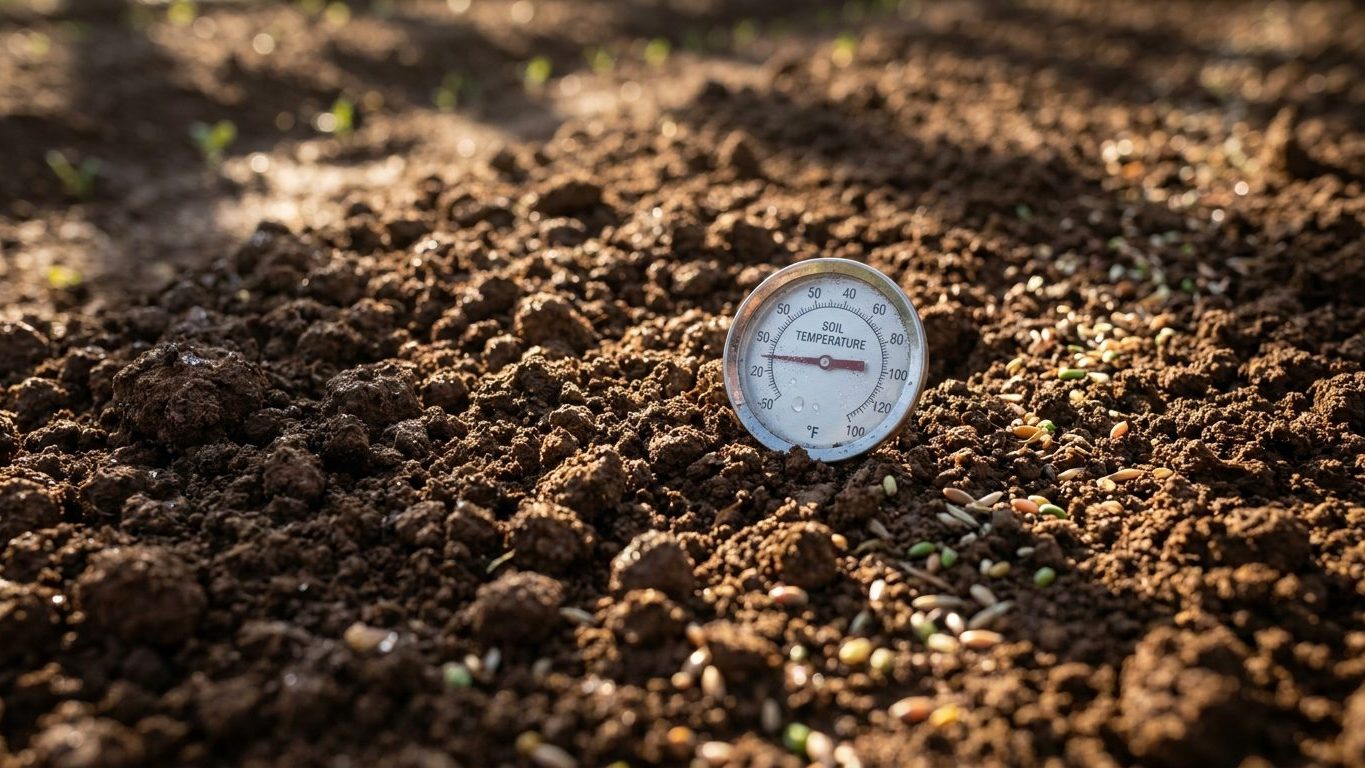
That’s worth saying plainly, because elsewhere on this site a frost date works as a stand-in for soil warmth: cover crops wait for warm soil, and soil warms after frost risk passes. Hawaii breaks that logic. Frost exists only above the treeline on Mauna Kea, Mauna Loa, and Haleakala, thousands of feet above anywhere with a vegetable bed. Down where people garden, the soil is warm enough to sow a tropical cover crop essentially any week of the year.
So what actually decides the sowing date? Moisture, mostly, and where the plot sits relative to the trade winds. On windward slopes, rain falls often enough that soil rarely dries out, and a cover crop can go in almost whenever a bed is free. On leeward sides, the dry stretch matters more than any temperature reading, and gardeners there time sowing around the wetter months or plan to irrigate through establishment.
Species suited to this climate are tropical rather than temperate. Sunn hemp, cowpea, lablab bean, and pigeon pea are legumes commonly grown as cover crops across the islands; sorghum-sudangrass is a common grass choice for fast biomass. All of them build organic matter and, in the case of the legumes, fix nitrogen through rhizobia bacteria living in their root nodules. How much nitrogen becomes available to the next crop depends on the species, how much biomass it built, and when it’s terminated, not on a fixed number that applies everywhere.
Seeding rate isn’t something to guess at either. It shifts with species, seeding method, and seed source, and a wrong rate can waste a whole planting window. Your best source is CTAHR, the University of Hawaii’s extension service, which publishes rates tuned to island conditions. Termination here is mechanical, not chemical: mowing, crimping, or cutting before a legume sets seed and turns woody.
How long the season lasts here
In most of the country, growing season length is a subtraction problem: last spring frost to first fall frost equals the window. That math breaks down completely in Hawaii, because both dates in the record are the same non-answer. NOAA’s normals report no computable freeze date in either direction for station USW00022521, so there’s no frost-defined season length to calculate, and estimating one anyway would just be inventing a number the data doesn’t support.
What replaces it is a growing window that runs, for practical purposes, the full calendar year in most lowland gardens. That changes the whole planning conversation. In a territory with a hard frost ceiling, the number of frost-free days sets a limit on how many cover crop cycles fit before a garden has to switch to food crops or sit fallow. Hawaii doesn’t impose that ceiling. A gardener can sow a legume, let it grow, terminate it, and sow again, cycling through several rounds in the time a colder climate manages one.
The tradeoff isn’t calendar days, it’s rainfall pattern and how much rest a bed needs between plantings. A wet windward garden can run back-to-back sowings with little pause. A leeward garden may need to plan around the dry season rather than the clock, waiting for reliable moisture before committing seed to the ground.
This is also where succession planning becomes more useful than frost planning. Staggering sowing dates by a few weeks, rather than trying to cram everything into one short window, spreads out labor and lets a gardener react to how the previous round actually performed. The general mechanics of that approach, timing gaps between plantings and reading how a crop is progressing before committing the next one, are covered in this site’s succession sowing guide, and they apply here even without a frost calendar to build around.
Heat and water in Hawaii
The mean daily minimum temperature for Honolulu’s coldest month sits at 66.8°F, according to NOAA’s 1991-2020 Climate Normals. That single figure explains a lot about why cover cropping in Hawaii doesn’t follow the same rules as a mainland garden. There is no month here cold enough to send a legume dormant or kill it back into a mulch layer. Whatever a gardener plants keeps growing, more or less, through what would be winter anywhere else.
That flips the usual winter question on its head. In a cold territory, the coldest month decides which species die back into a usable mulch and which need to be cut by hand, and a mild winter there can turn something like oats into a weed instead of an easy die-down crop. Hawaii doesn’t have that decision to make, because nothing dies back from cold in the first place. Every cover crop planted in lowland Hawaii needs a deliberate mechanical termination, mowing or cutting, since the climate itself never does the job.
The USDA Hardiness Zone Map places the state across a striking 9a-13a range, built on average extreme minimum temperature. That spread reflects the state’s elevation more than its latitude: Honolulu near sea level sits at the warm end, while high-elevation growing areas on Maui and the Big Island sit far cooler. A recommendation tied to Honolulu’s zone won’t hold at 4,000 feet on the slopes of Haleakala, and gardeners upcountry should treat the reference city figure as a starting point, not a rule for their own plot.
Rainfall works the same way, shaped less by season than by geography. Windward slopes catch consistent trade-wind moisture and high humidity for much of the year, which raises the odds of fungal disease on dense, low-airflow cover crop stands. Leeward areas run drier and hotter, where the limiting factor becomes water rather than mildew. A single territory-wide rainfall figure would flatten a contrast that matters more to a cover crop’s success than almost anything else here.
| Setting | Typical exposure | Main cover crop challenge |
|---|---|---|
| Windward lowland | Frequent rain, high humidity | Fungal disease, airflow |
| Leeward lowland | Dry season stretches | Moisture at establishment |
| Upland/elevation | Cooler nights, USDA zone shifts lower | Species suited to cooler nights |
Which cover crops suit Hawaii
Reasoning by type, rather than by variety, matters more here than almost anywhere else covered on this site. A continuous growing season with no frost to reset it favors species that can be sown, grown, and terminated in tight succession, since there’s no short window forcing a single-shot approach. Fast tropical legumes like sunn hemp and cowpea fit that pattern, building biomass quickly enough to fit several rounds into a year.
Humidity, more than heat, should drive the first cut in a windward garden. Dense stands with poor airflow invite fungal problems in a climate this wet, so disease resistance and a growth habit that doesn’t mat down at the base deserve more weight than yield alone. Lablab bean and pigeon pea, grown with enough spacing to let air move through the canopy, tend to hold up better in these conditions than crops packed in tight.
Heat governs the leeward and lowland picture differently: species need to tolerate sustained warmth and irrigation gaps rather than shade at the root, since shade is rarely the limiting resource in an open field. At higher elevations, where the 9a-13a zone range swings toward its cooler end, gardeners have more room to try species that would struggle in Honolulu’s warmth, including some cool-season legumes and grasses more familiar to temperate cover cropping guides.
None of this is a substitute for a variety recommendation, and this page won’t offer one. Cultivar performance depends on local trials, and the trials that mean anything for a garden in Hilo or Kailua-Kona were run in Hawaii, not extrapolated from a mainland catalog. CTAHR’s extension service maintains that trial data, along with current seeding rate guidance suited to island soils and rainfall. That’s the right next stop, not a brand name or a mix sold under a marketing label.