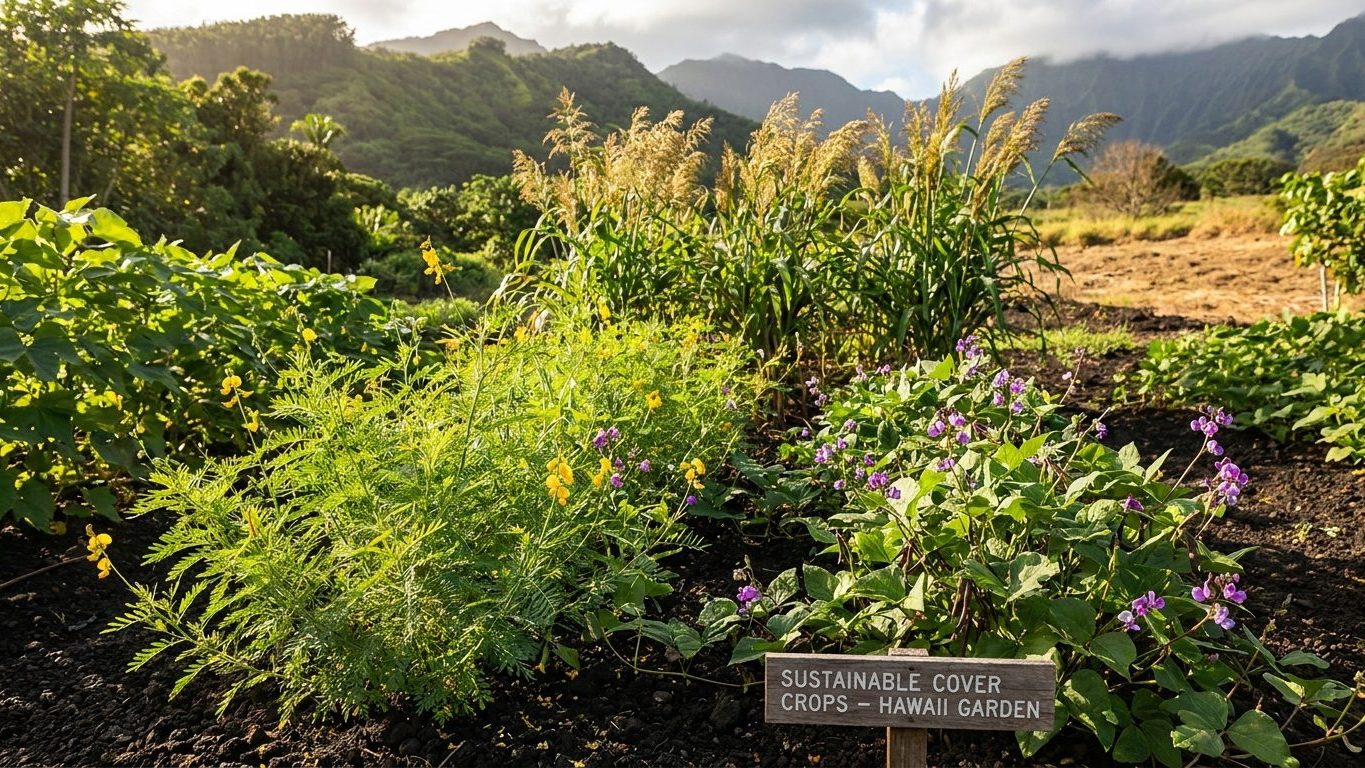

There’s no single “best” cover crop for Hawaii because there’s no single Hawaii growing season to plan around. With no frost to schedule against, the real choice comes down to rainfall and elevation: sunn hemp and cowpea for most lowland gardens, sorghum-sudangrass where you need fast biomass, and jack bean or velvet bean on the wetter windward slopes.
The short answer for Hawaii
Start with what Hawaii doesn’t have: a killing frost. NOAA’s 1991-2020 climate normals for the Honolulu reference station show zero days per year at or below 32°F, and the freeze percentiles are flagged as not computable because a freeze essentially never happens in inhabited areas. That single fact reshapes the whole question. On the mainland, “best cover crop” usually means matching a species to the number of frost-free weeks. Here, the limiting factor is rainfall and elevation, not temperature.
For most home gardens on leeward, drier sites (think much of the Kona coast or the lower slopes around Honolulu), sunn hemp is the workhorse. It germinates fast in warm soil, tolerates short dry spells once established, and builds nitrogen quickly enough to turn under in eight to ten weeks. Cowpea does the same job with a shorter, denser habit, and it’s more forgiving if you’re irregular with water.
If your goal is smothering weeds or building organic matter fast rather than fixing nitrogen, sorghum-sudangrass hybrids put on more biomass per week than almost anything else that tolerates Hawaii’s heat. They need more water to look their best, so they suit windward valleys and irrigated beds better than a dry leeward yard.
On the wetter windward side, where rainfall is frequent and humidity stays high, jack bean and velvet bean handle soggy soil and disease pressure better than sunn hemp does. Both are vigorous vining legumes that can climb over slower plants, so give them room or plan to mow them back.
Buckwheat is worth a mention because it’s popular on the mainland as a quick summer fallow crop, but it’s a poor fit for most of Hawaii. It bolts and sets seed fast in sustained heat, which means less time building biomass and more time managing volunteer buckwheat in your next planting. Treat it as a short-window filler at best, not a default choice.
None of this depends on picking a planting date the way a frost-driven state would. It depends on matching the crop’s water tolerance to your specific patch of ground.
What will not work here
The cover crops that fail hardest in Hawaii are the classic cool-season, winter-killed types: winter rye, hairy vetch, crimson clover, Austrian winter pea. On the mainland, the whole point of these crops is that they grow through fall, get knocked back or killed by winter cold, and leave a manageable, partly decomposed mat by spring. That strategy depends on a real cold season to do the killing for you.
Hawaii doesn’t have one. The coldest month’s average daily minimum, measured at the Honolulu reference station, is 66.8°F. That’s warmer than a mild spring morning in much of the continental U.S. Cool-season cover crops planted here either germinate poorly in soil that never really cools down, or they grow but never stop growing, turning into a woody, seed-set mess you have to till or mow down by force instead of letting winter do it for you.
There’s a second failure mode tied to the same fact: photoperiod. Some temperate legumes and grains are bred to respond to long summer days and short winter nights at mid-latitudes. Hawaii’s day length barely changes across the year, and that mismatch can delay flowering or bulking in varieties that were never trialed near the tropics.
Watering mistakes that compound the problem
A cover crop chosen for a dry mainland climate and then planted on a wet windward lot, or vice versa, tends to fail for reasons that have nothing to do with the species itself. Sunn hemp and cowpea, both reasonably drought-tolerant once established, will rot at the crown in consistently soggy, poorly drained windward soil. Jack bean and velvet bean, bred for that kind of moisture load, will sulk and grow slowly in a dry leeward bed watered only once a week.
The short version: don’t import a cover crop plan built around a frost date, and don’t assume one variety works statewide. Match the crop to your rainfall pattern, not to a calendar.
What changes across Hawaii
Hawaii isn’t one garden, and the USDA Plant Hardiness Zone Map makes that obvious at a glance. The state spans zones 9a to 13a, based on the 1991-2020 average annual extreme minimum temperature. That’s an enormous range for one state, roughly the same spread you’d see moving from the Gulf Coast all the way into equatorial lowlands. There is no single hardiness answer for “Hawaii,” and any planting guide that gives you one number is oversimplifying.
The practical driver of that spread is elevation combined with windward-versus-leeward exposure. Sites near sea level on the windward side stay warm and wet nearly year-round. Climb a few thousand feet, on the slopes of Mauna Kea, Mauna Loa, or Haleakala, and temperatures drop enough that frost does occur, just never where people actually garden. In between those extremes sit countless microclimates: a leeward valley can be arid enough to need drip irrigation for any cover crop to establish, while a windward gulch two miles away gets rain most afternoons.
What that means for you: a cover crop recommendation calibrated for Honolulu’s coastal warmth won’t automatically hold up at 2,000 feet on the Big Island, or in the drier upcountry pockets of Maui. If you garden at higher elevation, expect slower establishment and lean toward the more cold-tolerant, slower-growing legumes rather than fast, heat-loving grasses. If you’re right on the coast in a wet windward spot, lean the other direction and watch for rot rather than drought stress.
This page can only give you the statewide picture. For where your own property actually falls on that 9a-to-13a range, check the USDA Plant Hardiness Zone Map directly rather than guessing from a general description of your island or town.
Where to check this for your own county
Everything above is a state-level answer, and Hawaii’s terrain makes state-level answers unusually rough. The next step is the University of Hawaii’s CTAHR extension service, at ctahr.hawaii.edu/site/extension.aspx. This is the land-grant extension office for the state, and it’s the source that actually trials crops on different islands and at different elevations rather than describing Hawaii as a single climate.
When you get there, look specifically for two things. First, any county- or island-specific planting calendar, since sowing windows tied to local rainfall patterns will be far more useful than anything built around a frost date that doesn’t apply here. Second, look for variety trial results for your region: which sunn hemp, cowpea, or sorghum-sudangrass lines have actually been grown and measured on your island, at an elevation close to yours.
A county recommendation beats a state one every time, for a simple reason: it’s built from soil and rainfall data closer to your actual garden. This page is the state-level version, useful for narrowing down which type of cover crop fits your general situation, but it can’t tell you what performs best in a specific valley on Kauai versus a specific bench on the Big Ranch lands of Hawaii Island. CTAHR’s local offices and published guides exist to close that last gap, and they’re worth the extra ten minutes of searching before you commit a whole bed to one crop.
Checking this against your own garden
Once you’ve narrowed things down using the state and county information above, your own eyes and hands are still the best instrument you have, and they outrank every date or zone number on this page.
Start with soil warmth by feel. Push your fingers a couple of inches into the bed in the morning before the sun has warmed the surface. If the soil feels cool and slightly damp rather than warm and dry, most warm-season legumes like sunn hemp and cowpea will sit and sulk rather than germinate quickly, no matter what the calendar says.
Watch for the first flush of flowers once your cover crop is up and growing. Cowpea and sunn hemp both flower relatively early, and a strong, even flush across the bed tells you the crop found conditions it liked. A patchy, delayed, or sparse flowering usually points to uneven moisture across the bed, which matters more in Hawaii’s mix of wet and dry microclimates than it would in a more uniform mainland climate.
Finally, track how fast true leaves appear after the first seed leaves. A quick jump to true leaves within a week or so signals warm, well-drained soil doing its job. A long lag, especially paired with yellowing seed leaves, usually means the spot is wetter and cooler than you assumed, which is common on windward-facing beds even within an otherwise warm neighborhood. Adjust your next planting based on what you actually saw, not on what the general zone map predicted for your island.