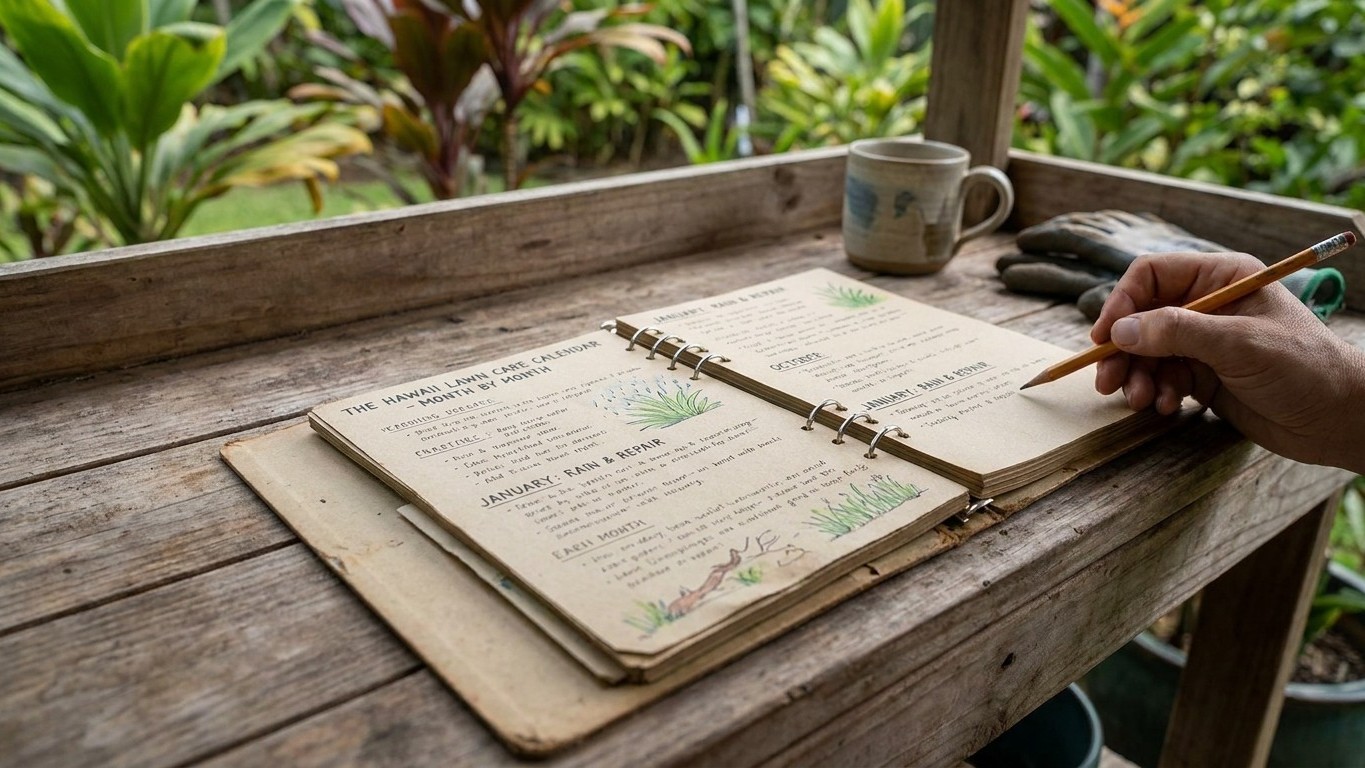

Your lawn out here never really sleeps, so the truth is there’s no month you get to skip. Zero freeze days on record for Honolulu means the grass is growing, and needs mowing and feeding, in every single month of the year — no dormant season to lean on, no spring green-up to wait for. So the one thing to nail down before anything else: figure out which warm-season grass is already growing in your yard, because the mowing height, the feeding rhythm, and the water schedule below all hinge on that answer, not on the month on the wall.
The short answer for Hawaii
There is no last-frost date to build a Hawaii lawn calendar around, because none of the state’s inhabited elevations freeze. NOAA’s data for the Honolulu station confirms this with a flat zero across every winter month on record. The practical result is that a Hawaii lawn grows, and needs mowing and feeding, in every month of the year. There’s no true dormant season to rest the schedule against, which is exactly why a calendar borrowed from a mainland cool-season program will always be wrong here.
The seven species that actually hold up under Hawaii’s heat are Bahiagrass, Bermudagrass, Carpetgrass, Centipedegrass, Seashore Paspalum, St. Augustinegrass and Zoysiagrass, per the warm-season list in Clemson’s HGIC 1214. Any cool-season grass, fescue or bluegrass among them, depends on winter cold to slow its growth and reset; without that cold it simply burns out in the heat. That’s the single biggest branch point on this page: your calendar depends entirely on which of the seven warm-season species is already in your yard, or which one you’re about to plant. If you haven’t settled that question yet, work through The Best Grass Seed for Hawaii Lawns before you follow any of the month-by-month advice below, because mowing height and nitrogen rate both shift by species.
What the rest of this calendar depends on, beyond species, is where on the islands you’re standing. A windward lawn on Oahu’s Kaneohe side gets soaked most of the year. A leeward lawn near Honolulu or on the Kona coast goes weeks dry. Elevation shifts the growing pace too. None of that changes the species you should plant, but it changes how often you’ll water, mow and fertilize inside the calendar that follows.
Working through the year

Why the calendar runs on rain, not months
Clemson’s species calendars (HGIC 1216 for Bermudagrass, HGIC 1217 for Zoysiagrass, HGIC 1215 for Centipedegrass, HGIC 1218 for St. Augustinegrass) are written for a climate with a real winter, so they space fertilizer applications and mowing changes across a spring green-up and a fall shutdown. Hawaii has neither. The mowing heights and nitrogen rates in those calendars still apply to the same species here, but you spread the growing-season tasks across all twelve months instead of six, and you swap the “before first frost” cutoff for “before the heaviest rains of the wet season.”
Bermudagrass, the most widely planted lawn grass in the islands, is mowed low and fed often under Clemson’s HGIC 1216 program: keep it in the lower mowing range for the species and split nitrogen into small monthly doses rather than one or two big feedings, since Hawaii’s grass never stops growing long enough to store a big feeding safely. St. Augustinegrass, covered in HGIC 1218, wants a taller cut and a lighter nitrogen hand. It scalps and thins if it’s mowed as short as Bermuda. Zoysiagrass under HGIC 1217 sits in between, growing slowly enough that missed mowings matter less, which is part of why it’s forgiving on steep or hard-to-reach yards. Centipedegrass, HGIC 1215, is the one species on this list that actively resents extra nitrogen. Feed it at the low end of the calendar’s range and it holds a fine, even texture. Push it past that and it grows soft, shallow-rooted and disease-prone.
Across all four species, irrigation follows rainfall rather than the calendar month. On a windward lawn getting frequent rain, you may not need to run a sprinkler at all for weeks at a stretch. On a leeward or upcountry dry lawn, water deeply and infrequently rather than little and often, which pushes roots down instead of keeping them shallow. Pre-emergent herbicide timing follows the rain, too: apply ahead of the wet season’s first flush of weed germination rather than watching for a soil-temperature window that a frost-free climate never really closes. Aerate whenever the lawn is actively growing and the soil isn’t waterlogged, which in Hawaii can be almost any month depending on your local rainfall pattern. There’s no autumn overseeding window here either, since a warm-season lawn that’s thin in one spot is patched by plugging or sprigging the same species, not by seeding a different one over the top.
| Species | Mowing habit | Nitrogen habit | Best fit |
|---|---|---|---|
| Bermudagrass | Cut low, frequently | Frequent, small doses | Full sun, high traffic |
| Zoysiagrass | Slower growth, forgiving | Moderate | Steep or awkward yards |
| St. Augustinegrass | Taller cut | Light to moderate | Part shade tolerance |
| Centipedegrass | Low, but low-maintenance | Low, resents excess | Low-input lawns |
What changes across Hawaii
Rainfall does more work than elevation
The Honolulu station’s zero-frost reading holds for essentially every inhabited elevation across the islands, because Hawaii’s true freeze line sits far above where anyone gardens. Frost shows up only on the high volcanic summits, Mauna Kea, Mauna Loa and Haleakala, none of which carry a lawn. So elevation changes growth rate and rainfall pattern here, not frost risk. A lawn at a few thousand feet on the slopes of Haleakala grows more slowly and stays cooler and damper than one at sea level, which slows mowing frequency without ever pushing the grass into dormancy.
Windward versus leeward exposure matters more day to day than elevation does. The windward sides of the islands, the Hilo side of the Big Island or Kaneohe on Oahu, catch the trade winds and the rain that comes with them, so lawns there rarely need supplemental irrigation but face heavier fungal disease pressure from prolonged leaf wetness. The leeward sides, including Honolulu itself and the Kona coast, run drier for long stretches and depend on irrigation to keep a warm-season lawn from going dormant-brown during rainless weeks. Neither of these figures should be read as a state-wide number: the FACTS above are measured at the Honolulu station, and a lawn on the wet windward coast of a neighboring island is working with a different rainfall total entirely.
Soil and slope compound both effects. A steep, well-drained leeward lot dries out faster than a flat one even at the same rainfall total, while a low-lying windward yard on heavy clay can stay saturated long enough to invite root disease. None of this changes which of the seven warm-season species will grow, since all of them tolerate Hawaii’s heat, but it does change how often you’ll be out watering, mowing or watching for fungal patches in a given month.
The mistakes this climate punishes
Most Hawaii lawn failures trace back to habits imported from a place that actually has a winter. The lawn doesn’t die outright, since warm-season turf here rarely goes fully dormant the way it does on the mainland, but it thins, yellows or mats down in ways that take months to reverse.
- Feeding a fall “winterizer” dose. There’s no dormancy to prepare for, so a heavy late-season nitrogen push just feeds excess growth into the wet season, when fungal disease pressure is already highest. The damage shows up as brown fungal patches four to six weeks later.
- Planting a cool-season grass out of habit. Fescue or bluegrass seed sold for mainland lawns has no winter cold to slow it down here, so it germinates, struggles through the first hot stretch, and thins out within a season, usually blamed on the soil rather than the seed choice.
- Cutting too short in the driest months. Scalping a leeward Bermudagrass lawn during a dry spell removes the leaf area the plant needs to shade its own roots, and the lawn browns within one to two weeks, taking longer to recover than a normal mowing cycle would.
- Overwatering a windward lawn that’s already getting rain. Adding irrigation on top of a wet trade-wind pattern waterlogs the root zone and invites the same fungal problems that overfeeding does, often showing as thinning rings within a month.
All four of these show their damage weeks after the mistake, not the day of, which is why they get repeated. If your lawn is thinning and you can’t place why, work back through what you fed and mowed four to six weeks earlier before assuming it’s a pest or a soil problem. If you haven’t reviewed the basics of choosing and installing a warm-season lawn yet, Hawaii Lawn Care covers the groundwork this calendar assumes you’ve already done.
Checking this against your county
Every figure above is measured at or near the Honolulu station, and rainfall, wind exposure and elevation all shift the details county by county and even yard by yard. Before you commit to a fertilizer rate or an irrigation schedule, check it against the University of Hawaii’s Cooperative Extension Service, listed at the CTAHR extension directory, which can point you to the office covering your island and soil type. A local extension agent is the only source that can tell you what your specific rainfall pattern is doing to a given species this year, since a single climate normal can’t capture a wet season that runs early or late.
Common questions
Does Hawaii grass ever go dormant or turn brown for winter?
No, not from cold. NOAA’s data shows no freeze at inhabited elevations, so a Hawaii lawn keeps growing year-round. Browning here almost always signals drought stress, disease or a mowing or feeding mistake, not seasonal dormancy.
Can I grow a cool-season lawn like fescue in upcountry Maui or Waimea?
It’s not a good bet even at higher elevation, because those areas still don’t get the sustained winter cold a cool-season grass needs to slow down and recover. Stick to one of the seven warm-season species and accept the slower growth that comes with higher elevation instead.
How often should I fertilize if there’s no growing season break?
Split the same total yearly nitrogen a mainland calendar would use for your species into more, smaller feedings spread across the whole year rather than concentrating it in spring and fall. Centipedegrass in particular should stay at the low end of its species’ range, since it thins and disease-checks under heavy feeding.
Why does my lawn stay wet and diseased even though I barely water it?
On a windward-facing yard, trade-wind rainfall alone can keep the root zone saturated without any irrigation at all. Cut back or stop supplemental watering first, and check for shade or poor drainage before assuming the problem is a fungus that needs treating.