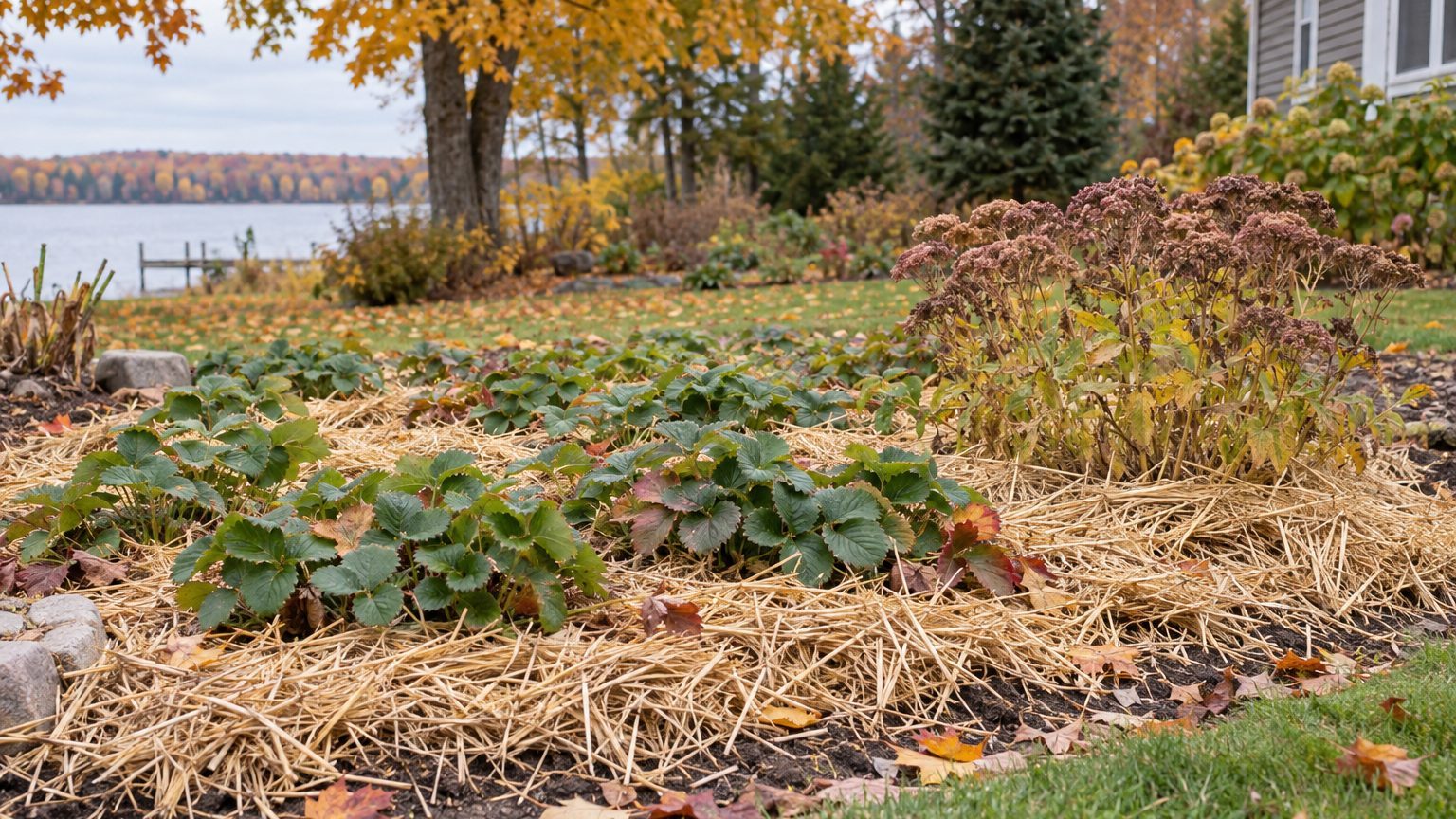

In Hawaii’s inhabited areas, there is no winter mulching date to circle. NOAA’s 1991-2020 Climate Normals record zero days per year at or below 32°F at the Honolulu station, so the mainland routine of waiting for the ground to freeze and then tucking plants in never starts. Mulch still earns its place, but as a year-round layer for moisture and weed control, not a winter blanket. What matters is depth, placement, and a handful of avoidable mistakes.
When to put winter mulch down in Hawaii
The mainland rule, and why it fails here
Gardeners in Minnesota or Vermont learn a rule that sounds backward: winter mulch goes on after the ground starts to freeze, not before. Its job is to keep soil frozen, not warm. A thick layer applied in early fall holds summer heat in the soil, invites rot, and gives rodents a cozy place to move in. Wait for the freeze, then cover.
That whole logic depends on frozen ground, and Hawaii’s gardens do not have any. The NOAA NCEI 1991-2020 Climate Normals for the Honolulu station (USW00022521) flag every freeze percentile at 32°F and 36°F as not computable, because the freezes never occur. The same dataset shows a mean daily minimum of 66.8°F in the coldest month. Frost does happen on the high volcanic summits of Mauna Kea, Mauna Loa, and Haleakala, but nobody gardens there. In lowland and mid-elevation Hawaii, a first fall frost date simply does not exist, which is also why the First and Last Frost Dates in Hawaii question has such a short answer.
So is winter mulch needed at all? Not in the northern sense. Skip the freeze-based calendar and mulch whenever a bed needs moisture or weed control, which can be any month of the year.
What governs timing instead
Hawaii’s growing conditions are driven by rainfall, elevation, and whether a garden sits on the windward or leeward side of its island. A windward bed that stays wet needs mulch to be thin enough to dry out between rains. A leeward bed that bakes between showers needs mulch for the opposite reason: to slow evaporation. The best time to lay it down is right after planting, or any time bare soil starts showing between plants.
The USDA Plant Hardiness Zone Map (2023 edition) lists Hawaii as a whole at 9a-13a. That system rests on a single variable, the average annual extreme minimum temperature, and the range covers the entire state. Honolulu is the reference city used here, and other parts of the islands differ, especially as elevation climbs.
| Purpose of mulch | Mainland cold climate | Hawaii’s gardening zones |
|---|---|---|
| Keep soil frozen | Main reason for winter mulch | Does not apply, no freeze |
| Prevent frost heave | Applied after ground freezes | Does not apply |
| Hold moisture | Secondary benefit | Main reason to mulch |
| Suppress weeds | Secondary benefit | Main reason to mulch |
More Island-specific advice lives in the Hawaii guides, where the questions shift from “when will it freeze” to “how much rain does this spot get.”
Strawberries
What the crowns are protected from elsewhere
On the mainland, strawberry crowns take two kinds of punishment in winter. Repeated freezing and thawing heaves the soil and pushes shallow roots and crowns up out of the ground, where they dry out. And bare cold, without snow or cover, can kill crown tissue outright. Clean straw spread over the plants after the ground freezes buffers both. That is the northern job, and it depends on frozen soil.
Hawaii’s gardens do not face either threat. With zero days at or below 32°F in the NOAA NCEI Climate Normals for Honolulu, and a coldest-month mean minimum of 66.8°F, heaving never happens. There is no reason to bury strawberry plants for winter.
What mulch does for strawberries here
Strawberries still benefit from a mulch layer, just for different reasons. Clean straw keeps berries off damp soil, which cuts down on rot and splashed dirt. It slows evaporation between rains and holds back weeds that would otherwise crowd shallow roots. In wet windward areas, straw also dries faster than a dense bark product, which matters for a plant that hates sitting in soggy conditions.
On depth, stay within the range NC State Extension gives for weed control: “A 2-inch to 3-inch layer of mulch suppresses most annual weed seeds and makes it easy to hand-pull any that do germinate.” That quote comes from the NC State Extension Gardener Handbook, chapter 11 (Woody Ornamentals). Strawberry crowns are small and sit at the soil surface, so tuck the straw around them and leave the crown itself uncovered. The center should always see light and air.
The northern chore of pulling mulch back in spring has no Hawaii equivalent, because nothing is buried in the first place. The matching task is simpler: refresh the straw when it breaks down or mats, and keep it clear of the crowns every time. For variety choices, bed layout, and everything else about the plant, see Growing Strawberries.
Perennials and borderline plants
“Borderline” is a mainland word. It describes a plant rated for a zone just colder than yours, one that might survive winter with some help. In Hawaii, with Honolulu’s coldest-month mean minimum at 66.8°F and the state sitting at 9a-13a on the USDA 2023 map, hardiness is rarely what limits a perennial. Most struggles come from rain, humidity, drainage, or heat.
That changes which perennials benefit from mulch. Shallow-rooted plants that dry out fast on leeward sides gain the most, since mulch evens out soil moisture. Plants that dislike wet feet, including many herbs and Mediterranean-type perennials, need the layer kept thin and the soil around them well drained. And plants that need a real winter chill to flower or return, as some mainland favorites do, will not be rescued by mulch. A layer of bark cannot supply cold the climate does not deliver.
Depth guidance stays the same as for strawberries. NC State Extension, on trees and woody plants, says: “Provide a 3-inch layer of mulch to reduce water loss and maintain uniform soil moisture and temperature around roots.” Together with the 2-inch to 3-inch range for weeds, that gives a clear ceiling. Do not go deeper. More is not better, and excess depth is exactly how a tidy ring turns into a volcano.
Placement matters as much as depth. Lay mulch in a ring around the crown or trunk, leaving a gap of bare soil next to the stems, instead of piling it against them. Keep a ring, not a pile, and the base of the plant stays dry enough to avoid rot. The reasoning behind that is laid out in Mulching Without Killing the Plant.
If you brought perennial herbs from a mainland garden, or you read advice written for colder states, Getting Perennial Herbs Through the Winter shows what those plants expect elsewhere. It is useful for understanding the plant, even though the protection steps stay on the mainland.
What goes wrong
Most problems here come from importing a northern routine without the northern conditions. A few patterns show up again and again.
The first is following a freeze-based calendar. Someone reads that winter mulch goes on after the ground freezes, then waits for a trigger that never comes, or mulches heavily “for winter” anyway. There is no freeze to protect against, so the heavy layer only adds problems. The fix is to mulch by need: bare soil, dry spells, or weeds.
The second is mulch that mats and rots. Straw or leaves laid thick in a wet spot can pack into a soggy sheet. Under it, crowns stay damp and soft tissue breaks down. It looks like yellowing plants with a slick, dark layer on top. Keep the depth to the 2-inch to 3-inch range, fluff matted spots, and replace straw that has turned to mush.
The third is shelter for pests. The vole nesting that plagues northern winter mulch is not a Hawaii issue, since it belongs to a freezing-season habit. Damp, deep mulch can still hide slugs and snails, which chew strawberries and tender perennials. Thin layers and a pulled-back ring leave them less cover.
The fourth is the Hawaii version of forgetting to uncover in spring: never pulling mulch back at all. Layers pile up year after year, creep against stems, and bury crowns. Pull mulch back from every stem and crown, and top up only to the 2-inch to 3-inch range, rather than adding on top of what is already there.
Common questions
Do I need to mulch strawberries for winter in Hawaii?
Not for winter protection. NOAA NCEI’s 1991-2020 Climate Normals show zero days per year at or below 32°F at the Honolulu station, so there is nothing to protect crowns from. Mulch is still worth using for moisture, weed control, and keeping fruit clean, at any time of year.
Does frost ever happen in Hawaii?
Only on the high volcanic summits: Mauna Kea, Mauna Loa, and Haleakala. In inhabited areas no freeze occurs, according to the NOAA NCEI normals. Gardening decisions here follow rainfall, elevation, and windward versus leeward exposure instead.
How deep should mulch be?
NC State Extension says: “A 2-inch to 3-inch layer of mulch suppresses most annual weed seeds and makes it easy to hand-pull any that do germinate.” For trees, it says to “Provide a 3-inch layer of mulch to reduce water loss and maintain uniform soil moisture and temperature around roots.” Keep to that range, and keep it off the crown or trunk.
Does the 9a-13a hardiness range mean the same advice applies everywhere in the state?
No. The USDA Plant Hardiness Zone Map (2023) gives 9a-13a for Hawaii as a whole, built on average annual extreme minimum temperature alone. Honolulu’s coldest-month mean minimum of 66.8°F is the reference point used here, and other parts of the islands differ, especially with elevation. Rainfall and exposure often matter more than the zone number when deciding how thick or how often to mulch.