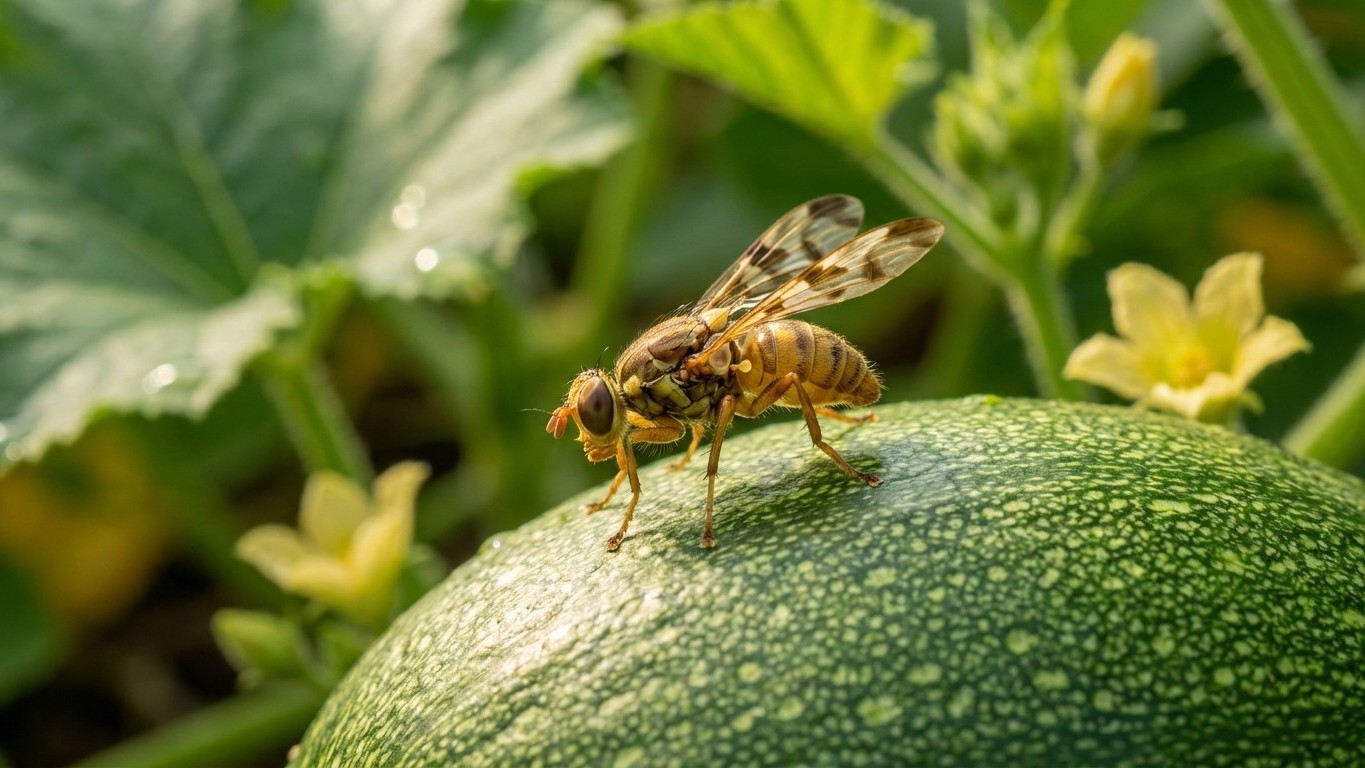

Melon fly doesn’t take a season off in Hawaii. The islands’ frost-free lowlands let this pest breed continuously, so instead of watching for a single “arrival date,” gardeners here track rainfall and fruiting stage. Control leans on fruit bagging, quick removal of stung produce, and traps, since sprays reach the adults but never the larvae already tunneled inside a squash or melon.
The weeks to watch

There isn’t a published start-and-stop window for melon fly in Hawaii, because the state’s cooperative extension materials don’t frame this species around a seasonal calendar the way mainland guides do for, say, Squash vine borer. The reason is structural: without a winter freeze anywhere in the inhabited lowlands, the fly’s life cycle never gets interrupted long enough to reset a “season.” Activity is present in every month of the year, on every main island where cucurbits are grown.
Year-round breeding
Adult females can find a host flower or young fruit in January just as easily as in July. That’s a real departure from mainland pest calendars, where a killing frost forces an insect to overwinter as a pupa or egg and re-emerge on a predictable clock. In Hawaii, generations overlap constantly, so a garden can have eggs, larvae, pupae, and flying adults present at the same time.
Peaks in warm, wet months
Even without a hard season, activity isn’t flat all year. Warm, humid stretches speed up development and egg-laying, which is why growers often notice heavier fruit-stinging during the wetter, warmer parts of the year and a slight easing during cooler, drier spells at higher elevation. That’s a tendency, not a fixed date range, and it shifts by island and by elevation band.
Reading the calendar from your last frost

This is the one section where the usual mainland gardening trick simply doesn’t apply. NOAA’s 1991-2020 climate normals for Hawaii’s lowland stations show zero days per year at or below 32°F, and every standard freeze-date percentile comes back “not computable.” There is no frost season to count backward from, because frost in Hawaii only occurs on the high volcanic summits of Mauna Kea, Mauna Loa, and Haleakala, nowhere near a home garden.
What replaces the frost date is the plant’s own growth stage. Melon fly females need a flower or a young, still-soft fruit to lay eggs in, so vulnerability starts the moment cucurbit vines begin setting fruit, not on a date pulled from a calendar.
- Skip the frost-date math entirely. There’s no freeze normal to anchor it to, so any “weeks before/after last frost” schedule borrowed from a mainland guide will mislead you here.
- Instead, mark the date your vines start flowering and setting the first small fruit. That’s the point protection (covers, bagging) needs to be in place, and it’s also roughly when the first stings or wilting tips tend to show up.
What it attacks, and what the damage looks like

Most gardeners spot melon fly damage before they ever see the insect itself. On young seedlings, the growing tip suddenly wilts and collapses even though the soil is moist, a sign that a larva has tunneled into the stem. On developing fruit, small discolored puncture marks appear on the skin, often oozing a bit of sap, and within days the flesh underneath turns soft and rotten from the inside out. Fruit that looked fine on Monday can be a mushy, dropped loss by the weekend.
The damage is done almost entirely by the larval stage, the maggot that hatches from an egg the adult female inserted just under the fruit’s skin. That matters for treatment: anything aimed at killing eggs or adults before they lay is useful, but once the maggot is feeding inside the fruit or stem, nothing applied from the outside reaches it. The only recourse at that point is removing and destroying the infested piece.
Melon fly’s host list runs well beyond its namesake fruit. In Hawaii home gardens, the crops most commonly affected include:
- Cucumber
- Cantaloupe and other melons
- Watermelon
- Summer and winter squash
- Pumpkin
- Bitter melon
- String beans
- Tomato
How Hawaii sits in this pest’s range

Within the United States, Hawaii isn’t one territory among many where melon fly happens to occur, it’s essentially the whole picture. This species became established on the main Hawaiian islands after its introduction in the early 1900s and has stayed established ever since, while the continental United States has remained free of it thanks to ongoing quarantine and inspection programs at ports and agricultural checkpoints. That asymmetry is the defining fact of melon fly’s US range: mainland states treat any detection as an emergency eradication event, while Hawaii manages it as a permanent, year-round resident pest of home and commercial cucurbit crops.
That distinction shapes the advice a Hawaii gardener gets versus one on the mainland. Mainland extension bulletins mostly describe what to do if the fly is ever detected and how to report it. Hawaii’s guidance skips straight to ongoing management, because eradication was never realistic once the population became self-sustaining across the islands’ warm, moist growing conditions.
What actually works against it

Cheapest and most effective first, this is the order a home gardener should actually try, since the fly’s biology makes some steps useless once fruit is already infested.
- Pull and destroy stung or fallen fruit immediately. Any fruit with a puncture mark or that drops early likely already has larvae inside. Removing it before the maggots finish feeding and drop into the soil to pupate breaks the next generation before it starts. Leaving rotting fruit under the vine is effectively running a breeding chamber.
- Bag young fruit individually in paper or fine mesh bags as soon as they form, leaving the bag on until harvest. This physically blocks the female from reaching the skin to lay eggs. It stops working the moment a bag is removed too early or torn, since a single unguarded exposure is enough for a sting.
- Cover flowering vines with fine mesh row cover before fruit sets, removing it briefly to allow pollination. The mechanism is the same physical block as bagging, just applied earlier and over more plant. Once pollination requires opening the cover, protection has a gap, which is why many gardeners switch to bagging individual fruit once flowering starts.
- Set out lure traps to monitor and reduce adult numbers. Traps pull in and kill flying adults before they lay eggs, lowering pressure on the whole garden over time. They don’t rescue fruit that’s already stung, and they work best used continuously rather than for a week or two.
- Rotate cucurbit plantings and clear garden debris after harvest. Since pupae develop in the soil beneath infested plants, moving next season’s squash or melon bed to different ground, and clearing old vines and dropped fruit, reduces the number of flies emerging near the new crop. This is a slow, cumulative measure rather than a quick fix.
Some gardeners in Hawaii also try copper tape around raised beds or ultrasonic repellent devices marketed for garden pests. Reports on both are mixed, and neither has controlled trial data specific to melon fly showing they reduce stings or larval infestation.
Common questions
Does melon fly ever go away completely during the year in Hawaii?
No. Without a freeze to interrupt its life cycle, the population persists in every month, though numbers can ease somewhat during cooler, drier stretches at higher elevation.
Can melon fly survive on the US mainland?
It has never become established there. Quarantine and port inspection programs are specifically designed to catch and eradicate any detection before it takes hold, which is why Hawaii remains the pest’s only established US territory.
Is it worth spraying once fruit is already stung?
Not for that piece of fruit. The damage comes from larvae already feeding inside, out of reach of anything applied to the surface. The only fix at that stage is removing and destroying the fruit to stop the next generation.