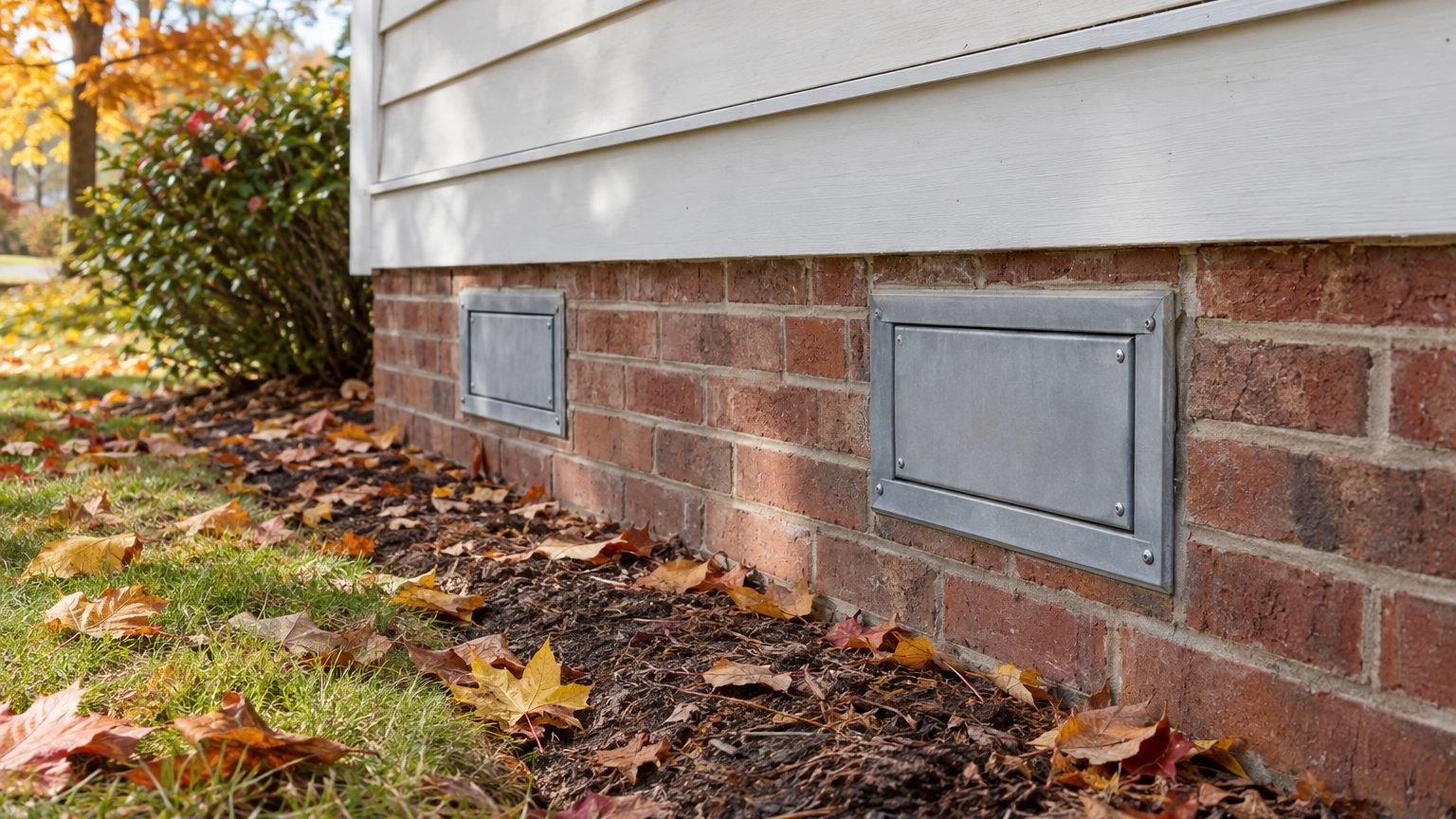

Whether to close foundation vents for winter depends on how the crawl space is built, and the sources describe two different designs. Before you touch a vent, open the access door, shine a flashlight inside, and see whether the ground is covered and the walls are insulated.
It depends on the crawl space

Whether to close the vents depends on what is under your house, and the sources do not hand out one rule for every house. They describe two different buildings. One is a vented crawl space that breathes outdoor air through openings in the foundation wall. The other is a sealed crawl space that has been closed off from the outside on purpose.
What the sources say about vented spaces
Building Science Corporation, in its Building America report BA-0401 on conditioned crawlspace construction, states that “Crawl space venting is generally viewed as good practice despite the obvious moisture problems.” Read that sentence slowly. It reports the conventional view, and it names the moisture problems in the same breath. The report is not telling you the vents are harmless. It is telling you why the practice is so widespread and why it is contested.
What the sources say about mixed setups
The same organization is blunt about the in-between case. In its newsletter BSI-115, “Crawlspaces – Either In or Out,” Building Science Corporation writes: “When crawlspaces are connected to both the outside and the inside ugly things happen.” A crawl space with open vents that also shares air with the living space above is that connected-to-both situation. Half-measures are the part the sources warn about.
What the sources say about sealed spaces
Building Science Corporation’s information sheet Info-512 on crawlspace insulation describes the sealed approach as crawlspaces with “the ground vapor sealed, their walls insulated and air sealed.” Notice that the vents are one item in a list. The ground cover and the insulated, air-sealed walls come with them.
So the honest answer is conditional. If your crawl space looks like the description in Info-512, closing the vents belongs to a larger plan. If it looks like the vented description in BA-0401, do not assume a winter vent cover is a harmless seasonal chore. Work out which one you have first.
Vented crawl space or sealed crawl space
The table sets the two approaches side by side, using only what each source says. It does not rank them for your house, because the sources do not.
| Type | What the sources say | What it means for the vents |
|---|---|---|
| Vented crawl space (often with a ground vapor barrier) | Building Science Corporation, BA-0401: “Crawl space venting is generally viewed as good practice despite the obvious moisture problems.” BSI-115 warns about spaces connected to both outside and inside. | The vents are part of how this design is meant to work. Covering them changes the design, so check what else is in place before you do. |
| Sealed (conditioned) crawl space | Building Science Corporation, Info-512: ground vapor sealed, walls insulated and air sealed. ENERGY STAR calls for a “continuous sealed groundcover of vapor diffusion resistant materials.” | The vent openings get closed permanently as one step in sealing the whole space, not as a seasonal cover. |
How a vented space gets converted
The DOE Building America Solution Center, run through PNNL, gives the method in its guide to unvented, insulated crawlspaces: “If the crawlspace has vents, install pieces of rigid foam cut to fit in the vent openings and seal in place with spray foam or caulk.” Read the wording carefully. The foam is cut to fit and then sealed in place. That is a fixed repair, and it sits inside a guide about making the crawl space unvented and insulated.
A loose board leaned against a vent, or a foam-backed cover that does not seal at the edges, is not that method. It may leave air moving around the edges while giving you the impression the opening is closed. The sources describe sealing, and a gap-ridden cover is not sealing.
Why the groundcover keeps coming up
ENERGY STAR, in its basement and crawlspace air sealing and insulating project, specifies a “continuous sealed groundcover of vapor diffusion resistant materials.” Building Science Corporation says the same thing in different words when it lists the “ground vapor sealed.” Both put the ground first.
That is why the vents alone do not decide the question. You can have covered vents on a crawl space with bare soil, and you can have open vents over a well-covered floor. Neither combination matches the sealed description in the sources.
What to check before touching a vent
You can gather most of what matters without any rule at all. Take a flashlight and look. Then decide which description your crawl space matches. If you cannot tell, stop and ask a crawl space professional or your local building department before you cover anything.
- Is the ground covered with continuous sheeting, or is it bare soil in places?
- Are the foundation walls insulated and sealed, or are they plain block and concrete?
- Do the vent openings have anything fixed in them, such as cut-to-fit foam?
- Is there a door or hatch between the crawl space and the living space that lets air pass?
- Do you see damp spots, staining, mold or standing water?
Ground cover and moisture signs
The ground cover question comes straight from the ENERGY STAR line on a continuous sealed groundcover. Gaps, torn sections and bare patches mean the cover is not continuous. For the signs of trouble themselves, our page on crawl space moisture walks through what to look for. Because Building Science Corporation’s BA-0401 names “obvious moisture problems” in the vented approach, moisture signs are worth settling before you change anything about airflow.
Insulation and pipes
Look at what is overhead and on the walls. Whether the floor above or the foundation walls are insulated tells you which of the two descriptions you are closer to. If you are weighing upgrades, our guide to insulating a crawlspace covers the options. Look at any water lines you can see, too. People often close vents out of worry for pipes, but the sources here do not say a vent cover protects pipes, so treat that as a separate question. Our page on frozen pipes deals with it directly.
If you are in Canada, follow Canadian guidance wherever it differs from the US sources quoted here. Your provincial building code and your local building authority are the places to ask.
Common questions
Can I just put foam board over my crawl space vents myself?
The method exists. The Building America Solution Center at PNNL describes rigid foam cut to fit the vent openings and sealed in place with spray foam or caulk. It appears in a guide about making the whole crawl space unvented and insulated, so confirm the rest of the space is ready first, and check with your local building department.
My crawl space has a vapor barrier on the ground. Is that enough to close the vents?
Not by itself. ENERGY STAR’s line on a continuous sealed groundcover covers only the ground. Building Science Corporation’s description of a sealed crawlspace also lists insulated and air-sealed walls. A ground cover with open vents is a vented crawl space with a ground vapor barrier, which is a different thing from a sealed one.
My crawl space smells musty since I closed the vents. What now?
Treat it as a moisture sign, not a smell to wait out. Building Science Corporation names “obvious moisture problems” in the vented approach. Look for damp soil, torn ground cover and wet insulation, and call a crawl space professional if you find any.
Do the same rules apply in Canada?
Not necessarily. The sources quoted here are American, and Canadian codes and guidance can differ. Use Canadian guidance when it differs, and ask your provincial building code office or local building authority.
These sources and local rules can change, so confirm current requirements with your local building department or the official source before you seal, insulate or cover anything.