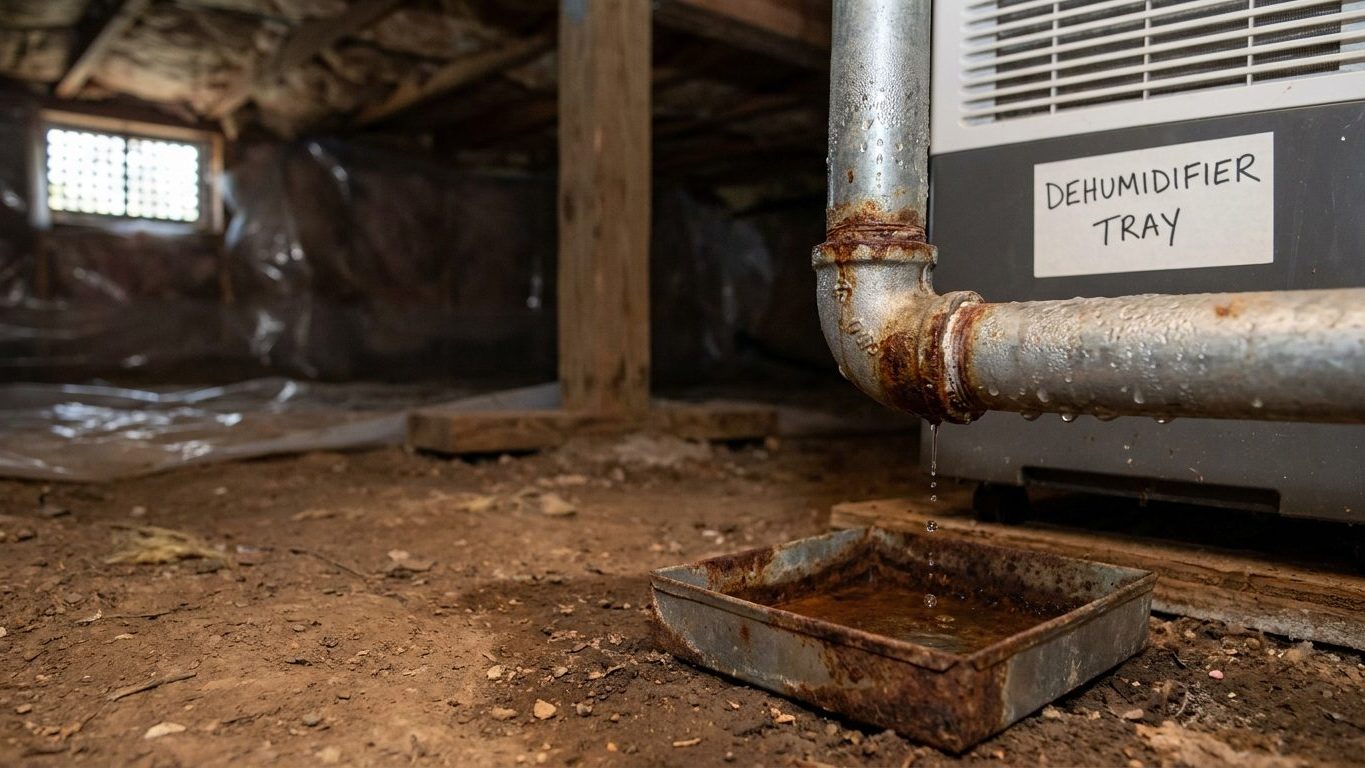

Crawl space moisture doesn’t stay under your floor. Warm air rising through the house pulls that damp, musty air up through subfloor gaps and duct seams, so it ends up in the rooms you actually live in as higher humidity and a smell you can’t quite place. Start by finding where the water is actually coming from, not by masking the smell with a plug-in dehumidifier upstairs.
What is actually going on

Why moisture moves upward
The mechanism here is the stack effect. Warm air rises through a house and escapes through the attic and upper floors, and that constant upward movement pulls in replacement air from wherever it can get in, most often the crawl space. Whatever is sitting in that air, moisture, mold spores, radon, gets drawn up through subfloor gaps, plumbing penetrations and the seams around ductwork, and it joins the air in the rooms above. A damp crawl space almost never stays a crawl space problem for long.
Moisture gets into a crawl space three main ways: bare soil releasing water vapor, groundwater or runoff coming in through the foundation, and humid outside air condensing once it’s inside a cooler space. Sealing a crawl space from the inside manages the humidity and hides the staining, but it does nothing about water coming in under pressure from outside. The order of work matters. Grading and drainage outside come first. Interior vapor barriers and sealing come second, once the actual water source has been dealt with.
Mold and radon: what’s not knowable, and what is
Mold is the part people want a number for, and there isn’t one. No federal agency sets an acceptable level of indoor mold, no home test kit settles how much is too much, and there’s no square footage of visible growth below which a crawl space is officially fine. What matters is removing the water and drying the space out, then deciding what to do with any affected material afterward. People react very differently to mold exposure, from no symptoms at all to real respiratory distress, and anyone with asthma or another respiratory condition should not be the one doing the inspection or the cleanup.
Radon deserves its own mention because a crawl space is exactly the kind of low point in a house where it accumulates. The EPA and the U.S. Surgeon General recommend testing every home for radon, regardless of foundation type, age or location, since levels vary from house to house for reasons that have nothing to do with what a neighboring property tested at. The EPA’s action level is 4 pCi/L, and the agency recommends considering action even in the 2 to 4 pCi/L range. No level of radon is known to be safe. Levels are usually highest in the lowest occupied or semi-occupied part of a building, which in many houses is the crawl space or basement floor. Testing is the only way to know what’s actually there, and if a result comes back elevated, mitigation is a job for a certified radon professional.
What to look at, and in what order
Work from the outside in, and from the cheapest check to the most invasive one. Each step either points toward a cause or rules one out, which is the reason to do them in this order rather than jumping straight to a fix.
| Check | If you see this | Points to | Rules out |
|---|---|---|---|
| Grading and downspouts around the foundation | Water pooling or running toward the house after rain | An exterior drainage or grading problem | A dry perimeter after rain rules out surface runoff |
| Crawl space floor | Standing water, dark wet soil or a musty smell right after rain | Groundwater or a foundation leak | A dry floor in wet weather rules out bulk water |
| Ground cover condition | No plastic sheeting down, or one that’s torn or unsealed | Soil vapor as a major moisture source | An intact, sealed cover rules out bare-soil vapor |
| Vents | Open vents in a humid climate, or none at all | Outside air adding to indoor humidity, or too little air exchange | Steady readings regardless of vent status rules out venting as the driver |
| Humidity over several weeks | Crawl space readings that track the readings upstairs | Crawl space air reaching the living space | Unrelated readings rule out the crawl space as the main source upstairs |
| Wood condition | Soft, dark or fungal-looking sill plates and joists | Long-term, repeated moisture exposure | Sound, dry wood rules out an ongoing chronic problem |
Reading the results
Bare soil in a crawl space releases a surprising amount of water vapor over the course of a season, which is why the ground cover check carries as much weight as the drainage check. If there’s no cover, or the existing one has failed, that’s the point where sealing a crawl space as a fuller project starts to make sense, but only once the exterior drainage checks come back clean first.
Soil type feeds into several of these checks at once. Homes sitting on clay soils that swell and shrink with the seasons tend to hold water near the foundation longer after rain, which changes how urgent the drainage step is and how often the ground cover and vent checks need repeating. The vent-or-seal decision itself comes down to climate and how the space gets used, and checking with the local building department before changing vent status matters, since requirements differ by jurisdiction.
Watch it, or get someone in
Some findings from the checklist above are things you can reasonably keep an eye on yourself. Humidity readings that level off once you extend gutters or improve ventilation, a ground cover that just needs re-taping at the seams, minor surface dampness that clears up after a grading fix, these are maintenance items, not emergencies.
Who to call, and why
Other findings mean picking up the phone, and who you call depends on what you found. A structural engineer assesses the foundation without selling you a repair, which makes one worth hiring first if you’ve seen new or widening foundation cracks, sagging floor joists, or a floor that’s noticeably out of level. An engineer’s report gives an independent read on what’s actually wrong before anyone quotes a fix.
A drainage contractor is a different call, brought in for exterior water management once you already know that’s the source, grading, downspout extensions, and drainage around the foundation perimeter. A waterproofing company representative is a third kind of visit entirely, usually offered free, and usually built around selling an interior system. That’s not necessarily bad information, but it’s not an independent opinion, and getting a second one, ideally from an engineer, is worth doing before committing to interior work that’s often expensive and hard to undo.
Radon is a case where testing itself is something a homeowner can do with a simple kit, but the result decides what happens next. If a test comes back at or above the action level, or even in the range the EPA says to consider addressing, mitigation is a job for a certified radon mitigation professional, not something to improvise with fans and vent covers.
Mold cleanup is the last category, and the size and location of the growth decide whether it stays a DIY task. Small, isolated patches on a hard surface are within reach for most homeowners once the water source is fixed. Extensive growth, growth on porous material like insulation or wood framing, or a moisture problem that keeps returning call for a remediation professional. Anyone with asthma, allergies or another respiratory condition should hand off the inspection and cleanup to someone else regardless of the size of the patch.
What has to happen first
The right order
The order of operations is where money gets wasted on this problem. Exterior drainage always comes before interior treatment, because an interior vapor barrier or sealed crawl space sitting on top of an unresolved water source just relocates the moisture instead of removing it. If water is getting in from outside, that has to be dealt with before anything inside the crawl space, sealing, insulation, encapsulation, is worth doing.
Diagnosis comes before repair for the same reason a doctor orders a scan before scheduling surgery. A crawl space taking on heavy vapor from bare soil needs a different fix than one taking on groundwater through the foundation wall, and treating the wrong one leaves the actual source untouched while money gets spent on the wrong end of the problem.
Water gets addressed before finishes go in. That includes the gutters and downspouts that carry roof runoff away from the foundation in the first place, which this site’s roofing guides cover, and any sump pump system needed to handle groundwater once it’s inside, which the plumbing guides go into. Basement walls that will eventually be insulated shouldn’t be finished until the water issue is settled, a step the insulation guides address, and the same logic applies to whatever material eventually goes down over a slab, which the flooring guides cover directly.
None of this happens in isolation from the rest of the foundation. A damp crawl space, a cracked basement wall and a settling slab are often symptoms of the same underlying water and soil behavior, which is why it’s worth reading the broader foundations and basements picture before deciding where to start spending money on any one part of it.
Common questions
Do I need to run a dehumidifier in my crawl space all year?
Not necessarily, and running one without fixing the water source just treats a symptom. Figure out whether the moisture is coming from bare soil, an outside leak, or humid air first, since that decides whether a dehumidifier is even the right tool or just an ongoing cost.
How do I know if the musty smell in my house is coming from the crawl space?
Smell it directly at the crawl space access and compare that to what you notice near floor vents or low outlets in the rooms above. Because of the stack effect, crawl space air tends to show up first at floor level in the lowest occupied rooms before it spreads through the rest of the house.
Can I put plastic sheeting down myself instead of paying for full encapsulation?
A basic ground cover over bare soil is a reasonable DIY step and addresses one real moisture source. It’s not the same project as full encapsulation, which usually also deals with vents, insulation and sometimes conditioned air, and it won’t help at all if the actual problem is water coming in from outside rather than soil vapor.
Is a musty crawl space smell a health risk by itself?
The smell itself isn’t something you can diagnose from, and there’s no test that turns a smell into a safe or unsafe verdict. Treat a persistent musty odor as a sign to go through the inspection order above, and if anyone in the house has a respiratory condition, have someone else do the crawl space inspection.