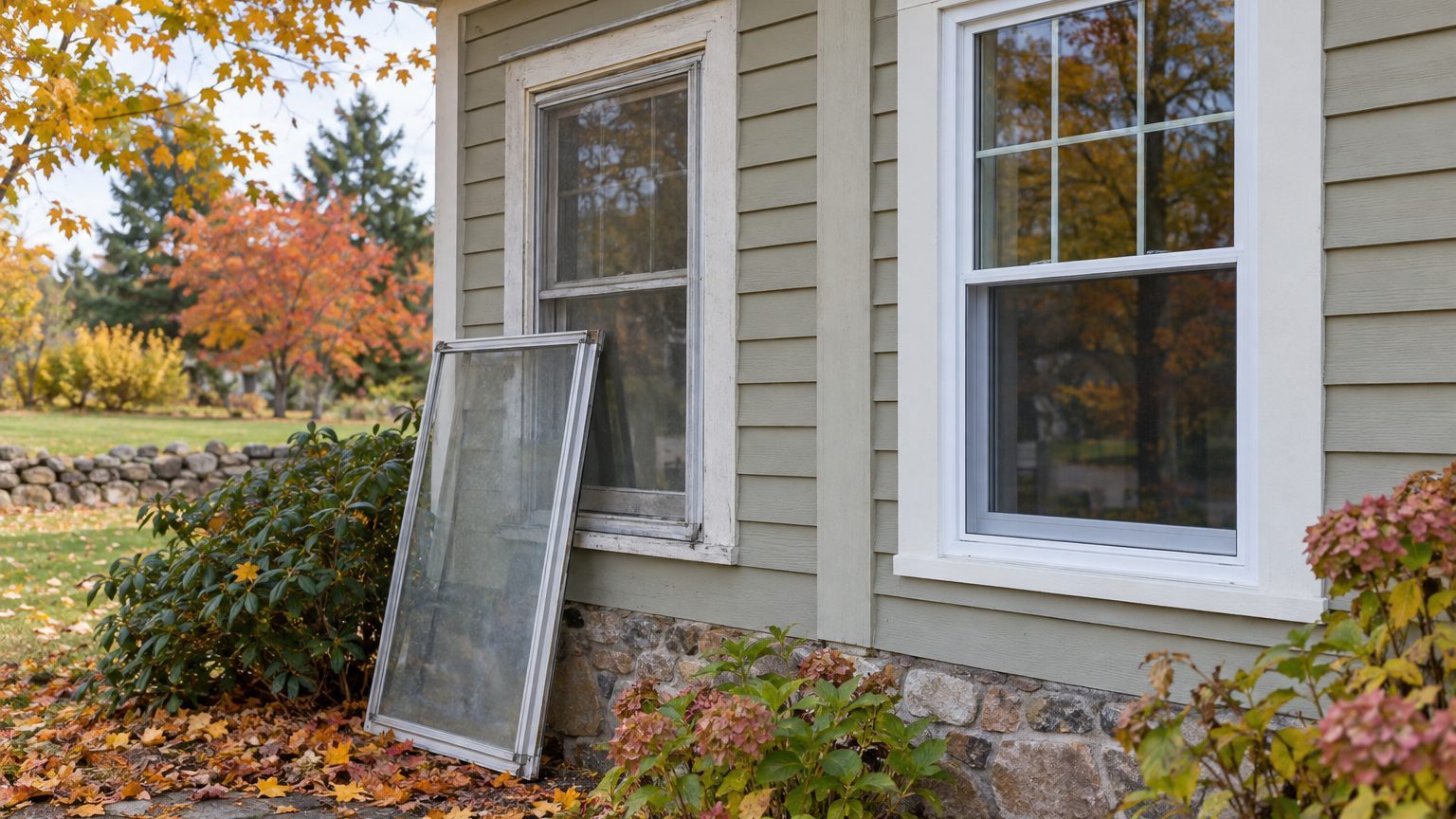

Single-pane windows with rattling sashes are usually cheaper to fix with storm windows than to tear out and replace. Replacement wins when the window itself has failed, because a storm window only adds a layer in front of what you already have. Before you price anything, hold your hand along the sash edges on a windy day and note which windows leak, since that tells you which route each opening needs.
Storm windows cost less; replacement windows do more

ENERGY STAR says storm windows cost ½ to ¼ the amount of common replacement windows, with much lower cost installation. The U.S. Department of Energy points to storm windows as an option especially where full window replacement is impractical, too expensive, or prohibited, as in historic properties. Those two statements explain most real-world decisions. The money gap is large, and in some houses the choice is not yours to make.
Where storm windows win
The installation gap makes sense once you picture the work. A storm window goes on or inside the opening you already have. Replacement means removing the old window and fitting a new one, and that labor repeats at every opening. In a house with many windows, the difference grows with each one.
Storm windows also suit a house where you want to keep the original glass and sashes. That matters most in a historic home, where the Department of Energy notes replacement can be prohibited. If you live in a historic district or own a landmarked house, call your local historic commission before you order anything. Rules vary by town, and this page cannot tell you what yours allow.
The Efficient Windows Collaborative adds that storm windows can be mounted permanently or for seasonal use. That flexibility is hard to get with a new window, which is a fixed purchase.
Where replacement wins
Replacement is the better route when the window itself is the problem. A rotted sill, a cracked sash, a frame that has pulled away from the wall or a window that no longer opens cannot be repaired by a panel mounted in front of it. A storm window sits over the old window and leaves its condition unchanged.
University of Maryland Extension advises sealing the primary window with caulk and weatherstripping before adding a storm layer. A window too far gone to seal is a candidate for replacement, and a contractor can tell you whether yours is.
Replacement also has its own published benefit. ENERGY STAR says replacing single-pane windows lowers household energy bills by an average of up to 13 percent nationwide. The table below sets that figure beside the storm window numbers, because they do not measure the same thing.
What each saves
Three bodies publish three percentages, and each one measures something different. Read the basis column before you read the number. None of them is a forecast for your house, and none should be averaged with another.
| Source | Figure | What it measures |
|---|---|---|
| ENERGY STAR (EPA) | Lowers household energy bills by an average of up to 13 percent nationwide | Replacing single-pane windows |
| U.S. DOE EERE | Heating and cooling costs reduced by 10%–35% | A low-e storm window installed over a low-performing window (DOE success story) |
| Lawrence Berkeley National Laboratory | 13% with the clear glass and 21% with the low-e windows | Overall heating load reduction in a field evaluation of six homes over one heating season, with storm windows added |
Reading the three rows
The ENERGY STAR line is about replacement. It says the average saving is up to 13 percent on household energy bills when single-pane windows are replaced. It describes whole-house bills nationwide, so a drafty house in a cold climate could land differently.
The Department of Energy’s EERE figure is about low-e storm windows. It says that installing one over a low-performing window can reduce a home’s heating and cooling costs by 10%–35%. The source gives the range and does not narrow it for your house.
The Lawrence Berkeley National Laboratory figure comes from a field evaluation of six homes monitored over one heating season, with and without storm windows. It reports an overall heating load reduction of 13% with clear-glass storm windows and 21% with low-e ones.
The two 13 percent figures are a coincidence. One belongs to replacement windows and ENERGY STAR. The other belongs to clear-glass storm windows and Berkeley Lab. Do not read them as agreeing or as a tie.
Using the numbers
Use the figures to decide which question to ask, not to calculate a payback. Ask a storm window supplier whether a low-e option is available and what it adds to the quote. Then compare that extra cost against what the Berkeley Lab evaluation reports for clear glass and low-e glass. Your own utility bills from a recent winter are the best baseline. Some utilities also offer a home energy audit, so check with yours.
Interior or exterior, permanent or seasonal
The Efficient Windows Collaborative says storm windows can be installed on the interior or exterior side of windows and can be mounted permanently or for seasonal use. That gives you four combinations, and the right one depends on how you want to live with the window.
- Interior mount: you install and remove it from inside, with no ladder for upper floors.
- Exterior mount: it goes on the outside of the window, so upper-story openings may mean ladder work.
- Permanent: you fit it once and leave it, which suits windows you rarely open.
- Seasonal: you put it up for the cold months and take it down, which means somewhere to store it.
Choose by access and by how often you open the window. A bedroom window you open every spring does not suit a fixed panel you cannot move easily.
Seal the window first
University of Maryland Extension says to make sure the primary window is sealed with caulk and weatherstripping before adding a storm layer. This step is easy to skip because the storm window looks like the fix. If air still moves around the old sash, you have stacked a new layer over an existing problem.
Start by finding air leaks around each window. A lit stick of incense held near the edges on a windy day shows where air moves. Then read up on weatherstripping doors and windows to pick the right material for your sash type. Caulk handles gaps between the frame and the wall. Weatherstripping handles the moving parts.
Do this work window by window, then add the storm layer. The order matters. Sealing after the storm is installed means taking the storm back off.
Where to go from here
Walk the house and sort your windows into two piles. One pile holds windows that are sound but leaky, which are storm window candidates. The other holds windows with damage you cannot seal, which are replacement candidates. Windows in historic homes go to your local commission first.
Windows are one part of a tight house, and insulation in the attic and walls works alongside them. Plan the work around the heating season so seasonal storms are in place before cold weather arrives, and check your manufacturer’s instructions for how and when to fit them. Canadian readers should also check Canadian guidance and their provincial or utility programs, since the rules and incentives there can differ from those in the United States.
Common questions
Can I put storm windows on a historic house?
Often yes, and the Department of Energy lists storm windows as an option where replacement is prohibited, as in historic properties. Rules on appearance and mounting still vary by town and by district. Contact your local historic commission before you order.
Do I have to take storm windows down in summer?
No. The Efficient Windows Collaborative says storm windows can be mounted permanently or for seasonal use. The Department of Energy’s figure covers heating and cooling costs, so leaving them up may help in the cooling season too. Your climate and the manufacturer’s instructions decide which is right for you.
Is a low-e storm window worth paying extra for?
Berkeley Lab’s field evaluation reports 13% with the clear glass and 21% with the low-e windows, so the low-e option scored higher there. Whether the extra cost is worth it depends on your quote and your bills. Ask for both options priced side by side.
How much will I actually save?
None of the published figures is a prediction for your house. They come from different studies measuring different things, and your result depends on your windows, your climate and how leaky the house is. Your own utility bills before and after are the real test.
Programs, incentives and local historic rules change, so confirm current requirements with the official source, such as your utility, your county extension office or your local historic commission, before you act.